


- History
- 17 de April de 2026
- No Comment
- 12 minutes read
Do not take the name “Institut Escola” in vain

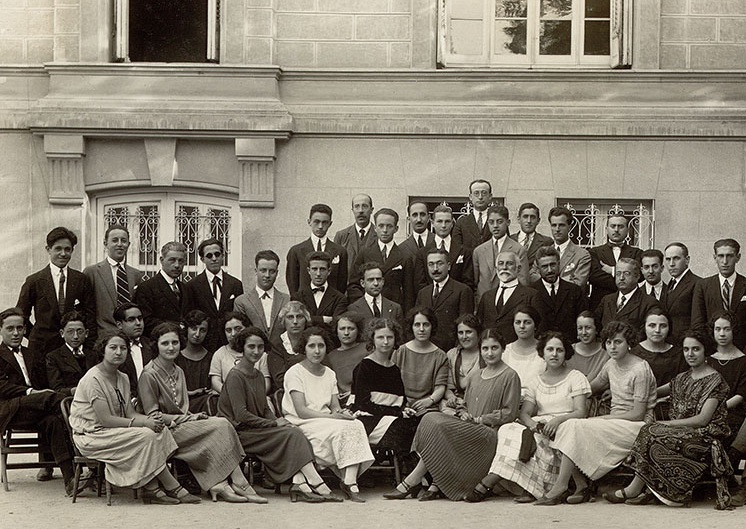
Teachers and students of the first cohort of the Instituto-Escuela, Miguel Ángel 8, June 1924. Residencia de Estudiantes, Madrid. / Photo: Laboratorios de la nueva educación exhibition



Felipe J. de Vicente Algueró
The Ley de Educación de Cataluña (LEC, Catalan Education Act) sets out, in Article 75, the different categories of Catalan state schools, introducing a new type of institution: the so-called institut escola. It appears to have been a personal contribution of Minister Maragall—unsurprisingly, given that his father was a teacher of Philosophy at the Instituto Escuela del Parque de la Ciudadela in Barcelona during the Second Republic. The introduction of this new designation also carried a respectable “progressive” pedigree, as it purported to recover elements of republicanism and Catalanism within the Catalan educational model.
However, the Instituto Escuela that existed prior to the Civil War was neither republican nor an expression of specifically Catalan pedagogy. Moreover, it was something very different from what today’s schools—rather grandly—display on their façades under the name “Institut Escola”.
The first Instituto-Escuela was created by decree on 10 May 1918, bearing the signature of King Alfonso XIII and that of Santiago Alba, Minister of Public Instruction in the conservative government of Antonio Maura. Alba belonged to the most left-leaning wing of the Liberal Party. In a sense, the Instituto-Escuela was a creation of the two major parties of the Restoration period. This is made clear in Article 1 of the decree: “Using the staff of the official teaching corps and under the inspection and direction of the Board for the Extension of Studies and Scientific Research (Junta para Ampliación de Estudios e Investigaciones Científicas), there shall be organised in Madrid, as a pedagogical experiment, an Instituto-Escuela providing secondary education…”
Its roots lie in the Institución Libre de Enseñanza and in one of the great achievements of the institucionistas (members of the Institución Libre de Enseñanza): the Board for the Extension of Studies, today’s Spanish National Research Council (Consejo Superior de Investigaciones Científicas). It was therefore not a republican institution, but a monarchical one. The fact that a branch of the Instituto-Escuela was established in Barcelona in 1932 does not alter its much earlier origins—thirteen years before the fall of the monarchy. As the decree itself makes clear, it was a “pedagogical experiment”, that is, an experimental centre designed to apply new methodologies and to train teachers. Legally, the Instituto-Escuela was a “secondary school”, as such institutions were then termed. Its novelty lay in the inclusion of three years of primary education, known as “preparatory” courses, intended to ensure that pupils were properly prepared to begin the Bachillerato (upper secondary education, typically leading to A-levels) at the age of eleven. The institution was centred on the Institute rather than the school, hence the name was not “Escuela-Instituto”.
The first Instituto Escuela in Barcelona—the one in Parque de la Ciudadela—was created by decree on 9 October 1931, signed by the President of the Republic, Niceto Alcalá-Zamora. Under this decree, the new institution came under the authority of the Generalitat of Catalonia, on the understanding that it would follow “the organisation and powers established in the decree of 10 May 1918 creating the Instituto-Escuela of Madrid”. Subsequently, the Generalitat issued a further decree specifying all aspects of the new institution, from its location to its teaching staff, which was drawn from the state corps of secondary-school catedráticos (senior teachers), with the exception of the so-called complementary teachers, equivalent to today’s temporary staff.
It is true that the Institut Escola adopted Catalan as its language of instruction and paid greater attention to the Catalan context in its curriculum, particularly in History and Geography. However, its dependence on the Madrid model was almost total. Its director for most of its existence (he died a few months before the end of the Civil War) was the Catalan Dr Josep Estalella, a secondary-school catedrático in Girona and Tarragona who had previously taught at the Instituto-Escuela in Madrid. In October 1931, the Generalitat’s Council of Culture published a set of pedagogical principles by which the centre was to be governed, even before their formal approval. These principles were, in fact, almost a literal translation of those published in 1925 for the Madrid institution. Alexandre Galí, one of the foremost exponents of Catalan pedagogy, wrote the following: “the men who drafted the Norms passed off as a product of the Generalitat something that was not its own, without the elementary courtesy of stating where they had obtained the elements to compose them” (Història de les Institucions i del Moviment Cultural a Catalunya, 1900–1936, Book III, p. 250). It would therefore be difficult to regard the Institut Escola as a major expression of Catalan pedagogy. Rather, it was the Catalan version of the pedagogical model advocated by the Madrid institucionistas. To make this dependence even more explicit, the official name of the Parque de la Ciudadela institution was: Instituto Escuela de Segon Ensenyament Giner de los Ríos, after the founder of the Institución Libre de Enseñanza.
Like its Madrid counterpart, the Institut Escola was a secondary school. It was by no means an “Escola-Institut”. There was a primary section housed on the ground floor of the former Governor’s Palace in Parque de la Ciudadela; however, unlike in Madrid (where it legally formed part of the Instituto-Escuela), in Barcelona it was in fact part of a municipal primary school. The Generalitat decree of 26 October 1931, which set out the organisation of the Institut Escola, stated that it would operate “acoblat” (that is, “attached” or “integrated”) to a primary school, which, of course, had its own staff—primary teachers. The intention was merely to ensure good coordination between the two. In practice, however, pupils could enter the Institut Escola either from the associated primary school or from any other school in Barcelona. Admission was not automatic: headteachers of primary schools were required to provide detailed reports on candidates wishing to begin the Bachillerato, and only those deemed to possess the intellectual ability for secondary education were admitted at the age of eleven.
The teaching staff of the Institut Escola bore little resemblance to the standards currently applied by the Generalitat in today’s Instituts Escola. The core of the staff consisted of catedráticos drawn from the state corps. They were appointed on secondment following a selection process, and both in Madrid and Barcelona there was a consistent effort to recruit the very best specialists in each field. All catedráticos were required to devote themselves fully to the institution, to identify with its pedagogical model, and to engage in ongoing professional development—though priority was given to deepening their expertise in their subject. Above all, they were expected to be first-rate specialists in their discipline. The same criteria were applied in the appointment of complementary teachers.
A clear example is the director of the Institut Escola, Josep Estalella. He was a catedrático of Physics and Chemistry, specialising in Physics, and had held a doctorate since 1902, with a thesis on X-rays—then a novel field which he helped to disseminate in Spain through numerous publications. He had been awarded a scholarship by the Board for the Extension of Studies, which facilitated his appointment to the Instituto-Escuela, where he taught for two academic years before accepting the directorship of the newly created Institut Escola. He later became President of the Catalan Society of Physical, Chemical and Mathematical Sciences. He combined professional prestige as a specialist with a strong interest in the teaching of his subject, in which he was also an outstanding educator.
He was not alone. Manuel Mateo, also a catedrático of Physics and Chemistry, was a member of the Catalan Society of Physical, Chemical and Mathematical Sciences and the author of well-regarded textbooks. Juan Nogués Aragonés, catedrático of French, was appointed at the age of just twenty-two as a Spanish lecturer in Montpellier on the recommendation of the Board for the Extension of Studies, as the holder of a government scholarship. Joan Ras Claravalls, a catedrático of Mathematics, would later become the first director of the second Institut Escola established by the Generalitat, the Ausiàs March; he was a distinguished scientist who went into exile after the Civil War. Josep Vergés i Fàbregas, catedrático of Latin, was closely associated as editor and translator with the Bernat Metge Foundation. In 1928 he translated the poems of Catullus, and in 1930 the speeches of Isaeus of Athens. And so on. For pupils, it was a privilege to be taught by such distinguished specialists. Ensuring that teachers are genuine subject specialists—that is what it means to defend public education.
As for methodology, the Instituto-Escuela adopted the innovations of the time, strongly influenced by the American philosopher John Dewey, whom I have discussed in another article. There were no examinations, and no textbooks—these were replaced by teachers’ notebooks. Reading was encouraged, as were manual activities, what we would now call extracurricular activities, contact with nature, practical exercises (for instance, in the laboratory), music and theatre. Pupils progressed from one year to the next without repetition. However, it must be borne in mind that there was no need for what we would now call provision for diverse learning needs: the vast majority of pupils came from professional middle-class backgrounds, and admission was strictly selective. These were always experimental centres, and there was no intention of imposing their methodology more broadly. Teachers trained there were free to adopt whatever elements they considered most appropriate in their subsequent posts. The curriculum itself was the official one and was always organised by subjects. At its core was the transmission of knowledge, albeit through highly innovative teaching methods. Some of these innovations later found their way into mainstream secondary schools, long before the LOGSE (the 1990 Spanish Organic Law on the General Organisation of the Education System), and without the need for grand pedagogical rhetoric.
The short lifespan of the Institut Escola makes it difficult to offer an overall assessment of its experience. However, the Instituto-Escuela in Madrid, which operated for more than twenty years, does allow for a proper assessment. This has been undertaken by a well-informed scholar, Salvador Doménech (L’Institut Escola de la Generalitat i el Doctor Josep Estalella, Barcelona, 1998). He notes that, over time, some pupils became demotivated, as they always progressed and invariably obtained certification. Among the teaching staff, there was a gradual abandonment of certain innovative methodologies, which came to be regarded as ineffective. There were no professional incentives for teachers, many of whom ended up combining their work there with teaching in other institutions, and the curriculum became increasingly standardised.
It is thus clear that the Institut Escola introduced by the LEC bears little resemblance to its predecessors. In reality, these centres are simply Escoles Institut, in which secondary education is subordinate to primary education—the exact opposite of the historical model. To call these centres Institut Escola is a genuine misuse of the term. It would be better not to mislead anyone and to rename them for what they truly are: Escoles Institut.
Source: educational EVIDENCE
Rights: Creative Commons