


- Politics
- 28 de April de 2026
- No Comment
- 12 minutes read
Evidence in education according to López Rupérez

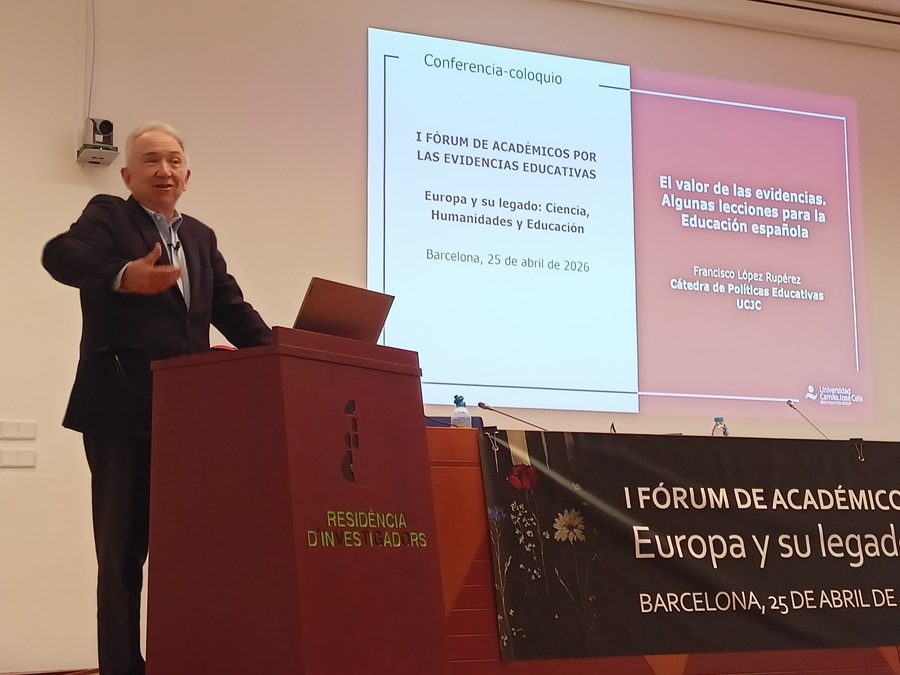
The professor and former president of the State School Council, Francisco López Rupérez. / Photo: Toni Hernández-Fernández


This article offers a synthesis of Francisco López Rupérez’s lecture on the value of evidence in education. The lecture was delivered as part of the I Fórum de Académicos por las evidencias educativas — whose programme and further details are available at https://fundacioepisteme.cat/forum2026/programa/ — where I had the pleasure of taking part in the closing round-table session for analysis and debate.
As the speaker himself was no longer in the room, owing to other commitments, I would like to use these pages to offer a personal synthesis of his argument and to add a few reflections of my own. Let this, then, stand as a kind of open letter. In his lecture, López Rupérez set out, and forcefully defended, the urgent need to move beyond an educational model governed by inertia, ideology and belief — often with little scientific rigour beyond the familiar refrain ‘it works for me’ — towards one firmly grounded in science and empirical data.
Clarifying what we mean by ‘evidence’
López Rupérez began, quite rightly, by addressing a terminological difficulty. Linguistics to the rescue. He pointed out that the Spanish word evidencia is a false friend of the English term evidence. Whereas the Royal Spanish Academy defines evidencia as a ‘clear and manifest certainty about which there can be no doubt’, Rupérez noted that in scientific and research contexts — as reflected in dictionaries such as Cambridge and Oxford — the English term has a more open meaning: the reasons, facts or information that support the validity of a proposition. A space for doubt remains.
For that reason, the European debate has tended to favour the expression ‘evidence-informed education’ (Pellegrini & Vivanet, 2020). This formulation matters, because it does not reduce educational knowledge to laboratory-style experimentation. It can also include qualitative and mixed methods when shaping policy and informing classroom practice. I remember Héctor Ruiz Martin once telling me, in conversation, that he preferred the phrase ‘education based on scientific evidence’, precisely to avoid ambiguity about the origin, quality or validity of that evidence — and to spare us endless linguistic hair-splitting.
The medical model
López Rupérez traced the origins of Evidence-Based Education (EBE) to the closing years of the twentieth century, explicitly mentioning pioneers such as David H. Hargreaves. Its principal model, he argued, was Evidence-Based Medicine (EBM). What is at stake here is the passage from a pre-scientific to a scientific discipline: a Kuhnian paradigm shift of the sort already undergone, in different ways, by psychology and linguistics. López Rupérez recalled Sackett et al.’s classic definition of EBM as the ‘conscientious, explicit, and judicious use of current best evidence’ (1996).
His analogy was clear. Medicine ranks the strength of its findings according to different levels, from rigorous meta-analyses to expert opinion (Tenny & Varacallo, 2025). Education, he argued, should seek to build a comparable framework. The aim is not merely to accumulate research, but to identify, with due rigour, which practices actually produce desirable outcomes — and, just as importantly, which help prevent undesirable ones (Kvernbekk, 2017).
Why education needs evidence
To justify this paradigm shift, López Rupérez advanced three central arguments, already present in some of his earlier work:
- The growing complexity of the context: As education systems become more complex, their governance must become increasingly knowledge-intensive, as Burns & Köster (2016) have argued.
- The decline in outcomes: Rupérez warned of a structural deterioration in student performance in North America and Europe — a decline which, he emphasised, predates the pandemic and stands in stark contrast to the progress achieved in South-East Asia (OECD, 2023).
- Proven effectiveness: Citing the Wing Institute, he argued that science remains the best method available for identifying the policies capable of reversing this negative trend.
One of the strongest elements in López Rupérez’s argument is that evidence is not merely a matter of effectiveness. It is also a moral imperative. If educators genuinely seek what is best for their pupils, they have a duty to use the tools most likely to lead them in the right direction. For Rupérez, the medical principle of primum non nocere — ‘first, do no harm’ — must also guide education. It should set ethical limits on the adoption of untested innovations, including the sudden arrival of technologies such as artificial intelligence, and on the influence of ideology in the classroom (López Rupérez, 2026a).
There is, of course, a whole strand of work devoted to the development of educational indicators, always with quality in view and metrics as the underlying framework (Garzón, 2019). Yet there is also a persistent confusion between good practice, educational innovation and research, as well as between each of these and the quality of the evidence on which they rest (Hernández-Fernández, 2019). The great challenge, as López Rupérez warned, echoing Burns and Köster (2016), is that education is a field heavily shaped by personal beliefs and identities — and these often collide with scientific findings. Hence his call to move from a ‘logic of intentions’ to a ‘logic of results’.
This point also brought to mind the unavoidable role of cognitive biases. Human beings, by virtue of our biology, are prone to error in judgement. Critical thinking is therefore indispensable: it requires us to remain alert not only to our own biases but also, as Daniel Kahneman would remind us, to noise — that hidden variability in judgement which affects our daily decisions far more than we usually realise.
Lessons for the future of Spanish education
López Rupérez concluded by outlining several clear directions for improving Spain’s education system.
First, he stressed the urgent need to address the substantial knowledge deficit that still affects the design of educational policies and practices.
Second, he called for a decisive qualitative leap: from a fragmented set of ‘Educational Sciences’ to a genuine, unified ‘Science of Education’.
Third, he argued that scientific thinking must be systematically developed in future teachers during their initial training, as an indispensable pillar of professional competence. This, however, will be all the harder if science teaching continues to be reduced in the pre-university stages.
Finally, Rupérez insisted that the teaching profession must be strengthened so that it ceases to be a ‘weak profession’, in both epistemic and deontological terms (Hernández-Fernández, 2025). In this respect, education should learn from the best and follow the successful path taken by medicine over recent centuries (López Rupérez, 2026b).
Just as Hippocrates, millennia ago at the heart of the European intellectual tradition, lit the flame of reason against superstition and forged a legacy that still protects us from the obscurantism of pseudoscientific fashions, education too must take up that torch. Europe’s legacy — as the cradle of critical thought and the scientific method — teaches us that healing the body and cultivating the mind require the same devotion to truth.
Let us resist the siren song of charlatanism. Let our classrooms, like our hospitals, stand as firm defences against intellectual quackery, fashionable anti-scientific fads and holistic absurdities. In every lesson, we should honour that ancient oath: to illuminate through knowledge and scientific evidence, to dispel ignorance and, above all, at the very least, to try not to harm the generations to come. For, as Mario Bunge put it, pseudoscience is intellectual rubbish — and not harmless rubbish. We must not allow it to erode a legacy that took centuries to build.
References:
- Burns, T., & Köster, F. (2016). Modern governance challenges in education. In Governing Education in a Complex World: Educational Research and Innovation. OECD Publishing. https://dx.doi.org/10.1787/9789264255364-en
- Garzón, A. (2019). Evaluación de la calidad de la educación: evidencias e indicadores. Edicions UOC. https://materials.campus.uoc.edu/daisy/Materials/PID_00266166/pdf/PID_00266166.pdf
- Hargreaves, D. H. (2000). La production, le transfert et l’utilisation des connaissances professionnelles chez les enseignants et les médecins: Une analyse comparative. In Société du savoir et gestion des connaissances. OECD.
- Hernández-Fernández, A. (2019). Good practices, innovation or scientific research in education? A conceptual reflection http://hdl.handle.net/2117/182023
- Hernández-Fernández, A. (2025). Tecnologia, tecnoètica i codi deontològic docent. Revista de tecnologia, 13, pp. 56-59. DOI: 10.2436/20.2004.01.69. https://hdl.handle.net/2117/442517
- Kvernbekk, T. (2017). Evidence-Based Educational Practice. Oxford Research Encyclopedia of Education. https://doi.org/10.1093/acrefore/9780190264093.013.187 / Enlace ResearchGate
- López Rupérez, F. (2026a). La innovación educativa como buena práctica. En VV. AA., La innovación en la educación contemporánea. Una reflexión desde el pensamiento crítico. Tirant lo Blanch.
- López Rupérez, F. (2026b, 20 de enero). La Educación puede mejorar si imita a la Medicina. El Debate. https://www.eldebate.com/educacion/20260120/educacion-puede-mejorar-imita-medicina_375940.html
- (2023). PISA 2022 Results (Volume I): The State of Learning and Equity in Education. OECD Publishing. https://doi.org/10.1787/53f23881-en
- Pellegrini, M., & Vivanet, G. (2020). Evidence-Based Policies in Education: Initiatives and Challenges in Europe. ECNU Review of Education, 4(1), 1-21. https://doi.org/10.1177/2096531120924670
- Pinker, S. (2018). En defensa de la Ilustración. Por la razón, la ciencia, el humanismo y el progreso. Paidós.
- Sackett, D. L., Rosenberg, W. M., Gray, J. A., Haynes, R. B., & Richardson, W. S. (1996). Evidence based medicine: what it is and what it isn’t. British Medical Journal, 312(7023), 71-72. https://doi.org/10.1136/bmj.312.7023.71
- Tenny, T., & Varacallo, M. A. (2025). Evidence-Based Medicine. StatPearls. https://www.ncbi.nlm.nih.gov/books/NBK470182/
- Wing Institute. (n.d.). Evidence-based education science. https://www.winginstitute.org/evidence-based-education-science
Source: educational EVIDENCE
Rights: Creative Commons