


- Face to face
- 20 de April de 2026
- No Comment
- 14 minutes read
Ian Tattersall: “Human evolution has not been one of the constant refinement of adaptations”

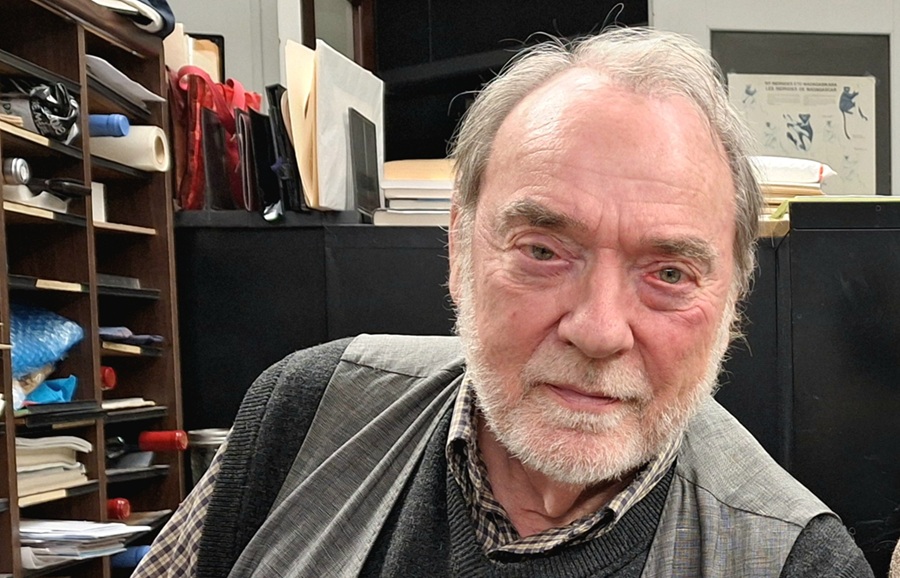
Ian Tattersall / Photo: Courtesy of the author
FACE TO FACE WITH
Ian Tattersall, paleoanthropologist associated with the American Museum of Natural History in New York


This interview arises from a professional relationship between Ian Tattersall and myself. Dr Tattersall and I collaborated on a book devoted to human evolution in honour of the late paleoanthropologist Dr José Gibert. The manuscript was published in 2016 by Publicaciones de la Diputación de Granada under the title Homenaje al Dr. José Gibert Clols. Since then, Ian Tattersall and I have remained in contact through email correspondence. Fortunately, ten years later, in January 2026, we were able to meet in person at Dr Tattersall’s workplace, the American Museum of Natural History in New York. With unmistakable British punctuality, Dr Tattersall was waiting for me, seated on one of the benches at the entrance. He then guided me through the labyrinth of corridors and offices of the museum until we reached the palaeoanthropology section. What follows is this interview, made possible thanks to his great personal kindness and his intellectually generous conversation. His white beard and calm gaze conveyed wisdom, scientific experience, and remarkable patience.
Dr Ian Tattersall is a renowned paleoanthropologist who has long been associated with the American Museum of Natural History in New York, where he continues to collaborate with the Department of Anthropology. His scientific career has focused primarily on human evolution and primate diversity, with particular attention to the evolutionary history of hominins. One of Dr Tattersall’s most distinctive research interests is the study of lemurs, the endemic primates of Madagascar. His long-term work on this island has contributed significantly to our understanding of primate evolution, biodiversity, and extinction.
The many books and maps of Madagascar in his office testify to the importance of this field within his broader scientific activity. Dr Tattersall is also widely known for his work as an author and science communicator. He has written numerous books and articles addressing human evolution, the fossil record, and the nature of scientific discovery, combining academic rigour with clarity for a wider audience. Throughout his career, he has played an important role in museum research, exhibition development, and the public communication of science. Nowadays, Dr Tattersall remains intellectually active, continuing to reflect critically on evolutionary theory, paleoanthropological interpretations, and the cultural dimensions of scientific knowledge.
What are lemurs, and what originally led you to begin studying them?
Lemurs are primates, distant relatives of humans, that are endemic to the huge island of Madagascar in the western Indian Ocean. Though all descended from an ancestral form that somehow reached the island from the neighbouring continent of Africa around 50 million years ago, they are very diverse today, with numerous species belonging to five distinctive families. However, they all retain some basic ancestral traits, such as relatively small brains and well-developed noses, that give us an idea of what our own 50-million-year-old ancestors might have been like. I originally went to Madagascar to study the fossils of some recently extinct lemur species, but I found their living relatives so charismatic that I subsequently spent several years studying them in the field.
You have worked at the American Museum of Natural History for many years. How long have you been associated with the museum, and in what professional capacity do you continue to collaborate today?
I came to the American Museum straight out of graduate school in 1971, as an Assistant Curator in Anthropology, and have subsequently never wanted to work anywhere else. I retired in 2010, taking on the title of Emeritus Curator. This allowed me to continue occupying my office and pursuing my research, and in some respects, I think my retirement has been more productive than when I also had curatorial duties to perform.
“The “Lucy” reconstruction (…) it will be the most accurate and scientifically informed reconstruction of any extinct hominin”
In your department, a complete reconstruction of the skeleton of Lucy, an Australopithecus afarensis female, is currently being designed. Who is leading this reconstruction, and when do you expect it to be presented to the public?
The “Lucy” reconstruction is being masterminded by my long-time associate Gary Sawyer, in collaboration with a team of experts from around the world. When it is finished, as it should be within the next few months, it will be the most accurate and scientifically informed reconstruction of any extinct hominin since Gary produced the first full-skeleton Neanderthal reconstruction some two decades ago. My hope is that, upon its completion, we will be able to incorporate the new “Lucy” skeleton into our existing Spitzer Hall of Human Origins.
Darwin and later evolutionary theorists described human bipedalism as a trait offering many future advantages. However, how could early bipedalism evolve without foresight of those advantages? How do you explain the emergence of initial bipedalism in our ancestors?
I am convinced that our hominin forebears would, indeed could, never have adopted bipedality on the ground if they had not already been in the habit of holding their trunks upright in the trees to which they were ancestrally adapted. Many individual “advantages” have been proposed for the adoption by early hominins of bipedality on the ground—you can see farther, for instance, and shed body heat more readily. But the fact remains that those ancestors would only have assumed an upright posture on the ground if this was already the most natural and comfortable alternative for them.
I notice that in your office there is a poster showing different grape varieties, and you have written a book on wine. You even mentioned wines from the Penedès region in my country, Catalonia. Where did your interest in the world of wine originate?
Wine has been in my life for as long as I can remember, although I never lived in a wine-producing country until I came to the United States in the 1960s. My father was a lover of wine, and even when he took the family to Uganda in the 1950s, he made sure that he had a reliable wine supply. Since those days, my work has taken me to many wine-producing countries, including Catalonia, and discovering local wines has been one of the great joys of my life.
During our conversation, the name of the late Stephen Jay Gould arose. You knew him personally. What was Dr Gould like, both scientifically and personally?
By the time I got to the American Museum, Steve Gould had already moved to Harvard University, so I saw him relatively rarely, though I have fond memories of playing highly competitive table tennis with him in a castle on an Austrian mountaintop. My main connection with Steve was through my American Museum colleague Niles Eldredge, with whom he collaborated to develop the notion of punctuated equilibrium in 1972. Not only did I learn a great deal of evolutionary theory from Niles, but it was he who truly taught me the importance of systematics that has guided my research ever since.
“I have come a long way since my initial training in palaeoanthropology, a science that was then dominated by the Evolutionary Synthesis”
I brought with me from Barcelona your book Becoming Human, which you kindly signed. In your view, has human evolution been a linear process, or, if not, how would you describe its overall pattern?
I was very flattered when you produced your copy of that book, in its Catalan edition! As anyone who reads it will quickly realise, I have come a long way since my initial training in palaeoanthropology, a science that was then dominated by the Evolutionary Synthesis. The Synthesis held that evolution was largely a matter of change within lineages via natural selection. What it overlooked—and what punctuated equilibria addressed—is that the main signal in the fossil record is not one of constant gradual change. Instead, it is a signal of diversification: of the generation and elimination of new lineages. My association with Niles made me acutely aware of this, and my experience working with the hugely diverse lemurs reinforced that awareness. Bringing this perspective to bear on the human fossil record made it clear to me that the story of human evolution has not been one of the constant refinement of adaptations leading towards perfection. Rather, it is a story of vigorous evolutionary experimentation, as new species arise and enter the ecological stage to compete with others and are just as likely to go extinct. What the record in fact tells us is that highly specialised species are much more vulnerable to extinction than less specialised ones.
The former coordinators of Atapuerca, Drs Arsuaga, Carbonell, and Bermúdez, argue that the Sima de los Huesos represents the first intentional human burial. Other interpretations, including my own work, suggest accumulation by felines followed by water transport within the cave. Which of these interpretations do you find more plausible?
I cannot speak to the nature of the evidence itself, having never studied it. But intentional burial would have been an outlier among behaviours at the time, and the symbolic overtones sometimes attributed to the Sima de los Huesos accumulations are not consistent with the broader archaeological picture as I understand it.
“Researchers have increasingly had to recognise that more species are needed to account for the observed diversity”
In the context of my forthcoming book, to be published by the Universitat Autònoma de Barcelona, we discussed scientific biases in human evolution. Do you think all proposed palaeontological species in human evolution are real, or do some researchers go too far in naming new species?
Back in 1950, the ornithologist Ernst Mayr told paleoanthropologists that the picture of human evolution was strictly linear, consisting of a single gradually evolving lineage encompassing just three successive species. It was already clear that this notion was mistaken, yet it has influenced paleoanthropological thinking ever since, imposing a form of systematic minimalism. Nonetheless, as the human fossil record has expanded dramatically, researchers have increasingly had to recognise that more species are needed to account for the observed diversity. I would go further and argue that we also need more hominin genera to organise that diversity.
What is your opinion on Homo antecessor from Atapuerca? Do you consider it a distinct species, or a biological variant of Homo erectus?
I would consider any concept of Homo erectus that included fossils from outside eastern Asia to be a wastebasket species. So I am quite comfortable with Homo antecessor.
Some palaeontologists argue that certain books on human evolution contain more of the author’s beliefs than solid evidence. How do some authors succeed in making highly questionable evolutionary narratives appear convincing?
We humans are a storytelling species, and we all love a good story. Narratives are how we make sense of the world. But science is a special kind of narrative—one that can be tested for reliability against observable facts. There will always be a subjective element in palaeoanthropology, one that can be exploited by a skilled storyteller; but fortunately, any sound scientific narrative is constrained by empirical evidence, which should be apparent to the reader.
Human evolution has been an exceptional process, and some people wrongly interpret it as being directed by a non-human intelligence. How can such ideas be refuted?
Human beings are indeed exceptional; but I think the process by which we got here was entirely routine. In fact, I remember my colleague Niles Eldredge remarking that there was no evolutionary process that could not be illustrated from the human record. There is no evident need for conscious, intelligent direction.
“We cannot know why we think what we think today if we do not understand what we thought yesterday, and long before that”
How do you relate your professional success to the importance of strong academic training, the transmission of knowledge, and a culture of sustained effort?
I am very fortunate to have been trained in some exceptional institutions by some exceptional people—even people with whom, in retrospect, I disagree. Being taught how to think is vastly preferable to being taught what to think. My experience was made possible by highly supportive intellectual cultures in the UK and the USA, and it is vital to preserve those cultures, even in the face of some worrying recent developments.
Finally, thank you very much for this interview. Could you tell us about your most recent or upcoming project, book, or line of research?
One’s interests evolve idiosyncratically as one gets older; but one constant is that invariably one develops an enhanced appreciation of history. We cannot know why we think what we think today if we do not understand what we thought yesterday, and long before that. My mind is accordingly turning towards the past, and to the contributions made by our predecessors that eventually made us into the people we are today. We do not always know who those people were; and my current project is to find out whatever I can about a collector who worked almost anonymously in Madagascar in the mid-nineteenth century and thereby helped shape our modern notions of lemur diversity.
Source: educational EVIDENCE
Rights: Creative Commons