


- Face to face
- 27 de April de 2026
- No Comment
- 11 minutes read
Oliver Hochadel on Atapuerca: “They saw journalists as ‘friends’”

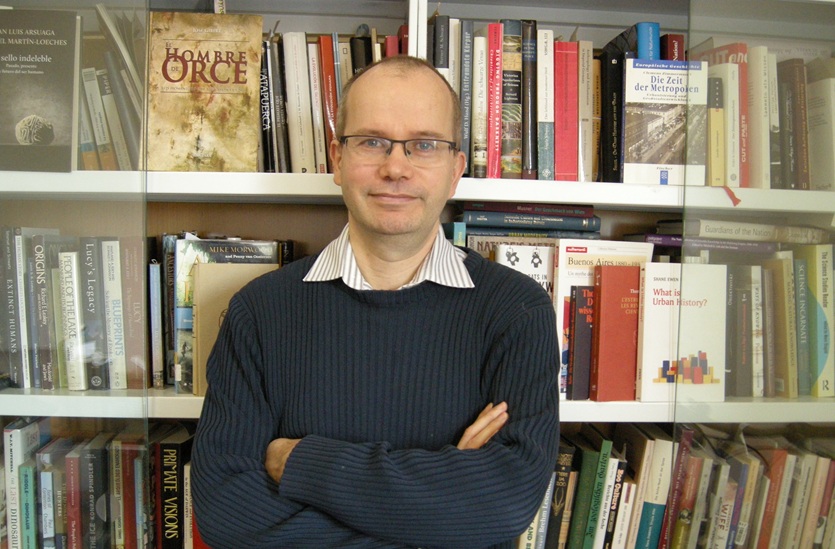
Oliver Hochadel. / Photo: courtesy of the author
FACE TO FACE WITH
Oliver Hochadel, historian of science and Research Professor at the Institució Milá y Fontanals del CSIC


Oliver Hochadel (Bruchsal, Germany, 1968) is a historian of science and a Research Professor at the Institució Milà i Fontanals of the CSIC (Spanish National Research Council) in Barcelona. His research focuses on the interaction between science and its publics over time. His academic career has taken him to several countries, including Germany, Austria, Switzerland, the United States and Spain, allowing him to address a wide range of topics from diverse cultural and scientific perspectives. Hochadel has worked on public electricity in the German Enlightenment, the history of nineteenth-century zoos, twentieth-century research into human origins, and the urban history of science around 1900.
Among his publications, El mito de Atapuerca: Orígenes, ciencia, divulgación (2013) stands out—a work examining how the Atapuerca project, one of the most important in the study of human origins in Spain, has become both a major science communication phenomenon and a paradigmatic case of the relationship between science and society. Alongside his research, Hochadel worked for nearly twenty years as a science journalist, taking an active part in debates on the public communication of knowledge and the formation of critical, well-informed audiences.
What first led you to specialise in the history of science and to pursue a research career at the CSIC?
My training is as a historian. In the mid-1990s, while looking for an engaging topic for my doctoral thesis, I came across a topic on itinerant lecturers on electricity in the eighteenth century. These “scientific showmen” turned the popularisation of science into a business. From that point on, I never lost my fascination with the history of science—with trying to understand how scientific knowledge is produced and how science interacts with society.
How would you describe the development of your career, from your studies to becoming a Research Professor at the Institució Milà i Fontanals?
My academic career has been full of surprises and unexpected turns. I came to Spain in 2007 to study the case of Atapuerca on a postdoctoral fellowship from the Universitat Autònoma de Barcelona. The fellowship was for eighteen months, but I have now been here for more than eighteen years.
And how did that come about?
I was fortunate enough to secure a permanent research position at the CSIC in 2011 through a competitive selection process. The community of historians of science in Catalonia has grown enormously over the past eighteen years, and it is both an intellectual pleasure and a real privilege to work in what is now an internationally recognised research “hotspot”.
“Having worked for many years in science journalism was crucial for my research on Atapuerca”
What role has your multidisciplinary background (history, communication, journalism) played in shaping your approach to science?
Having worked for many years in science journalism was crucial for my research on Atapuerca. Understanding from the inside how the media operate, how journalists think, and how researchers in turn perceive the media, allowed me to identify the communication machinery that the Atapuerca team had built.
When did your interest in human evolution begin?
I first became interested in research into human origins while working as a journalist in Austria. An Austrian anthropologist tried to establish himself in the Afar Depression in Ethiopia but ran into a series of problems. He was accused of being “neo-colonialist”, of “taking away” a promising site from a young Ethiopian researcher. I quickly realised how tense palaeoanthropology can be, and how scientists themselves often turn to the media—either to celebrate their discoveries or to attack their opponents and their interpretations. The media thus became a battleground for scientific controversies.
In your experience, what are the main challenges in conveying accurate scientific knowledge to non-specialist audiences?
The first challenge—common to journalism more broadly—is to generate interest in the topics you want to present to your readers. Why should they read your pieces when the supply of “content” is effectively endless? Which buttons do you need to press to capture their attention? Without compromising your professional standards, this is a structural problem facing journalism as a whole.
And why do people read the sports section more than the science section?
Writing about science brings an additional difficulty, because people tend to assume it is “difficult” and may be reluctant to engage with it.
Yet you have devoted your life to science journalism.
My agenda as a science journalist has been strongly shaped by my training as a historian of science. Science is—and has always been—a social and cultural practice. This constructivist approach is still a minority position in science journalism, which generally focuses on “facts” and often presents science as an infallible machine that produces reliable knowledge with the familiar phrase, “scientists have discovered that…”. However, if citizens are to be properly informed, they need to understand that this process is far more complex. Only then can they make informed decisions about science and its funding—about what can reasonably be expected of it, and what cannot.
“Science is the best response we have to many problems, but we must understand its limits and its difficulties”
This brings to mind vaccine denialism during the pandemic.
The pandemic was an instructive example in this respect. At the outset, knowledge about the virus and how to combat it was limited, uncertain and even contradictory. People grew impatient or even anti-scientific. Science is the best response we have to many problems, but we must understand its limits and its difficulties.
What prompted you to write El mito de Atapuerca?
One day, the publisher Gonzalo Pontón contacted me. He was aware of my research on Atapuerca and suggested that I write a book on the subject for the series “El espejo y la lámpara”, published by the Universitat Autònoma de Barcelona. The idea was to produce “high-level popular science”, and it offered me a golden opportunity. Writing the book in Spanish allowed me to reach a much broader readership in Spain, as it differed markedly from my academic articles in English, which are aimed at a more specialised audience.
Do you consider Atapuerca to be the most important human fossil site in Europe?
It is clear that many people think so, and arguments can certainly be made to support that view. But it is not a particularly meaningful question for a historian of science. We do not evaluate the quality of a site; we are neither judges nor enthusiasts. What interests us are questions such as: who makes these claims? With what motivations? On what grounds? Why is the language of superlatives so powerful? What role do the media play in amplifying these claims? We often hear about the oldest fossil, the most complete specimen, the largest assemblage, and so on. Yet if you ask palaeoanthropologists and archaeologists, they will tell you that what really matters is whether the finds contribute to our understanding of our ancestors—how they lived, how they functioned, and so forth. Even so, the temptation to speak in superlatives is always there, especially when one has a microphone in front of one. This dynamic has turned Atapuerca into something like a new point of origin for the history of Spain.
“The former directors of Atapuerca were very clear that positive media coverage was key to the project’s success”
Do you think the former directors of the Atapuerca team exaggerated certain discoveries in order to attract greater media attention and public funding?
If an archaeologist or palaeoanthropologist—whether at Atapuerca or at any other major site—engages with the media, they will almost always seek to highlight their site, as well as the quality and significance of their findings and the merits of their research team. That is what the communicative context calls for. And in fact, the former directors of Atapuerca were very clear that positive media coverage was key to the project’s success. They said so from the outset. They saw journalists as “friends”, as amplifiers of their message. Atapuerca is a site with extraordinary finds and highly talented researchers, but it also benefited from a media environment eager to promote a narrative of “national success”. This is precisely what happened from the mid-1990s onwards, when Spain was affected by a certain “inferiority complex” in terms of scientific achievements. This helps explain why the media were so enthusiastic about the discoveries from the Sierra de Atapuerca.
Are you currently working on any research project or book related to science communication or the history of science?
In recent years I have not worked extensively on the history of palaeoanthropology, but I have long been researching the history of zoos from the nineteenth to the early twentieth century. This includes both local history—such as that of Barcelona Zoo—and broader global perspectives. I am interested in how, around 1900, the “global zoo” emerged: a network of zoological gardens that exchanged animals regarded as exotic, as well as knowledge about how to care for and exhibit them. In the case of Barcelona, I am currently writing the biography of an elephant that lived in the zoo for more than twenty years and became something of a media star around 1900. These, I think, are topics of considerable interest to a wide range of audiences.
What themes or lines of inquiry would you like to pursue in the coming years?
Alongside my work on the history of zoos, my interests are increasingly turning towards the question of “coexistence” between humans and animals from a historical perspective, particularly in urban settings. We tend to associate the modern city with houses, cars and concrete, but it is also—and always has been—an ecosystem. Humans share urban space with pigeons, dogs and cats, but also with wild boar, rats and mosquitoes, as well as lions and elephants in zoos. If we look further back, we find horses, livestock and poultry in streets, backyards and even inside homes. In the face of climate change, invasive species, the threat of zoonotic pandemics such as COVID-19, and the accelerating loss of biodiversity, we must ask ourselves what the best way of sharing this common space might be.
Source: educational EVIDENCE
Rights: Creative Commons