


- Opinion
- 23 de April de 2026
- No Comment
- 6 minutes read
A new Sant Jordi against the dragon of illiteracy

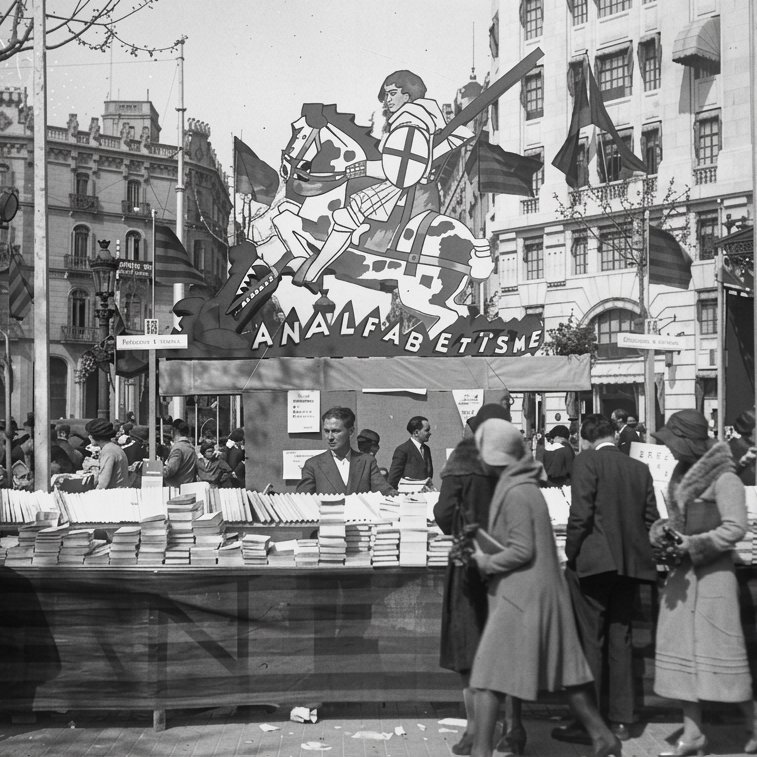
Photo: (Sant Jordi, 1932. Stand of Llibreria Catalònia) Gabriel Casas i Galobardes . / https://clubdellector.edhasa.es


Ramiro Gil
On 23 April 1931, just nine days after the proclamation of the Second Republic, Barcelona’s booksellers persuaded the authorities to move Book Day—until then held on 7 October—so that it would coincide with the Feast of the Rose on Saint George’s Day. That is how Sant Jordi, as we know it today, came into being, shaped by the spirit of the new republican regime. From the outset, it was more than a cultural celebration: it became a symbol of Catalan identity and, crucially, a day devoted to championing culture, education and literacy—an ethos that quickly took root in schools.
Contemporary newspapers and photographs bear witness to this. They show bookstalls alongside striking imagery of Sant Jordi battling the dragon of illiteracy. At the time, the metaphor was anything but fanciful: in 1931, a third of the Catalan population could neither read nor write, and universal schooling was still far from a reality. The republican authorities tackled the problem head-on. Through the reforms led by the Radical Socialist Minister of Public Instruction, Marcel·lí Domingo, a native of Tortosa, and through the expansion of schools under the republican Generalitat, significant efforts were made to address the situation. New schools were built, teachers were recruited, and their salaries improved, all with the aim of providing a dignified education for all. This commitment is unmistakable in the outlook of republican lawmakers, who made education a central priority despite the economic difficulties brought about by the aftermath of the 1929 crash. They understood that education and culture were the foundations of a free and democratic society—and acted accordingly.
It is striking that, in 2026, nearly a century later, those emancipatory principles seem to have been all but forgotten. Today’s policymakers often appear to be moving in the opposite direction. Investment in education is no longer a priority. Rather than ensuring well-resourced schools and fairly paid teachers, we are confronted with stark figures: teachers in Catalonia are now the worst paid in Spain, having lost more than 21 per cent of their purchasing power over the past fifteen years. At the same time, diagnostic assessments place Catalonia near the bottom of national rankings, while a worrying proportion of pupils reach secondary school with serious deficiencies in basic literacy, despite years of formal education. Something is clearly amiss. Any system that cannot guarantee literacy by the age of twelve scarcely deserves to be called an education system at all.
Teachers’ concerns, moreover, extend far beyond pay. There is a growing awareness that the administration has, whether by design or by neglect, contributed to the steady erosion of the system—and that this must be reversed. The curricula and methodologies imposed in recent years often seem ill-suited to genuine learning. In Catalonia, the embrace of passing pedagogical fashions has stripped schools of academic substance, turning them into little more than holding spaces for children and adolescents, while reducing teachers to mere facilitators—or, worse, entertainers. Subject hours continue to be cut back to make room for superficial projects that deliver little of lasting value. At the same time, passes and qualifications are increasingly awarded to pupils who have not met even basic standards. Project-based learning and competency-based approaches, as implemented, have proved deeply misleading—not only for students but for society as a whole. Placing the pupil’s happiness at the centre, while downplaying effort and intellectual discipline, has led to a gradual but unmistakable decline in educational standards. A poorly conceived model of inclusion has further undermined pupils’ right to a rigorous education. In many cases, it is only the quiet resilience of committed teachers that ensures that any meaningful knowledge is still transmitted in the classroom.
It is sobering to realise that, a century on, the aspirations of republican Catalonia remain unresolved. We are confronted with the paradox of a society that celebrates the Day of the Book while reading less and less. A society that prides itself on the cultural symbolism of Sant Jordi, yet simultaneously encourages the abandonment of textbooks, the spread of superficiality and the advance of functional illiteracy in its schools. More troubling still, there is little sign of any willingness to change course.
Perhaps the time has come to reclaim Sant Jordi not merely as a day of celebration, but of reaffirmation—a day to stand up for high-quality education. Let us not reduce it to a picturesque ritual that allows us to flatter ourselves as a nation of readers. Let us instead remain true to the values we claim to uphold, and use this occasion to call, from our classrooms and beyond, for a renewed commitment to literacy and learning. Because what is at stake is clear: we want our young people to read, to think, to study, and to leave school with a solid intellectual foundation.
We should never lose sight of a simple truth: a well-educated society is a free society. One that abandons its future generations to ignorance is, sooner or later, a society in decline.
Source: educational EVIDENCE
Rights: Creative Commons