


- Face to face
- 25 de May de 2026
- No Comment
- 26 minutes read
Ferran Ballard: “Now I really do reveal all my secrets”

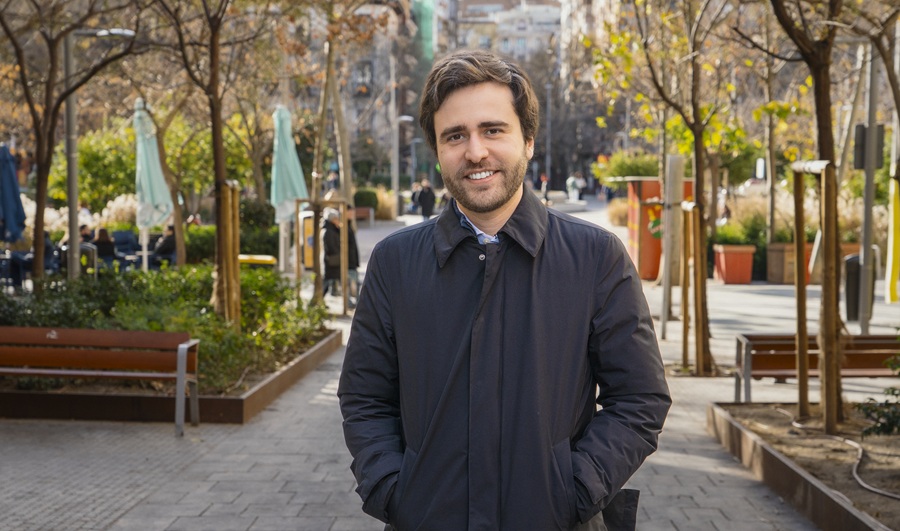
Ferran Ballard. / Foto: ©Carlos Ruiz
FACE TO FACE WITH
Ferran Ballard, Communicator and trainer in study techniques, memory and learning


One morning last April I heard a young trainer say that, in order to learn, it is necessary to experience frustration, make an effort and persevere in overcoming mistakes through humility, memory and understanding. At that moment I knew immediately that I wanted to speak to him, and through social media I tried to contact Ferran Ballard, a young communicator specialising in learning and memory strategies who is currently making a huge impact. That very afternoon he called me himself, and for more than an hour we shared an intense conversation about education, effort and the transmission of knowledge, full of renewed logic, enthusiasm and energy. In order to discover the best ways of learning effectively, this pioneer consulted teachers, students and manuals so as to distil the method he now teaches through courses and seminars aimed at companies, teachers and students.
Ferran became interested from a very young age in rapid memorisation techniques, which he initially applied in magic performances, one of his great passions. He studied a double degree in Law and Business Management at the Pompeu Fabra University, a period during which he had already begun helping other students learn more effectively. At the age of eighteen he founded a university academy that would later evolve into The Brain School, a project aimed at teenagers, university students and companies.
His career emerged from his own initial difficulties in learning how to study and from his inability to find useful materials on the subject. For this reason, he researched and recovered principles of traditional wisdom such as effort, repetition, frustration management and reflection as tools for deep and lasting learning. Now, as co-author of the book Aprender con estrategia (Learning Strategically) (Libros Cúpula, 2026), he defends the importance of associating ideas and reinforcing long-term memory. In this way he has trained more than 10,000 students throughout Spain. This interview is only the tip of the iceberg when it comes to understanding who Ferran Ballard is.
Magic directs our attention away from where the trick really lies, just as educational policy often directs it away from teaching itself. How did you go from performing magic to specialising in learning and study techniques?
For me, the transition was very natural. In fact, even before magic I had already been fascinated by memory. My grandfather was very good at remembering people’s names, a skill he had learned from a book by an American magician, Harry Lorayne, who taught techniques for improving memory. He did this through mnemonics, techniques already used by the ancient Greeks more than two thousand years ago and which allow numbers, words, names and ideas to be remembered more effectively.
And when did you begin using those strategies?
Well, I began using those apparent magic tricks when I was fourteen, with my classmates. But I soon ran out of repertoire. From there I moved on to the magic tricks we all know, and within a few months I was already performing shows.
“A magician ultimately works with the audience’s perception and mind, and this has many points of contact with learning”
At fourteen years old?
Yes. Magic gave me many things that later proved decisive in teaching: understanding attention, knowing how to structure an explanation, capturing the audience’s interest, managing rhythm, creating surprise and making ideas more memorable. A magician ultimately works with the audience’s perception and mind, and this has many points of contact with learning.
And when did the shift towards learning techniques begin?
The turning point came when I began a double university degree and realised that I did not know how to study. I could be curious, disciplined and put in the hours, but that did not mean I had a good method. So I began searching for one and shortly afterwards I started teaching it and left magic performances behind. In other words, I went from trying to amaze people to trying to help them learn. And, in reality, both involve understanding how the mind works and making an experience meaningful. The difference is that before people left wondering “How does he do it?”, whereas now I want people to understand exactly how I do it in order to learn properly. Now I really do reveal all my secrets.
Some people say that learning is a form of play through problem-solving. Others, however, argue that learning means retaining knowledge in the long term and not simply enjoying temporary entertainment that you will no longer remember afterwards. How does your method approach this question?
Learning means retaining knowledge over the long term. But that is precisely what allows you to engage playfully in problem-solving. Let me explain: in order to learn any discipline, we need to retain its foundations and fundamental principles in memory. Without these foundations, we may carry out activities that appear highly stimulating, yet often remain little more than temporary entertainment that disappears after a few days. By contrast, when knowledge is well consolidated, you can build on it with confidence and, over time, combine it with knowledge from other fields in order to solve new problems. That is why I am a great defender of the art of memorisation. And that is also why I am fascinated by learning things by heart.
“When knowledge is well consolidated, you can build on it with confidence and, over time, combine it with knowledge from other fields”
There is an observation by George Steiner that has always stayed with me: when you know something by heart, nobody can take it away from you; it remains inside you, grows with you, changes with age and circumstances, and each time you understand it differently. Now, memory is only useful when accompanied by understanding. Memorising without thinking is like adding without numbers. You may repeat words, formulae or definitions, but that does not mean you have transformed them into knowledge. For this reason, a good learning method does not seek to make the student accumulate information mechanically, but rather to teach them how to transform information into knowledge.
Earlier you said that learning does not simply mean enjoying something briefly only to forget what was learned a few days later.
That is true, and it means giving students the tools to ask themselves whether they really know what they think they know. Because one of the major problems in learning is how easily we deceive ourselves. Reading something and finding it familiar is not the same as knowing it. Underlining is not knowledge. Understanding something while someone explains it does not guarantee mastery either. Knowing means being able to retrieve, explain, apply and connect knowledge when necessary. Over the years I have realised that people who learn well also think better. And the reverse is also true: people who think well learn better. The two are closely connected. When you learn deeply, you organise ideas better, detect mistakes more effectively and build better judgement. And when you think better, you also study in a more demanding and precise way. So I do not oppose learning and problem-solving play. On the contrary: in order to play well with problems, you first need pieces with which to play. And those pieces are knowledge that is well understood, well memorised and available in long-term memory.
“In order to play well with problems, you first need pieces with which to play. And those pieces are knowledge that is well understood, well memorised and available in long-term memory”
You explained to me that you compiled all those efficient study techniques contributed by students, teachers and experts. What role did your studies at Pompeu Fabra University play in shaping your method?
Without my studies at Pompeu Fabra University, I would not be who I am and the method would not be what it is. The difficulties I experienced at university and within a demanding degree programme were partly what began my journey into the world of teaching. There I understood that studying a great deal does not always mean studying well, and that behind good results there lies not only ability but also method. Moreover, at university I met Alejandra Scherk, who co-created the method with me. And I think this is one of the most important keys: I did not create the method alone. We built it through comparison, discussion and constant revision. Even today, Alejandra and I engage in continuous debates about what should be included and what should remain outside, what is interesting but not essential, or what may be true but does not sufficiently help people learn better. Working in this way forces you to accept that you cannot see all your blind spots. You need someone who does not always agree with you, but who trusts you enough to say: “This is not as clear as you think it is”. Every time one of us concedes because the other has the stronger argument, the method improves.
But you did not just create a method — you also expanded it beyond the university, didn’t you?
That is true. The second decisive step was creating a university academy. The idea was to help university students pass their different subjects by applying a more effective method, while also preparing teachers so that they could convey content more effectively and ensure that students genuinely learned it. The fact that the initiative worked, and that fifteen years later it is still going strong, gave us a large body of students to observe, compare and analyse. We could see what happened when different students studied with the same notes, attended the same classes and nevertheless obtained very different results. This allowed us to understand better why some achieved good marks and others did not.
“One of the most interesting things we observed is that many poor results stem not from a lack of ability, but from excessive confidence in one’s own judgement”
Some experts in education say that the best learning method is the one each student finds most suitable for themselves. Is that really the case?
One of the most interesting things we observed is that many poor results stem not from a lack of ability, but from excessive confidence in one’s own judgement. We saw students who, despite being given clear guidance on how to study more effectively, preferred to do things their own way even when that method was not producing good results. I find this confirmation bias fascinating because, in reality, we see it every day in society. We find it very difficult to abandon a way of doing things once we feel it belongs to us, even when the evidence tells us it does not work. In this sense, university not only provided me with demanding training, but also gave me the context and the real problems that ultimately shaped the method.
As you speak, you strike me as a restless person eager to learn from everyone and everything. You also explained that at first you did not know how to study. What did you do about it, and how did that difficulty influence your professional trajectory?
I have asked myself that question more than once. Most students encounter difficulties during their studies, yet I am surprised by how many do almost nothing to try to change the situation. They fail, get stuck, become anxious, think they are not cut out for studying or that the syllabus is too difficult, but they rarely ask themselves: what if the problem were my method? In my case, had magic not been part of my life, I probably would not have had the attitude necessary to change my way of studying. In order to progress in the world of magic, you must learn from the best. That means being willing to accept that the person in front of you knows things you do not yet know. In fact, I learned enormously from books written by great magicians. Later, I transferred that mindset to studying, because when I wanted to find a good method, I quickly reached the conclusion that I needed to ask the best students how they did things.
I imagine magic taught you more than simply a learning method. What else did it teach you?
Magic also taught me that improvement depends upon observation, practice and correction. If a trick does not work, you do not blame the audience. You review what you have done, where attention broke down, which gesture failed to appear natural or which detail revealed the secret. This way of thinking showed me that if a learning method does not work, you must be able to examine the process coolly and ask yourself: how am I studying, when do I revise, how do I check whether I know it, am I memorising or merely recognising, can I explain it without looking? That is why, when I encountered difficulties as a student, I experienced them as a problem that could be studied and improved. And so I began observing what good students did, testing techniques, discarding those that did not work and building my own method — not upon intuition, but upon practice, evidence and results.
“Magic taught me that improvement depends upon observation, practice and correction. If a trick does not work, you do not blame the audience”
Has all this influenced your empathy towards students?
Over time, that difficulty has profoundly shaped my professional trajectory. Having been on the other side, having heard that I did not know how to study, has helped me understand students better: their fears, excuses, needs and frustrations. It also taught me that when you explain knowledge, you must know how to make it accessible. In that sense, my own difficulties have shaped both the method and the way I connect with others. I do not speak about learning from a theoretical or distant standpoint. I speak because I have lived through it, struggled with it and discovered that, with the right method, many people who thought they were incapable of learning can realise that they simply had not yet learned how to do so.
The current education system — the LOMLOE itself says so — places little emphasis upon effort and repetition as learning tools. How do you think educational policymakers should be persuaded to improve teaching?
I think we need to be very clear here. Effort, repetition, memory, practice and rigour are necessary tools. There is no solid learning without a certain degree of discomfort. And if the education system conveys the idea that learning should always be easy, motivating and immediate, then we are deceiving students. Learning is difficult. And precisely because it is difficult, you need method.
“If the education system conveys the idea that learning should always be easy, motivating and immediate, then we are deceiving students. Learning is difficult”
But does not the LOMLOE defend the idea that each student can learn in their own way and that every teacher has their own method?
The problem is that among teachers there remains a strong belief that every teacher has their own way of doing things. So even when you explain evidence-based learning techniques to teachers, some still will not apply them because they trust too much in their own judgement or believe their methods already work. That is why I do not think general recommendations are enough. We should establish a number of shared, simple and applicable rules that every teacher ought to incorporate into the classroom. For example, something as simple as beginning each lesson with a short test on the previous lesson could form part of any teacher’s checklist. There would be no need to turn it into a major exam or bureaucratise it. Simply retrieve the content. Make the student think. Force them to bring into memory what they saw the previous day. We know this kind of practice helps consolidate learning and is far more useful than merely rereading or underlining.
I used to ask about the previous lesson at the beginning of every class.
Good. But I would not place all the responsibility upon the teacher. I think one of the most effective measures would be to include, at the beginning of the school year, a specific training session for students and families on study techniques. A real session on learning how to learn using concrete tools: how to organise the syllabus, how to memorise, how to revise, how to plan and how to detect whether something has genuinely been understood. Just as schools provide guidance at the beginning of the year about what is expected academically, they should also explain to students and parents how to approach studying in the most efficient way possible. This would partly relieve teachers and, above all, empower students. Because students should know how to learn properly regardless of which teacher they happen to have in front of them.
What should a good teacher value more highly in relation to their subject: pedagogy or subject knowledge?
There are people who possess extremely valuable knowledge but who do not always know how to ensure that others learn it. That does not mean they fail to provide value. During my degree I had lecturers who explained extremely interesting things, but because of the sheer amount of information they had to transmit, they could not always attend to the quality of each student’s learning and attention. And I thought that was perfectly reasonable, because I understood that my responsibility was to work through that material, organise it, practise it and genuinely learn it.
“I believe educational policy should stop searching for grand slogans and return to some basic ideas: knowledge, effort, repetition, memory, rigour and method”
What should policymakers do to improve our education system?
I believe educational policy should stop searching for grand slogans and return to some basic ideas: knowledge, effort, repetition, memory, rigour and method. This does not mean returning to a rigid school system or denying the importance of motivation. It means understanding that motivation often comes after seeing that you are making progress, not before. And that students only develop autonomy once they possess knowledge and a method for working with it. If we want to improve teaching, we must persuade educational policymakers that learning does not simply mean exposure to activities, projects or competences. Learning means incorporating knowledge, retrieving it, testing it and building judgement. And this requires a school culture in which effort is not viewed as a failure of the system, but as an indispensable part of the process.
You fought against and overcame your own barriers as a student. How important is good academic training for developing effective learning skills?
A good academic education is important, but on its own it does not guarantee a good learning method. You may pass through a highly demanding and well-structured education and still never truly learn how to study better. In Spain, for example, civil engineering training is excellent and demanding. Yet it is also a degree programme many students abandon. This shows that a good academic education may expose you to high levels of demand, but does not necessarily teach you the tools required to overcome them. That said, I do believe a good education can plant the seed of a good method. When education is rigorous, serious and complete, it forces you to confront real difficulties and develop your own resources in response. In that sense, if you learn to make decisions, organise knowledge, detect your mistakes and adjust your method, that education leaves you with the capacity to continue learning throughout your life.
“If you learn to make decisions, organise knowledge, detect your mistakes and adjust your method, your education leaves you with the capacity to continue learning throughout your life”
What would you say has disappeared today from effective teaching?
Today we find ourselves in a situation where almost all discomfort has been removed from the learning process within academic education and, along with it, an essential part of learning itself. With the help of artificial intelligence, it is now possible to go through the entire process of studying without making a single intellectual decision. We see how the fashionable tool summarises material for you, tells you what is important and even proposes how you should memorise it. We make the mistake of delegating method itself, and this has very serious medium-term consequences, because learning means deciding what is relevant, making mistakes, correcting them, organising, comparing, prioritising and constructing your own perspective. For this reason, academic education must contain knowledge, discipline and rigour, but it must also make students conscious of the learning method itself. Above all, students must not delegate this process, because otherwise they will incur a cognitive debt that sooner or later they will have to repay.
We are living in a moment when our education system has more pedagogues than ever before, yet international indicators such as PISA and TIMSS show declining educational standards. Do we really need so many pedagogues in education, and how do you assess the role of teachers in conveying knowledge and teaching students how to learn?
I would say the issue is not counting pedagogues, but asking ourselves what kind of pedagogy inspires the system. Pedagogy is necessary if it helps teachers teach better, organise content, detect difficulties and ensure students’ progress. But it becomes problematic when it replaces teaching with empty language, when it speaks constantly about competences, emotions or methodologies but very little about knowledge, effort, memory and rigour. Poor results in assessments such as PISA or TIMSS cannot be attributed to a single cause, but they should make us reflect. Perhaps we have confused innovation with improvement and assumed that changing the language of schooling was enough to transform it. Yet schools do not improve because they possess more pedagogical discourse, but because students learn more and learn better.
“So yes, we do need pedagogy — but a pedagogy at the service of knowledge and of the teacher, not a pedagogy that takes the teacher’s place”
How do you think a good teacher should be in light of everything we have discussed?
To me, the teacher’s role is absolutely central. Above all, a good teacher is someone who knows things and knows how to teach effectively. They are an intellectual authority who introduces students to forms of knowledge they would struggle to discover alone. Without that transmission, talk of “learning to learn” becomes misleading, because nobody learns how to learn in the abstract. You learn how to learn by learning mathematics, languages, history, science, music or literature. So yes, we do need pedagogy — but a pedagogy at the service of knowledge and of the teacher, not a pedagogy that takes the teacher’s place. And we need teachers who are respected, well trained in what they teach and granted sufficient freedom to do what gives school its meaning: convey knowledge, form judgement and help students grow intellectually.
You have worked with a wide range of groups, including students, candidates preparing competitive examinations and professionals. What differences do you observe in the way they learn?
Secondary school and university students usually develop their own study systems. The problem is that they often assume those systems are correct. And when they fail, they look for explanations elsewhere: the syllabus is too difficult, the teacher explains badly, they do not have enough time, or they end up thinking they are simply “not cut out for studying”. Yet very often they never question whether the real problem may lie not in themselves but in the method they are using.
With candidates preparing competitive examinations, almost the opposite occurs. They usually place themselves entirely in the hands of the tutor and follow the proposed method with enormous faith. That has advantages, because it creates structure, constancy and discipline. But if the method is not the right one, they may spend months or years repeating it without ever asking themselves whether they are truly learning in the best possible way.
And then there are professionals. In many cases, they feel learning belongs to a distant stage of life. They think they no longer need a method for learning, or that they have somehow lost the capacity they once had when they were students. As a result, they end up closing themselves off to new opportunities: they do not dare to take on a new project, a new role, a new tool or a professional change. The outcome is that, unless they question how they learn, they may claim to possess twenty years of experience when in reality they have repeated the same year twenty times.
In truth, the difference between these groups is not merely age or context, but above all their relationship with their own method and with knowledge itself. My work consists precisely in making that method visible, questioning it and helping people construct a more conscious, demanding and rigorous way of learning.
“When a person stops learning, they close themselves off from surprise, change and the possibility of seeing the world differently”
What struck you most about the case of the Nobel Prize-winning economist Daniel Kahneman, and why has it influenced your view of lifelong learning?
What struck me most about the case of Daniel Kahneman was that his final wish before dying was to learn something new. I find that profoundly moving. We are speaking about someone who already knew an enormous amount, who had reached the highest recognition in his field and who had transformed the way we understand decision-making, cognitive biases and human behaviour. And yet, at the end of his life, he was not seeking to prove anything or receive further honours, but simply to continue learning. I find this gesture immensely powerful because it breaks with the idea that learning is merely a stage of life. For me, learning is a way of living and, indeed, curiosity and the desire to learn form part of what makes us human. They accompany us from beginning to end. When a person stops learning, they close themselves off from surprise, change and the possibility of seeing the world differently. Learning means never assuming that everything is already finished.
Finally, it is obvious to anyone who knows you that you speak quickly, energetically and with great enthusiasm. Above all, I hope you never lose that enthusiasm. Tell us about your latest project, book or line of research, and what impact you hope it will have upon the world of education.
Enthusiasm should never be lost. I think we all need a challenge every day, something that forces us to keep learning, improving and stepping outside our comfort zone. Right now, our next great challenge is to take the method beyond our borders. We have seen that it works, that it helps very different kinds of people and that it can have an impact far beyond our immediate environment. Closer to home, I want to bring learning techniques into the world of performance. I am preparing a theatrical production about learning designed for the whole family — something parents, children, students, teachers or anyone curious can come and enjoy. The idea is for them to enjoy themselves, but also to leave knowing more than they did when they arrived. Ultimately, whatever the format I work in, my aim is that every person who walks through my door leaves knowing how to learn better. Because learning opens doors for you — and afterwards you decide which ones you want to close.
Source: educational EVIDENCE
Rights: Creative Commons