


- Literature
- 24 de April de 2026
- No Comment
- 5 minutes read
“Don’t buy flowers—buy books”: a farewell to Ian Watson


Ian Watson delivering his speech at the UPC Miquel Barceló Science Fiction Prize, 17 September 2025. / Photograph by the author


On 13 April 2026—just ten days before Sant Jordi, Catalonia’s day of books, roses and lovers—the worlds of science fiction and literature lost one of their most brilliant, daring and original minds. Ian Watson, the British master who chose Gijón as his home for the last fifteen years of his life, died at the age of 82. He was far more than a prolific genre writer: he was an anthropologist of possible worlds, an explorer of the frontiers of the mind, language and our relationship with technology.
I had the good fortune to meet him last year at the ceremony for the UPC Miquel Barceló Science Fiction Prize. Watson was an extraordinary writer who used science fiction to ask the most fundamental questions about who we are. He was also a man of infectious vitality and humour, deeply in love with life, science and literature. In place of a conventional farewell, his family shared his final—and characteristically brilliant—wish: A expreso deseo del fallecido: no compren flores, compren libros (At his express request: don’t buy flowers—buy books).
The Embedding and the limits of language
As a physicist and linguist, I feel almost compelled to return to his first novel, The Embedding (1973). But the recommendation is universal. It is a masterpiece that established him at once and which, in our digital age, feels more relevant than ever. Few novels have explored with such clarity how the structure of language shapes the very fabric of reality.
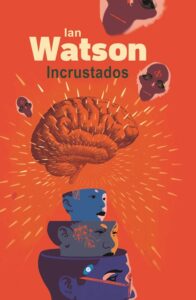
The narrative weaves together three strands with remarkable precision. First, we encounter Chris Sole, a linguist working in a British hospital, engaged in an experiment as radical as it is ethically troubling: he raises a group of orphaned children in isolation, teaching them an artificially constructed, highly complex language in an attempt to reshape their cognitive perception of the world. Meanwhile, his former colleague and friend Pierre, an anthropologist, is deep in the Amazon studying the Xemahoas—an isolated tribe on the brink of extinction. Through a psychedelic fungus, the Xemahoas access a second, sacred language that allows them to commune with the essence of reality itself.
The novel ultimately expands into the cosmic with the arrival of the Spthra, an alien species that travels not in search of resources, but of languages. Their aim is to collect and overlay all forms of communication in the universe in order to decipher the underlying code of reality—and perhaps escape it. It is, quite simply, irresistible for anyone drawn to the mysteries of language.
Screens, algorithms and the robot child: Watson’s technological legacy
Read today, The Embedding reveals itself as an unsettlingly prescient metaphor. Sole’s experiment—echoing the behaviourist models of B. F. Skinner—resonates strongly with current debates about technology in education and the so-called addiction to screens. Just as those children were shaped by an artificial language that altered their cognition and distanced them from lived human experience, we too now find ourselves “embedded” within the ecosystems engineered by big tech: in human–machine hybridity, in the revival—one might say—of Ortega’s ontological centaur.
Social media and artificial intelligence algorithms have become the new language imposed upon us. Our brains—and especially those of younger generations who have known nothing else—are being retrained under the regime of instant dopamine, infinite scrolling and constant notifications. We are participants, largely passive, in a vast global experiment in cognitive embedding, where attention—and, more troublingly, perception itself—has been quietly reprogrammed by codes we barely understand. And no Spthra are coming to rescue us.
Source: educational EVIDENCE
Rights: Creative Commons