


- Politics
- 6 de May de 2026
- No Comment
- 9 minutes read
Curriculum, textbooks and deep learning, according to Nuno Crato

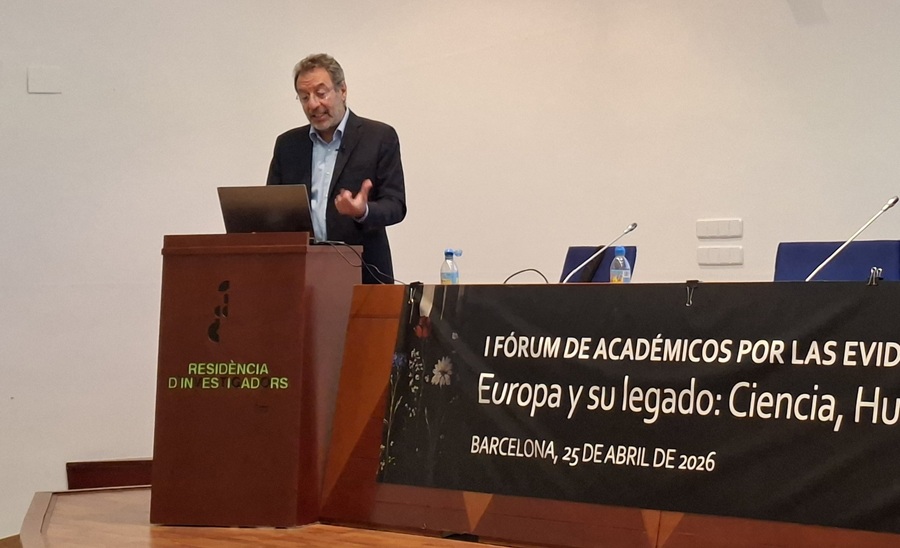
Lecture delivered by Nuno Crato at the I Fórum de Académicos por las Evidencias Educativas of the Fundació Episteme. Barcelona, 25 April 2026. / Photo: Antoni Hernández-Fernández



The lecture delivered by the former Portuguese Minister of Education and Science (2011–2015), Nuno Crato, offered a fine synthesis of his thinking on education. He began by referring to a painting by Johannes Vermeer, The Astronomer (1668). Seated at his desk before an open book and an astronomical sphere, the figure appears to reflect on how to connect a written text with a three-dimensional object—a map of the stars. It is, in effect, a metaphor for the work of both teacher and student: rendering an intricate reality intelligible through text.
The book in question—an astronomical treatise of the period—cannot strictly be regarded as a textbook in the modern, school-based sense of the term. Textbooks did not emerge in an explicit and systematised form until the nineteenth century, with the spread of national curricula and the formalisation of the curriculum, whose function was to give verbal, textual form to what all pupils were expected to learn. Yet the underlying idea remains essentially the same as that which preoccupied Vermeer’s astronomer. Today, Nuno Crato went on, textbooks are often discredited and no longer regarded as central to education—something which, in his view, is mistaken: textbooks do matter.
Since the advent of international assessments such as TIMSS (1995), PISA (2000) and others, education has gained access to a body of evidence previously unavailable, or at best only intuitable. This represents a genuine scientific turning point in education: we are now able to make comparisons based on objective data. These studies provide solid evidence of the importance of textbooks: results consistently show that countries making intensive use of textbooks tend to achieve better outcomes than those that do not. Moreover, variations in textbook quality may account for up to 30% of the standard deviation (Agodini et al., 2009).
Why, then, do textbooks remain discredited in certain educational circles? The reasons for this loss of prestige in some countries—and the resulting move away from textbooks—lie in a range of pedagogical approaches opposed to their use, whose origins date back to the 1960s and which continue to exert influence today. Among the principal arguments against textbooks are the following:
- The idea that education should be centred on the student, rather than on the transmission of knowledge.
- The emphasis in dominant pedagogies on “method” over “content”, as Bianca Thoilliez has pointed out.
- The radical educational reforms carried out in the United States in the 1960s, according to which “textbooks only promote memorisation”.
- The tendency in Western curricula towards constant innovation, flexibility and differentiation.
Crato’s position is clear: in education, everything begins with the curriculum, and textbooks are its concrete expression: they define what is to be taught and provide the basis for both formative and summative assessment. The textbook is therefore a tool not only for teachers and students, but also for parents, enabling them to support their children and understand what they are studying and learning. It also facilitates the preparation of tests and examinations and constitutes an introduction to the practice of intelligent reading (Mardsen, 2001).
In support of the idea that “everything begins with the curriculum”, there exists a wide-ranging body of literature, since it determines the knowledge to be taught. Examples include Lev Vygotsky (1934)— “Instruction precedes and shapes development”; Antonio Gramsci (1935)—the teaching of scientific ideas that challenge magical thinking and popular culture, and that elevate young people beyond their immediate environment (Entwistle, 1979, 2023); and Michael Young (2008), Bringing Knowledge Back In, with his argument that there is such a thing as better knowledge (“powerful knowledge”). This corresponds to what Gregorio Luri (2022) describes as powerful knowledge, which requires mastery of the discipline being taught—an aspect particularly emphasised by Xavier Massó (2021), in his defence of the right to advanced knowledge, and by M. A. Tirado (2025), in relation to disciplinary knowledge. Crucially, the curriculum also fosters something fundamental: shared knowledge, as E. D. Hirsch (2025) argues—shared knowledge is the foundation of education.
Any curriculum must, of course, include both knowledge and skills, but it must be guided by knowledge. This is for a simple reason: skills lack structure, whereas knowledge possesses it. General skills outside specific domains of knowledge are illusory; they are domain-specific. Knowledge, by contrast, enables further knowledge to be acquired (vertical coherence), while also linking disciplines together (horizontal coherence). We are thus speaking of deep learning, in which structure takes precedence over surface: moving from facts to simple schemas, and from these to more complex ones (L. Rupérez, 2022). Dispersed activities, by contrast, do not give rise to coherent structures. And what then occurs, paradoxically, is that memorisation becomes unavoidable.
The curriculum is the tool that enables students to progress in their acquisition of knowledge. As Josep Pla wrote (Lo infinitamente pequeño [“The Infinitely Small”]): “It is only when we know something that we feel the desire to know more; when we know nothing, curiosity fades”.
In this sense:
- The curriculum builds new conceptual schemas upon those already acquired.
- It must be clear and precise: teachers and students should understand how new concepts emerge from earlier ones.
- It must be ambitious, leading students to higher levels.
- It should not overemphasise the spiral curriculum.
- It should not overemphasise flexibility—we need a shared culture.
- It must allow for rigorous and precise assessment.
A good curriculum and a good textbook must also take into account several key principles from cognitive psychology:
The principle of sequencing: to understand what a rainbow is, for example, one must first grasp reflection and refraction, the nature of suspended water droplets, and the composition of light. Cognitive load must be managed: knowledge cannot be transmitted all at once, but requires careful pacing.
Equally important are the multimedia principle and the coherence principle. Important research on the multimedia principle was carried out by Paivio, a psychologist active some fifty years ago and now largely unknown to the general public. His dual-channel theory distinguishes between a verbal channel (auditory, written) and a visual one. One can follow a visual explanation while listening to an oral one, or vice versa. However, presenting two elements through the same channel—for instance, overlapping images—hinders understanding. Nor should one speak while simultaneously displaying written text on screen (a common practice), since any divergence between the two may generate cognitive conflict. In other words, if one speaks, one should not display the text. This brings us back to the painting with which the lecture began: a man with a book and an image—three-dimensional, but still an image. This is the principle of coherence.
A well-designed textbook, accordingly, promotes learning that is sequential, active and systematically organised.
Crato concluded by warning of the consequences of poorly conceived curricula and textbooks. These prove to be the very opposite of what those who are radically opposed to memorisation claim to seek. For where there is no structural coherence, memorisation becomes the only possible recourse—simply because understanding has not taken place. This is what David Ausubel termed non-meaningful learning—an experience marked by boredom and the progressive devaluation of knowledge.
In short, Dr Crato’s lecture amounted to a genuine masterclass, and we strongly recommend watching the full recording at the following link.
Source: educational EVIDENCE
Rights: Creative Commons