


- Opinion
- 26 de May de 2026
- No Comment
- 7 minutes read
The new elit

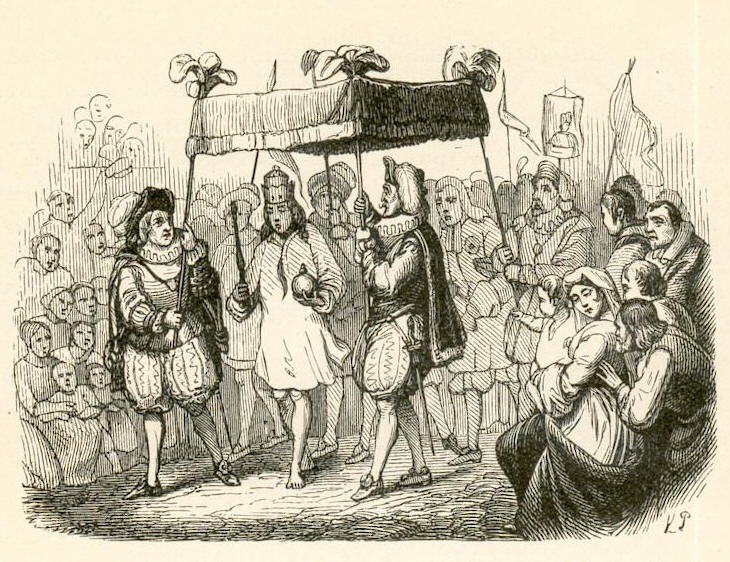
Illustration for The Emperor’s New Clothes. / Wikipedia. Illustration by Vilhelm Pedersen (1820–1859).
THE GREAT SCAM. Opinion section by David Cerdá


The new elite will be cognitive; or rather, it already is. Such has been the devastation inflicted upon public education in general, and secondary education in particular — after the successive machete blows of family and cultural disorientation, political shamelessness and the distractions of the attention economy — that an unbridgeable gulf has now opened between those brought up in homes where the habit of thinking has been cultivated and partially shielded from the dopamine-driven pull of smartphones, and those who have simply been left to fend for themselves. Parents know it. Schools know it, at every level. The organisations that will later hire these young people know it too. Yet one still cannot speak openly about the matter in all those places where power has embedded itself like a tick, because that same power continues to puff out its chest about everything while taking responsibility for precisely none of its failures.
There was once a time when public education stood as the great bastion of democracy: the opportunity open to all, the place where the poor child could catch up with the rich one. That story is over. With the connivance of none other than self-proclaimed “progressivism” — half self-interest, half ignorance — we have allowed the principal engine of social mobility to break down, throwing equality of opportunity down the drain. Today, two factors above all determine how your life is likely to turn out: the amount of time your parents can devote to you, and the kind of culture that permeates your home. In other words, we are drifting back towards an age of profound inequalities of birth: once again, even in the developed world, one has to cross one’s fingers at birth: If you are fortunate enough to have parents capable of supporting your studies and engaging you in intellectually stimulating conversation, and if you grow up surrounded by books and a certain degree of intellectual life, then you will probably become part of the elite. Otherwise, you are likely to find life extraordinarily difficult. This diagnosis is sociological, not deterministic. Naturally, many remarkable lives will emerge from deprived circumstances, and many opportunities will be squandered. But broadly speaking, this is the reality: in 2026, in one of the best countries in the world in which to live, every passing day makes your future depend more heavily on where you happen to be born.
The new privileges are not fundamentally financial, though that scarcely matters, because they remain just as unjust. It cannot be right that a child whose mother runs a successful business and whose father is a lorry driver should enjoy fewer opportunities than one raised by a university lecturer and a stay-at-home father. If ethics is the answer to the question “what constitutes the good life?”, then political ethics — the ethics of coexistence — demands that one’s destiny should not depend upon the circumstances of one’s birth. Too many people have died to secure the principle that a person, born with their dignity intact, ought to be able to fight for a future in which circumstances do not end up crushing them. This regression amounts to spitting upon the graves of those who gave their lives so that Juan de Mairena’s words might ring true: nobody is superior to anybody else.
The new elite is not financial, because wealth alone no longer guarantees nearly as much as it once did. Yet it is obvious that those able to compensate for the wider breakdown with a cheque book enjoy a far easier path. Politicians who describe themselves as progressive do little more than cheapen public education while sending their own children to elite schools. And yet nobody will protest until the political right returns to power. I do not know whether it will take three months or three weeks; what matters is that the chorus will only raise its voice once those outside its ideological tribe are in power. I assure you this is exactly what will happen: they will remind us of the Wert Law and treat all the intervening years as though they were nothing more than a parenthesis. The hypocrisy is so blatant and so obscene that I genuinely struggle to understand how anyone continues to buy into the arguments of those who will shout tomorrow while remaining silent today.
As Leibniz explained, justice is ultimately nothing more than charity governed by wisdom. In other words, it is an enlightened form of self-interest: wanting as many people as possible to flourish is, ultimately, a struggle for a society in which we ourselves would rather live. We need to wake up immediately. A world growing steadily more unjust is the prelude to violence and every other form of iniquity. We are only a cold — an economic crisis — away from pneumonia, despite the fools who endlessly celebrate macroeconomic figures. Technology will not rescue us from this situation; only civic honour will. Politicians will not save us; only a mobilised civil society can do that. Google for Education, hyper-classrooms, new pedagogies — enough of feeding off a corpse. Our problem is not one of methodologies, but of shame. We are sending young people into the mire with smiles on our faces while reinforcing their increasingly hollow and illusory sense of entitlement. Parents, students, teachers, citizens: we must cry out that the emperor has no clothes. Let us finally understand what King Lear said long ago:
“Through tattered clothes small vices do appear;
Robes and furred gowns hide all. Plate sin with gold,
And the strong lance of justice hurtless breaks;
Arm it in rags, a pygmy’s straw does pierce it”.
Source: educational EVIDENCE
Rights: Creative Commons