


- HumanitiesLiterature
- 20 de May de 2026
- No Comment
- 12 minutes read
Eduardo Moga: «Rimbaud was the greatest poet of his age»

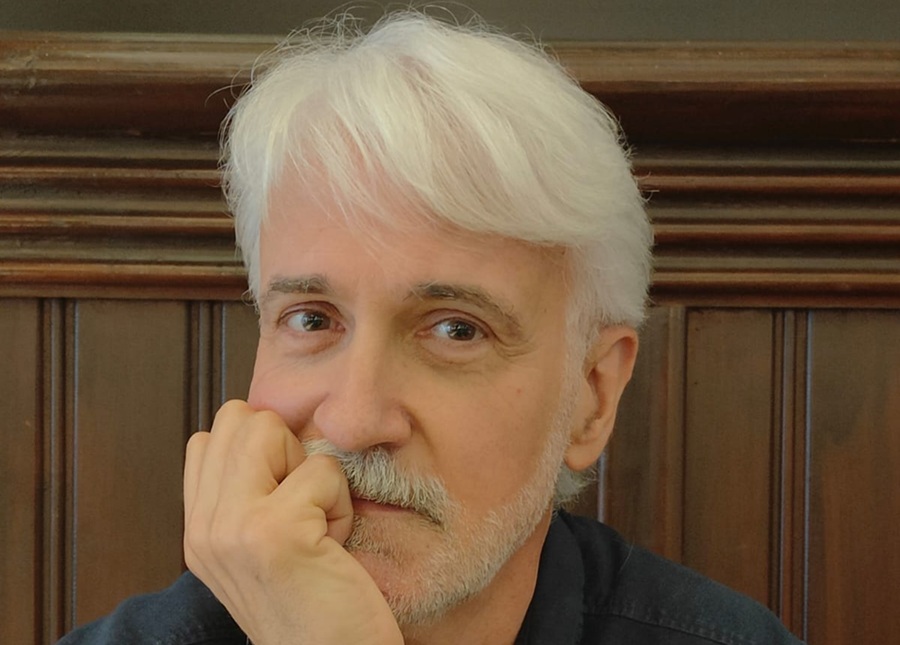
Eduardo Moga. / Photograph supplied by the author


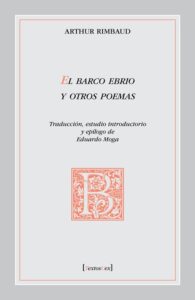
Eduardo Moga (Barcelona, 1962) is a poet, writer and essayist, holds a degree in Law and a degree and doctorate in Hispanic Language and Literature from the University of Barcelona. It would be impossible to summarise his work here, but it is worth noting that he gathered his poetry in the three volumes of Ser de incertidumbre. 1994–2023 (Dilema). He has just published an edition of El barco ebrio y otros poemas (The Drunken Boat and Other Poems), by Arthur Rimbaud, whose work he has studied and translated, through the presses of the University of Extremadura.
How many books have you published over the past two years?
Not many: only my collected poetry (Ser de incertidumbre, in three volumes), my doctoral thesis (El esplendor y la amargura. La poesía de Basilio Fernández), five translations — of Arthur Rimbaud, Sharon Olds, Edgar Lee Masters, Harold Norse and Jay Wright — two reissues of earlier poetry collections (Dices y Poemas enumerativos), and a travel book, La vuelta al mundo en 80 museos.
Who was Arthur Rimbaud? What sort of figure was he?
Rimbaud was born into a French Catholic family of fiercely conservative values — though perhaps I should say mother alone, because his father, a career soldier, abandoned the family when the future poet was only six. He possessed extraordinary intelligence, verbal brilliance and sensitivity, and during his brief life devoted himself to poetry, wandering, absinthe, mind-altering substances, esotericism, his turbulent relationship with Paul Verlaine, life in Africa and arms trafficking. He was the greatest poet of his time — and remains one of the greatest of ours — as well as one of the founding figures of modern poetry.
“Arthur Rimbaud sustains contemporary poetry as air sustains the flight of birds: invisibly, yet indispensably. There is no lyric poetry without Rimbaud”. Is that really true?
Yes.
“Translating Rimbaud is no trivial matter”…
No, it certainly is not. The difficulties arise not only from references to social and cultural realities now far removed from us, but also from the visionary — indeed at times almost hallucinatory — quality of much of his poetry. As I said, this was encouraged by alcohol, by various mind-altering substances, and by the magical or esoteric understanding of reality that he cultivated, or claimed to cultivate. Rimbaud also delighted in coining neologisms. Like many poets who have attempted to push language beyond its conventional limits — and through language, the limits of the world itself — ordinary words were insufficient for his purposes. He needed to invent new ones, capable of following the fluctuations of his psyche and the demands of his expression.
Which poem from El barco ebrio y otros poemas would you choose above all others?
“El barco ebrio”.
Walt Whitman and yourself…
We are old friends. I first read Leaves of Grass as an adolescent, and fifteen years ago I spent two and a half years translating it. That inevitably creates a certain intimacy. I feel at ease in Whitman’s company: he is vigorous, radiant and compassionate, with an immense breadth of vision.
Pablo Neruda and yourself…
We are long-standing acquaintances too. Canto general was my first truly overwhelming poetic experience. I encountered it at fifteen with equal parts wonder and incomprehension — though the incomprehension hardly mattered. I have since read all of Neruda, though I return most passionately to Residence on Earth and the Elementary Odes. I have taken enormous pleasure in them. His influence on my own poetry is unmistakable, especially in my early work. For precisely that reason, I later tried to distance myself from him: I had no wish to become a mere postscript to Neruda, or one of his epigones.
“What links Rimbaud to Gimferrer — and to contemporary poetry itself — is brilliantly explained in Rimbaud y nosotros”
Arthur Rimbaud and Pere Gimferrer…
What binds Rimbaud to Gimferrer, and indeed to contemporary poetry more broadly, is superbly explained in Rimbaud y nosotros, a marvellous little volume based on a lecture by the Catalan master on the French poet’s creative personality and enduring influence.
As for my own relationship with them: with Rimbaud, it lies in the shock produced by reading his magnificent work and learning about his shattered life; with Gimferrer, in having devoured Arde el mar and so many of his later books — works at once ornate and sensual, forceful yet delicate, sustained by an absolute faith in literature.
Which of your own books would you regard as your masterpiece — or your definitive work?
That is almost impossible to answer. No writer really has a definitive work, and very few produce masterpieces. If I had to single out one book, I would probably choose Insumisión, published by Vaso Roto in 2013. Very close behind it — perhaps on the same level — I would place La luz oída, which won me the Adonáis Prize thirty years ago, along with Tú no morirás (Pre-Textos, 2021) and Hombre solo (Huerga & Fierro, 2022).
What are love and death?
The two great driving forces of my poetry, alongside the experience of language itself. And the two great driving forces of human existence.
What is poetry?
The art of language pushed to its furthest extreme. Language shaped in such a way as to produce the most intense aesthetic emotion possible.
What is an “enumerative poem”?
A poem composed entirely through enumeration — that is, to follow the dictionary definition, a rapid and animated succession of ideas, or of different elements belonging to a broader concept or thought.
Who is Eduardo Moga?
That is precisely the question I have been asking myself since childhood. I still ask it every morning when I look in the mirror. I have yet to arrive at any firm conclusion. I do know, however, that he enjoys women, reading and writing, the company of friends, and the material pleasures of life: food, art and nature.
Which philosopher do you feel closest to?
Like the question about my favourite book, this is difficult to answer too. I was tempted to answer simply Chiquito de la Calzada, the Spanish comedian, and leave it at that. And I shall indeed mention him — though alongside Lucretius, Seneca, Baruch Spinoza, Arthur Schopenhauer, Martin Heidegger, Ludwig Wittgenstein, Emil Cioran, and the two Marxes: Karl Marx and Groucho Marx.
Why Marcel Proust?
Because he is the finest analyst of the human psyche in Western literature, and the writer who most successfully translated that analysis into style. His prose is inexhaustible: it flows like a river over a rocky bed, branching and multiplying without fear of digression or syntactic subordination — indeed with a positive passion for both.
How many articles have you written for your blogs? Tell us about that literary empire…
I have never counted them, though there must be around 1,200 or 1,300 by now. I launched my first blog, Corónicas de Ingalaterra, when I arrived in London in September 2013, and during its first year I posted daily. Later, both there and in the blog I began after returning to Spain in February 2016 — Corónicas de Españia — I settled into a rhythm of one post every five or six days.
My blog is my travel diary. The diary of life itself. It gives me the freedom I need and makes me feel less alone. Whenever I write something for it, I imagine a small group of readers — sometimes several hundred, occasionally several thousand — accompanying me. That sense of company is consolation enough.
“Camba used to say that all civilisation is little more than a desperate struggle not to have to work”
Do you still consider yourself a socialist?
If by socialism you mean commitment to social justice, civil liberties, human rights, respect for the planet and equality between men and women, then yes, absolutely. More than that, I still believe it necessary to work towards the abolition of capitalism, which subjects us to inhuman laws and endless injustices, and towards its replacement by some form of communal organisation capable of respecting individual freedom while fostering social equality.
Perhaps the most urgent task is to abolish work itself — and the culture, if one can call it that, built around it. Julio Camba used to say that all civilisation amounts to a desperate struggle not to have to work. Let us struggle, then, for a world in which we can meet our needs without alienating ourselves — without having to prostitute ourselves merely in order to survive.
Which younger writers are you reading at the moment? What interests you these days?
I do not read many younger writers, unfortunately. Just as younger readers, for the most part, do not read me — nor, indeed, do they generally read their elders. Even so, I hold in high regard the work of Mario Martín Gijón, Julio César Galán, Marta Agudo, José Luis Gómez Toré, Joan de la Vega and Christian T. Arjona. And I continue to take pleasure in rereading the classics — from Juan de la Cruz to Antonio Gamoneda — as well as the most distinguished members of my own generation (those born between the mid-1950s and the late 1960s): Juan Carlos Mestre, Jordi Doce, Agustín Fernández Mallo, Tomás Sánchez Santiago, Ramón Andrés, Jesús Aguado, José Ángel Cilleruelo, María Ángeles Pérez López, José María Micó, Miguel Ángel Curiel, José Antonio Llera, Jordi Virallonga, Vicente Valero, Miren Agur Meabe, Ángel Cerviño, Diego Doncel, Mariano Peyrou, Amalia Iglesias, Enrique Falcón, Antonio Orihuela, José Luis Rey, Javier Pérez Walias, Juan Antonio González Fuentes and Ada Salas, among others.
What are you writing now? And did you know who El Tostado was?
I am finishing a new collection of poems, still untitled — though that tells you very little, since I am always finishing a book of poems. Once again, I reflect on the self, though also on the collective “we”, and I try to do so honestly, without allowing rhetoric to win the battle.
As for El Tostado, I had no idea who he was until you asked me. I consulted Wikipedia and filled the gap in my knowledge.
Why do we live?
We live because there was a Big Bang, and afterwards a series of events occurred that brought us here, to this body and this consciousness. Nature decided it that way. There is no need to complicate the matter further.
Source: educational EVIDENCE
Rights: Creative Commons