


- Opinion
- 29 de September de 2026
- No Comment
- 9 minutes read
A TED Talk on Improving Education

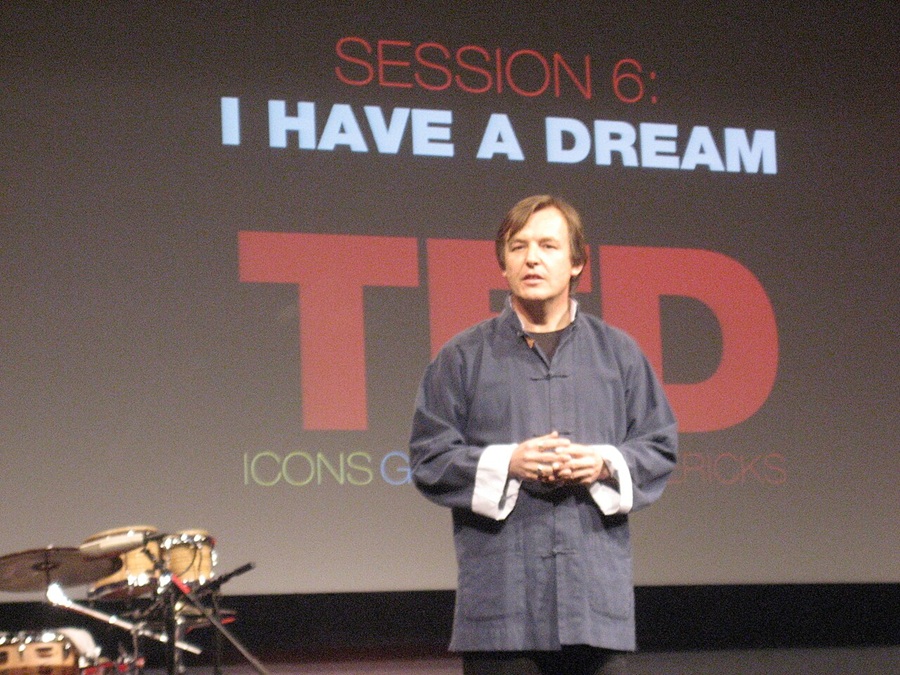
Chris Anderson speaking at TED 2007 / Photo: Pierre Omidyar – Flickr, CC BY 2.0, https://commons.wikimedia.org/w/index.php?curid=1919016


In my library, I have a habit of punishing books that put forward hypotheses without arguments or supporting evidence. When that happens, I turn them around so that their spines face the wall; all you can see is the thin strip of paper between their pages rather than the title of the treatise. That way, it is clear to me which books have tried to convince me with cold will-o’-the-wisps rather than the warm light of genuine knowledge. And this brings us to TED Talks, now ubiquitous worldwide, and the broad range of knowledge they disseminate. A TED Talk is a short talk in which a speaker presents an interesting, well-argued or inspiring idea clearly and accessibly. Its aim is to spread ideas worth spreading in less than 18 minutes. TED originated in 1984 at a private conference organised by Richard Saul Wurman and Harry Marks. The event was linked to the fields of Technology, Entertainment and Design.
Later, in 2001, TED was taken over by the Sapling Foundation and placed under Chris Anderson. As a successful media and technology entrepreneur, he drove its global expansion. In fact, he founded and ran Future Publishing and other media outlets focused on technology, culture and business. In short, Chris Anderson has established TED as a global platform with sponsors and links to a range of world leaders and figures from the technology, academic and cultural sectors (Gates, Branson, Google executives, etc.). Together, they generate millions of dollars through the organisation of TED conferences. Its sponsors, donors and global partnerships emphasise innovation in technology, education and other areas of society. Today, TED Talks are also organised by independent local teams, under an official TED licence granted by its original founders. One such event was TEDx Igualada, which in December 2023 began developing an education-focused TED Talk that took shape the following year. The aim was to contrast two opposing educational ideologies in order to improve our education system. In fact, our national education system is caught between two ideologies. The first, an innovative social-emotional approach to education, places greater importance on socialising in the classroom than on imparting knowledge; the second, a progressive, structured approach to teaching, places greater importance on students acquiring lasting knowledge. The former is defended by the vast majority of politicians, sociologists and educationalists, while the latter is argued for by teachers, neuroscientists and psychologists, along with other experts in cognitive learning.
The script for the 2024 educational improvement TED Talk argued that, ideologically speaking, the former approach had now completely prevailed, namely an innovative social-emotional approach to education, but posed the question: which was more effective? The final, argued-for position was to defend a renewed form of teaching based on the transmission of knowledge by subject-specialist teachers. This approach was entirely innovative for TED Talks since their expansion in 2001. For more than twenty years, if we look at social media and online archives, TED talks on education have tended to favour social-emotional education over the transmission of knowledge. The former includes project-based learning, learning by doing, competency-based education, banning lectures, emotional education, teaching without exams, teaching without homework, Universal Design for Learning, schools without memorisation, and many other approaches. All these techniques assume that students can learn for themselves through discovery; in other words, just as we learn to speak or walk, everything can be learnt spontaneously without teachers who have mastery of their subject or specialist knowledge of it. The teacher therefore need only accompany pupils in their discoveries, giving them as much new technology as possible so that they can learn for themselves. The 2024 TED Talk was now going to challenge this trend.
Putting forward a completely different educational vision from the talks of the previous twenty-five years would exemplify what TED champions most: innovation. The new effective approach to teaching should provide a solid body of sound, reliable knowledge to create autonomous, socially responsible and critical adults, and thus avoid producing manipulable, selfish and submissive citizens. Educational innovation should arise from variations on a tried-and-tested historical tradition, trust in experienced teachers and empirically validated science. All this was highly striking if we consult the archive of all previous educational TED Talks, in which innovation was the automatic answer to any educational deficiency and new technologies and social networks were the sources from which pupils were expected to obtain information. From 2006 onwards, a series of TED Talks by Sir Ken Robinson went viral, presenting precisely this vision of innovative social-emotional education. In February 2006 he gave the talk “Do schools kill creativity?”, which amassed more than 75 million views; in 2013 he spoke about “How to escape education’s death valley?”, which exceeded 15 million views. Another widely shared video was the animated film released online in 2010 entitled “Changing Education Paradigms”. It was viewed more than 17 million times on YouTube. In all these talks, Sir Ken Robinson told his stories with great emotional force, advocating the abolition of traditional schooling in favour of a supposedly liberating innovation to replace the old ways. One of Sir Ken Robinson’s hypotheses was that all pupils possess innate abilities and aptitudes that teachers should awaken, but that the current system of education, schools and culture blocks and buries these capacities. In short, Robinson argued that we are wasting our resources on school, and that it needs to be radically changed by any means necessary because the current education system was designed, conceived and built not for the twenty-first century but for the eighteenth century, during the Enlightenment.
Sir Ken Robinson’s way of thinking has now become dominant in our education system, and innovation is discussed without empirically analysing its consequences. It should be noted that none of Robinson’s talks contained scientific arguments, but they did possess considerable symbolic persuasive power. Many people like the idea that innovation is good, without considering that change may make things worse, or have no effect, rather than improve them. And let us remember that Robinson advocated eliminating what came before not because it had failed, but simply to make way for social networks and new technologies. It was no longer simply a matter of changing in order to improve, but of changing for the sake of change, burning our bridges and making a return to the original port impossible. We may agree that, if we innovate for innovation’s sake, what has been changed will soon have to be changed again, meaning that every innovation comes with planned obsolescence and an expiry date. Defending radical innovation means doing away with what came before, while also preventing the improvement, progress and renewal of what deserves to remain.
In light of the educational talks described above, and with the aim of improving teaching, preparations for the educational improvement TED Talk were well under way in 2024. The speaker himself was surprised that this was even possible given the background described above, but everything was under way, with the scripts ready just weeks before rehearsals. Then, on 29 April 2024, he received an email informing him that the talks had to be constructive and solution-focused, but that in his case they felt he was dwelling on what was wrong and on confrontation. The email added that higher authorities, without naming Chris Anderson’s Sapling Foundation, might penalise the local TED organisation; there had been talks at other local TED events that, because they focused on confrontation, had been removed from the TED website, and their organisers had also lost their licence to create new local TED events. In the end, for logistical reasons, that year’s organisers cut the programme, dropping his education talk, but promised to postpone it to the 2025 edition so that they could work on it more thoroughly and at a later date.
It is obvious that you did not see the educational improvement TED Talk in either 2024 or 2025, nor is one being prepared for 2026. All we can say is that education matters not only to civil society as a whole, but also to the highest echelons of international economic and technological circles—something that is neither positive nor negative, merely unsettling.
Source: educational EVIDENCE
Rights: Creative Commons