


- Books
- 20 de October de 2026
- No Comment
- 8 minutes read
The New Critical Thinking: An Empirically Informed Introduction

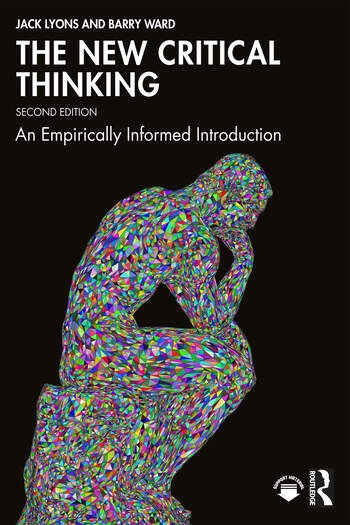
Cover: Routledge
The New Critical Thinking: What Matters in the Age of AI


Knowledge is not the opposite of critical thinking; it is one of its essential preconditions. To evaluate an argument, identify a misleading claim or recognise an error, learners need more than general reasoning skills. In fact, they need relevant knowledge of the subject, concepts with which to interpret evidence, and an understanding of how reliable knowledge is produced. Without this foundation, critical thinking risks becoming an empty exercise in questioning everything without being able to distinguish well-supported claims from plausible but false ones. Education must therefore develop both disciplinary knowledge and the capacity to question, connect and apply it.
This becomes particularly important in the age of generative AI. Large Language Models (LLMs) can produce fluent, coherent and apparently authoritative answers, but fluency does not guarantee truth, and plausibility is not evidence. And, ultimately, LLMs are just simulators—very good ones, mind you—of language (Hernández-Fernández, 2026). Without sufficient prior knowledge, users may be unable to identify hallucinations, detect hidden assumptions or recognise when an answer oversimplifies a complex problem. Knowledge provides the epistemic resources needed to challenge AI outputs rather than merely accept them.
The educational goal should not be to compete with AI in producing answers, but to develop people capable of evaluating those answers, understanding their limitations and taking responsibility for their own judgements. In this sense, the more we delegate to AI, the more important it becomes to know enough to question what it produces. Its convenience, however, raises an educational question that is more important than whether a machine can complete a task: are we really still teaching our students (and the students consequently learning) to judge the answer? When outsourcing becomes the default, the risk is not simply that AI will make mistakes, but that we will stop noticing when it does.
Jack Lyons and Barry Ward’s The New Critical Thinking: An Empirically Informed Introduction (Routledge, 2024) offers a timely framework for resisting this intellectual passivity. Rather than treating critical thinking as a narrow exercise in formal logic, the authors connect reasoning with psychological research on the shortcuts and biases that shape everyday judgement. The book moves from deductive and inductive arguments to causal inference, probability, the assessment of testimony and science, and the rhetorical and communication strategies through which beliefs are encouraged or manipulated. Its central lesson is practical: sound judgement requires evaluating not only whether a conclusion follows from its premises, but also whether those premises deserve our trust.
This approach reminds me Daniel Kahneman’s account of fast, intuitive thinking and slower, more deliberate reasoning (system 1 and system 2) in his classical Thinking, Fast and Slow (2011). Intuition is indispensable, but fluency and confidence are not guarantees of truth. AI-generated answers can intensify this problem: polished language may create an impression of authority even when claims are unsupported, sources are unreliable or causal conclusions exceed the evidence. Critical thinking therefore means checking provenance, testing assumptions, considering alternatives and distinguishing correlation from causation—not merely asking a chatbot to explain its answer.
But, more recently, Carl Hendrick’s Rethinking Fast and Slow challenges the oversimplified assumption that good thinking always requires slowing down and consciously correcting intuition. Drawing on research into creative problem-solving (Beucler & De Neys, 2026), Hendrick argues that correct intuitive responses may depend on how well knowledge is organised and interconnected in semantic memory. This has important implications for education: expertise is not simply a matter of accumulating facts or applying deliberate reasoning strategies, but also of building rich conceptual networks that allow relevant knowledge to be retrieved and connected efficiently. Deliberation remains essential when problems exceed the reach of intuition, but the educational goal should be to develop both well-founded intuitions and the capacity to scrutinise them critically. In the age of AI, this perspective reinforces the importance of substantive knowledge: without it, learners may lack the conceptual resources to evaluate plausible but incorrect outputs.
For education, the implication is not to reject AI, nor to demand laborious reasoning for every routine task. It is to preserve learners’ responsibility for the intellectual work that matters. Students should compare an AI response with credible sources, reconstruct its argument, identify missing evidence and explain why they accept or reject its conclusions. And above all, to recognize what they know and what they do not know, what they have learned and what they still need to learn. Teachers, in turn, need to assess the quality of that reasoning, not just the polish of the final product. And to set an example of honesty in what they ask of their students (and, of course, to learn what they themselves do not yet know!).
But Lyons and Ward (2024) do not offer a manual for AI literacy: their contribution is more fundamental. They provide tools for judging claims in a world where information is abundant and persuasive answers (bot answers!) are cheap. Precisely because AI can do more of the work for us, education must protect the capacity to think for ourselves. Tailored to their level, this book should be a mandatory manual for every student.
Because, after all, critical thinking is essential for moving from knowledge to wisdom, something we should all aspire to in the long run, both for ourselves and for our students. Best of all —as my mentor Antoni Elias showed me in the course I currently teach on Creativity and Critical Thinking at the UPC— there is nothing better than learning how to think, and, what’s more, it can be a lot of fun!
References:
Beucler, J., & De Neys, W. (2026). Intuitive insight: Fast associative processes drive sound creative thinking. Cognition, 271, 106422. https://doi.org/10.1016/j.cognition.2025.106422
Hendrick, C. (2026, 10 January). Rethinking Fast and Slow. The Learning Dispatch. https://carlhendrick.substack.com/p/rethinking-fast-and-slow
Hernández-Fernández, A. (2026). Large Language Models and Quantitative Linguistics: Simulation within the Scientific Framework of Language. Journal of Quantitative Linguistics, 1-32. https://doi.org/10.1080/09296174.2026.2695077
Kahneman, D. (2011). Thinking, Fast and Slow. Penguin Books.
Lyons, J., & Ward, B. (2024). The New Critical Thinking: An Empirically Informed Introduction. Routledge. Second Edition. https://www.routledge.com/The-New-Critical-Thinking-An-Empirically-Informed-Introduction/Lyons-Ward/p/book/9781032317281
Title: The New Critical Thinking: An Empirically Informed Introduction
Authors: Jack Lyons and Barry Ward
Edition: 2nd edition (2024)
Publisher: Routledge
ISBN: 9781032317281 (paperback); 9781003311027 (eBook)
Source: educational EVIDENCE
Rights: Creative Commons