


- Face to face
- 7 de October de 2026
- No Comment
- 12 minutes read
Xarli Diego: “You never stop learning”

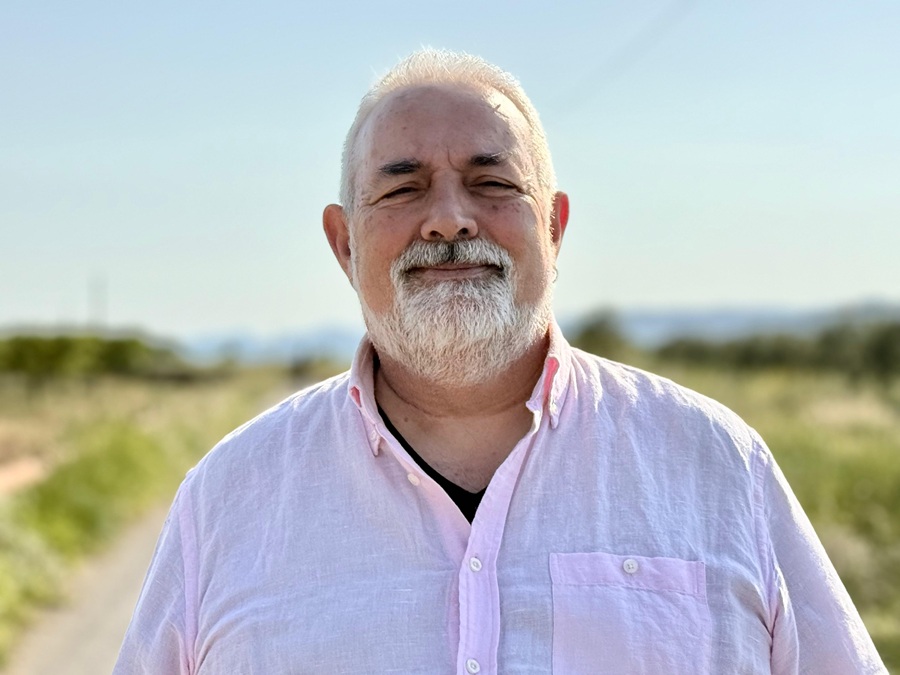
Photo of Xarli Diego courtesy of Ana Dévora
FACE TO FACE WITH
Xarli Diego, radio broadcaster, television presenter and scriptwriter


Actor Toni Albà introduced us after a chance meeting at the restaurant of the Masia del Pla in Alt Camp. It was late April 2026, and our relaxed conversation revealed a long, varied and surprising career in the world of communication.
Born in Terrassa on 23 November 1956, Xarli Diego is a communicator with extensive experience as a radio broadcaster, television presenter and scriptwriter. He began his career at stations including Ràdio Manresa, Ràdio Barcelona and Antena 3 Radio, and also contributed to the written press and music magazines during the 1980s. But this restless and free-spirited man, as his eyes reveal, was not content with radio alone. He went on to work as a television scriptwriter on the programme Ahí te quiero ver, as well as presenter of TV3’s El joc del segle and an adviser to the TV3 programme No passa res, among others.
But I must also mention his entrepreneurial work in the music industry, running record labels and developing his own projects. In short, he has been, and remains, a free spirit who never stays tied to one job for too long, while remaining fully committed to everything he takes on. For more than a decade, for example, he was head of press for the Tricicle company, alongside running his own communications consultancy, Xarli Diego Comunicació. He has also worked with prominent figures such as Rosa Maria Sardà and Joaquim Maria Puyal, experiences that have shaped his career. The author of several books since 2019, he currently hosts the podcast “Cave canem”, devoted to Ancient Rome. His career reflects a constant curiosity, independence and passion for communication. This “Face to Face…” with Xarli Diego was therefore inevitable.
Your early years in radio were full of experiences that must have left their mark on you. I imagine there is no interview in which you would want to overlook Joan Castelló of Ràdio Barcelona. Why?
My mother, who was born in Flix, used to tell me: “You have to be grateful, son”. Joan Castelló was a hugely important figure in Catalan radio. He had voice, diction and talent, and he knew how to spot talent and how to lead. He believed in me, and I have never forgotten it. I later became deputy director of programmes at Ràdio Barcelona. You cannot understand the great names of that era without him: Puyal, Cuní, Arribas Castro and so many others. But we should not lose radio’s historical memory. I would like to reclaim the figure of Joan Castelló Rovira as one of the greats of our radio, unjustly forgotten.
You have worked in many areas of communication. Do you think the effort you put into your education and training is crucial to sustaining such a diverse career? What examples of perseverance would you give from your own experience?
I have always been clear that education and training are very important. Especially at the beginning of life—in my case, at school and university… I wanted to build a cultural foundation on which to construct my castles. Then you must never forget the importance of reading books. For me, newspapers have been, and remain, a constant, daily source of learning. My university lecturer Manuel Parés i Maicas used to say the same. In my case, perseverance means adapting when necessary, and doing so with humility. Although I am passionate about music, I could not spend my whole life presenting music. That is why I have tried my hand at so many different areas of communication. I have adapted to circumstances. From music to political communication. And now, to Ancient Rome—and Xarli smiles at me.
“In my case, perseverance means adapting when necessary, and doing so with humility”
How did working with figures such as Rosa Maria Sardà and Joaquim Maria Puyal influence the way you understand communication?
First of all, they have formidable intelligence and an innate talent for what they do. They are brimming with personality. They work in different fields, but both are extremely demanding (well, Sardà is no longer with us). They are never satisfied. That demanding attitude starts with them and extends to everyone around them. Tireless workers. Sardà used to tell me that she was a very hardworking lazybones. All of this has influenced the way I understand communication and life.
What did working with Tricicle bring to your career? And what about La Trinca?
Tricicle were one of a kind. Carles Sans, Paco Mir and Joan Gràcia achieved a very special kind of success. People love them everywhere. With other people, I had to draw interviews out; with them, the job was usually deciding what needed to be done and what did not. Both they and La Trinca shared characteristics with Sardà and Puyal: talent, high standards and an enormous capacity for hard work. With Tricicle, I learned to live with the daily applause directed at my clients (and friends). With La Trinca, I gained a very practical understanding of show business—and learned how to turn my hand to all sorts of things and turn everything into gold.
You are restless, independent and enthusiastic, always looking for new challenges where you can make your own decisions. Perhaps that is why you have often combined several projects at once. What role do self-discipline and education play in all this?
Yes, I am self-disciplined, and that has been fundamental. There have been moments in communication when, all at once, I have found myself juggling subjects ranging from prisons and books to fashion and board games. “Be calm”.
Easy tiger?
Yes, I am calm, and that has helped me survive. Above all, education gave me a mental structure that has enabled me to organise my work properly and to keep reading about subjects related to my work and beyond. You never stop learning. Although I have never been one for “master’s degrees”, I have taught the occasional class—and once again he smiles at me ironically.
“Above all, education gave me a mental structure that has enabled me to organise my work properly”
Although you were not affiliated with a political party, between 1995 and 2003 you were Communications Adviser to the Generalitat de Catalunya’s Departments of Justice; Justice and the Interior; and Governance. What brought you into politics?
Politics did not bring me into politics. I am too independent to belong to a political party. My curiosity, and my openness to everything, meant that at a certain point a proposal came my way almost by chance, and after five interviews, Minister Cuenca hired me as director of communications at the Department of Governance.
I believe she was the first woman to serve as a minister. Looking back, how do you remember that experience?
Yes. As I have just said, I worked with Maria Eugènia Cuenca. She was born in Calatayud, and although I did not work with her for long, I felt very comfortable working with her. It was the early days of the Mossos d’Esquadra, the Catalan Police. She had a very strong personality.
Which other minister did you work with?
For many years I was Núria de Gispert’s communications adviser in three different departments. Núria de Gispert has a very practical understanding of politics as public service; she is capable of acknowledging mistakes and putting them right. She placed great trust in me, and I am proud of that. They were difficult areas: justice, prisons, minors… We still see each other from time to time. I like her very much!
In May 2019 you published your first book, Gràcies per la música, with Pagès Editors. Did you meet some of the great names in international music? Who? The Fifth Beatle, Billy Preston?
For many years of my life, music was at the centre of everything I did, both in radio and with two record companies. And now I always work with music playing! Ten minutes ago I was listening to Dominican singer Juan Luis Guerra, and half an hour ago to Oques Grasses. I met many great names in person, including Cyndi Lauper, Bonnie Tyler, Supertramp, Boney M, Claudio Baglioni, Romina Power and Al Bano… and I had lunch in London with Dire Straits and dinner with Phil Collins and Genesis.
“I met many great names in person, including Cyndi Lauper, Bonnie Tyler, Supertramp, Boney M, Claudio Baglioni, Romina Power and Al Bano… and I had lunch in London with Dire Straits and dinner with Phil Collins and Genesis”
And during all those years, I understand you discovered a musical gem?
Yes. I discovered eight-year-old Nikka Costa for the Spanish market. Her father was an orchestra conductor for Frank Sinatra and Paul Anka… Nikka’s song “On My Own” was a huge hit and reached number one.
And Billy Preston? The Fifth Beatle? What can you tell us about him?
Billy Preston was one of my artists at the Clash record company. A big kid and an exceptional artist. We would be walking down the street in Madrid and, all of a sudden, Paul McCartney would call him. Billy played live with both the Beatles and the Rolling Stones—an extraordinary keyboard player.
The world of music production presented you with major challenges, particularly when you faced the great technological changes of the time. How did the transition from vinyl to CD affect many small record companies? Did the SGAE, Spain’s collecting society for authors and publishers, also play a part through its different treatment of small and large companies? Why?
Back then, in the 1990s, music production had nothing to do with what it is today. Things had always gone well for me and I was willing to take on anything, so I thought I should set up a record company with a financial partner. Economically, it was the first financial failure of my life. We were living through the transition from vinyl to CD. You had to manufacture in both formats, doubling costs at every level. When SGAE dealt with small companies manufacturing vinyl and CDs, it charged us its fees in advance; it did not do so with the multinationals… And if you failed to sell what you had manufactured, you were sunk because you did not get a single euro back… At the same time, nobody helped you get onto the radio… even though my artists (who were very good) appeared on television stations across Spain. Many record sellers want records to sell themselves. And I had artists of the calibre of Billy Preston, The Rubettes (“Sugar Baby Love”) and the Italian band I Pooh. Well, there was also rumba, flamenco, Barragán… ha, ha, ha.
To finish, can you tell us about the latest project, book or research you are currently working on?
At the moment I am working on the Ancient Rome podcast “Cave canem – cuidado con el perro”. At the end of May, I will be at the Roman festival “Tàrraco Viva”. I give talks and am a member of the association “Divulgadores de la historia”. It is a rigorous podcast with touches of humour and meticulous attention to production. It is available on iVoox and many other platforms. I hope to publish my fourth book soon, on a very topical subject… and then another book about Ancient Rome with a sense of humour. I cannot do anything without making people laugh a little… That’s just me!
Long may there be people like you, great Xarli Diego, in this world full of prejudice and vested interests.
Source: educational EVIDENCE
Rights: Creative Commons