


- Cover
- 6 de November de 2026
- No Comment
- 7 minutes read
Where Are the 76?

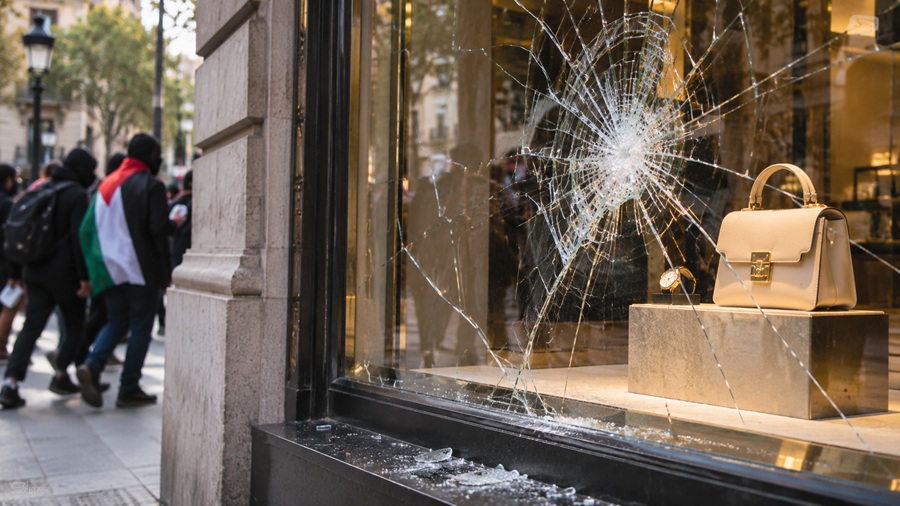
Image created using AI


Felipe J. de Vicente Algueró
During the disturbances in Barcelona on 24 October, 130 young people were arrested, 76 of them minors, including one 12-year-old—a very precocious boy indeed. Of these minors, 74 were boys and two were girls. Among the instigators or leaders of the unrest, a 17-year-old was arrested. One of the creators of Blocus, the mysterious recruitment and mobilisation channel, appears to be a 16-year-old boy, who was arrested after the events.
The affluent bourgeoisie (which includes political leaders from most parties), who regularly shop in central Barcelona, watched in terror on television as 23 shops were looted and street furniture was damaged, while 14 Mossos d’Esquadra¹ officers and one local police officer were injured.
We might ask this bourgeoisie: are you only just finding out? Do you think this is something new? Where are these 76, and many more besides? They are in Catalan secondary schools—in other words, in institutions rarely visited by those who live in well-off neighbourhoods. For many years, however, teachers have been complaining about the presence in classrooms, especially in secondary education, of this kind of pupil, once dubbed “school refusers”. These are pupils who are in class against their will and express their rejection of education through constant indiscipline. For them, the do-gooder approach to compulsory education has become “imposed education”. And impositions provoke reactions.
TALIS is, for want of a better comparison, the PISA for teachers, and it is the largest international survey of teachers and school leaders. According to the latest report (2025), one third of Spanish teachers acknowledge that classrooms are noisy and that they lose a great deal of time because of pupil interruptions. Forty per cent of Spanish teachers report suffering stress because of classroom indiscipline. Looking at the figures by autonomous community, Catalonia is above the average: 55 per cent report stress.
As for assaults on secondary-school teachers, 80 per cent have suffered some form of abuse from pupils and 10 per cent have been physically assaulted, according to trade-union sources. Recently, attacks via social media have soared. One in five teachers experiences several forms of violence at the same time.
Andreas Schleicher, the OECD’s Director for Education and Skills (the OECD produces the TALIS report), has gone so far as to acknowledge that “indiscipline is a problem in Spain”. Mr Abelardo de la Rosa is the Secretary of State for Education and, commenting on the TALIS results, has declared: “There is no widespread discipline problem” (I suppose he would also say there is no widespread problem with railway safety). According to this senior official, “diversity is the new normal, which enriches us and must be addressed decisively” (El Mundo, 10 October 2026). It seems that, for Mr de la Rosa, indiscipline is merely diversity and, what is more, it enriches us.
Mr Schleicher believes the solution lies in placing the most experienced teachers in the most conflict-ridden schools. The Secretary of State’s proposal is even more brilliant: teachers must be offered more training. He has not specified what this training should involve. Perhaps he means martial arts. Elsewhere, solutions take a different direction: Denmark’s social-democratic government wants to make it lawful for teachers to restrain pupils physically or remove them from the classroom if they seriously disrupt lessons. I wonder what advice the gentlemen mentioned above would give shopkeepers in the areas vandalised by the Blocus boys: put the most experienced shop assistants in those locations? Give sales staff more training?
The week after the major disturbance, the police mounted a major operation to prevent a recurrence. We saw shops boarded up to protect them from the new vandals. The objective is clear: let us save Barcelona’s fashionable shops and make sure these people do not come back here. But these teenagers still exist. They may not disturb the peace of the respectable people who shop in central Barcelona for quite some time. They remain in the classrooms of many secondary schools, continuing to disrupt lessons and sometimes assaulting hard-pressed teachers, who cannot board up their classrooms to keep them out and have no protection when they need it. They have disappeared from the field of vision of the well-to-do, simply because they no longer see them in action on Passeig de Gràcia.
Yoda, the wisest Jedi master—wiser than Mr Schleicher and Mr de la Rosa—in Star Wars says that fear is the path to the Dark Side. Indeed, the fear that violent teenagers might disturb our downtown has pushed the grave problem of classroom indiscipline out of sight of most of society. Those at the OECD and the Ministry of Education must think ‘let the teachers put up with it, that’s what they are paid for’. Some people are simply that insensitive. But let us not fool ourselves: compulsory comprehensive education, as practised in Spain, is a pipe dream that has become a nightmare for those who want to study but cannot because someone constantly disrupts the lesson, and a source of torment for those who feel forced to remain in education against their will.
Daniel Pennac is a French secondary-school teacher, well known for his books and novels. His best-known work is School Blues, translated into Spanish. This quotation comes from that book: “An undisciplined pupil is an unhappy child. Chaos does not set them free; it causes them anguish”2. We should take the problem seriously rather than consign it to the Dark Side.
___
¹ The Catalan regional police force.
2 Translation from the Spanish edition. The wording has not been verified against the published English translation.
Source: educational EVIDENCE
Rights: Creative Commons