


- History
- 2 de October de 2026
- No Comment
- 9 minutes read
30 years of LOGSE, or Don Avito Carrascal’s experiment

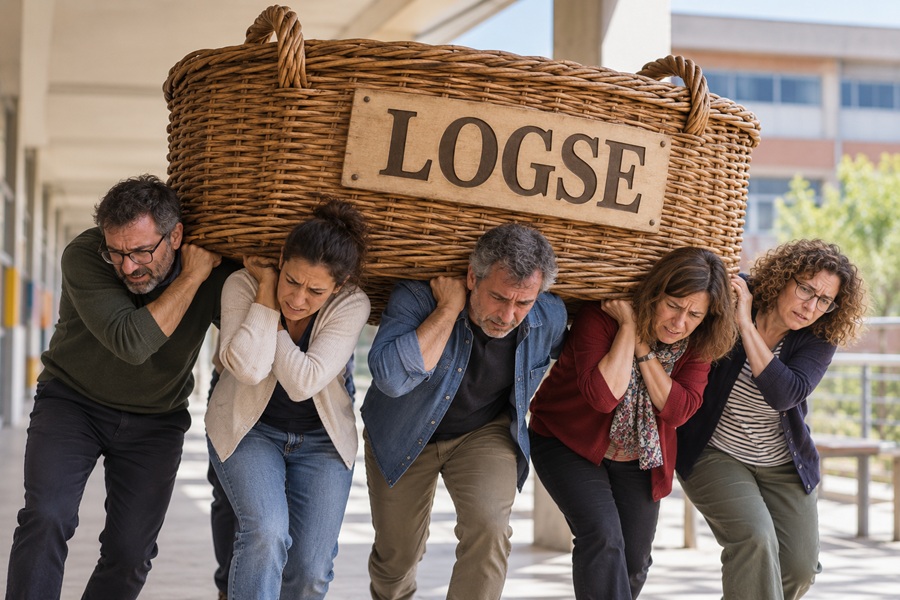
Image created using AI



Felipe J. de Vicente Algueró
The Organic Law on the General Organisation of the Education System (LOGSE) was published in the BOE (Official State Gazette) on 4 October 1990. Its implementation was phased, however, and was not fully rolled out until the 1996–97 school year. That year, the old EGB (Basic General Education) and BUP (Unified Polyvalent Baccalaureate) were phased out. Pupils who that year would have been in the 7th year of EGB all moved into the first year of ESO (Compulsory Secondary Education). Everyone born in 1986 or later has followed the LOGSE curriculum. Thirty years have now passed since then.
A few years earlier, in 1902, Miguel de Unamuno published a short novel entitled Love and Pedagogy. It tells of the attempt by Don Avito Carrascal, a rationalist intellectual, to father a child and educate him according to the principles of modern pedagogy. His aim is to turn poor Apolodoro, his guinea pig of a son, into a genius.
A reader familiar with the state of education in Spain cannot help but recognise Unamuno as one of the critics of what would eventually become a new Avito: the LOGSE. The aim was the same: to turn the Spanish education system into an experimental laboratory for producing millions of new “competency geniuses”: children and adolescents endowed with great powers of critical analysis of reality, imbued with feminist, anti-sexist, solidarity-minded, environmentalist and civic-minded values, free of gender prejudice, and naturist, internationalist, anti-racist and inclusive in outlook—and whatever else Don Avito calls sociological pedagogy. But will they even know who Unamuno was?
Don Avito entrusts the education of his son Apolodoro to a certain Fulgencio Entrambosmares, who, according to the author, professes a holy hatred, an odium philosophicum, of common sense. Does this incompatibility between the LOGSE and common sense ring any bells? In this analogy, Don Avito is the LOGSE (or its authors), while Don Fulgencio represents the sanctimonious pedagogues who, over the years, have been the main transmission belt for imposing LOGSE-ism in classrooms, including the two major trade unions, UGT and CCOO, which greeted LOGSE with jubilation.
Even so, Don Fulgencio realises how difficult Don Avito’s experiment is and, in a moment of lucidity, refers to Don Avito’s ideas, ideotas, ideitas, idezuelas, pseudo-ideas and ideodes—all manner of fanciful variations on the word “idea”—but, despite everything, he continues to take charge of Apolodoro’s education. Shall we take a look at the ideas, ideotas, ideitas, idezuelas, pseudo-ideas and ideodes that LOGSE and the laws that followed it have brought us?
We begin with the two great foundational ideas behind the so-called Reform: comprehensive schooling and constructivism. Comprehensive schooling is schooling without distinctions: all pupils, regardless of their abilities or interests, are in the same classroom, following the same curriculum up to the age of 16. The consequences of comprehensive schooling include automatic promotion, assessment by cycles rather than by school years, a two-year Bachillerato (upper secondary education), and no numerical grades…
Constructivism has its roots in Piaget, who used the term itself in some of his later writings. César Coll, who was part of the Ministry of Education team working on LOGSE, summarised the concept of constructivism in these terms: the constructivist conception of learning and teaching holds that learning consists fundamentally in constructing meanings and making sense of what is learned, and in getting pupils to engage in this process of constructing meanings and making sense on the basis of their personal experience and the knowledge, feelings and attitudes with which they approach school content and activities. Would Don Avito say anything different today?
From these foundational ideas came a cascade of ideotas that all teaching staff had to take on board (even if they did not fully understand them):
Meaningful learning.
Curriculum design: first, second and third levels of curriculum specification.
Curriculum project.
Classroom planning.
And all this was followed by suffocating bureaucracy. And a whole host of careerists who made hay while the sun shone by preaching the new pedagogy in courses, workshops, documents and well-paid jobs in the many cosy little outfits that the education authorities created in LOGSE’s shadow. All to turn Apolodoro – in other words, Spanish pupils – into the intended recipients of their pedagogical revolution.
Just as we were beginning to get to grips with this cascade of new concepts, now compulsory currency in staff meetings, assessments and meetings of all kinds, the OECD appeared on the scene in 2002 and launched the so-called DESECO project (Definition and Selection of Competencies). In other words, all this verbiage laboriously absorbed in the early LOGSE years is already vintage. Now the time has come for the so-called competencies. This pedagogical approach can be summarised as follows:
- Act autonomously
- Use tools actively
- Interact in heterogeneous groups
This requires mobilising:
- Knowledge
- Practical and cognitive skills
- Psychosocial resources such as attitudes, motivation and values.
The competency-based curriculum has arrived. After the effort to specify the curriculum (third level of specification) in concepts, procedures and attitudes, now reduced to antiquated relics, along come the OECD’s caviar pedagogues to dismantle the whole edifice and bring us competency-based teaching. This whole business of competencies is about getting pupils to perform the simplest tasks without even having to understand what they are doing. That is the one that counts. The real deal. And yet another opportunity for pedagogical charlatans to flood staff meetings with more talks, conferences, short courses and verbal massage, all to recycle the latest jargon.
Apolodoro is bewildered, overwhelmed and distressed. Because the process is not over. There is more to come. Another wave of ideotas arrives in the form of Escuela Nueva 21 and other heavily subsidised contraptions: learning situations, projects, Universal Design for Learning, didactic sequences, inclusivity… The whole business of learning situations is the surreal culmination of the process that began 30 years ago. Here are some examples of learning situations taken from the website of the Catalan Department of Education:
Biology and Geology: Do You Smoke?
Social Sciences: Are we on the threshold of a change of era? How might we organise ourselves in the near future?
Physical Education: I’m starting at a new rugby club
Visual Arts and Audiovisual Education: What do we want to say on 25 November?
Spanish Language and Literature. Cono flow. An approach to poetry through rap
Catalan Language and Literature. Write your Christmas song
Foreign Language (English): A Christmas Carol Exhibition
Mathematics: Pascal and Fermat’s correspondence and the problem of points (1654)
Music: Sound self-portrait
Enough to drive anyone mad. That is what happens to Apolodoro. Fed up with all this pedagogy, the poor boy decides to take his own life because, on top of everything else, he has suffered a disappointment in love. But before doing so, he writes a letter to his former girlfriend and gives her this advice, should she have a son: make men, men of flesh and blood; make them with your life partner, with love, with love, with love, not with pedagogy. There is no need to call in a host of experts to understand the PISA failure.
Final note: if any reader wants to learn more about the recent history of Spanish education – in other words, the process that drove Apolodoro to madness – they can read the book: De la ley al aula. Crónica de la educación en España 1977-2022. In any case, I will understand if many prefer not to know. At the very least, read Unamuno’s novel.
Source: educational EVIDENCE
Rights: Creative Commons