


- Humanities
- 28 de September de 2026
- No Comment
- 14 minutes read
Carmen Fontaneda: “Anti-pedagogism is an uncomfortable subject”

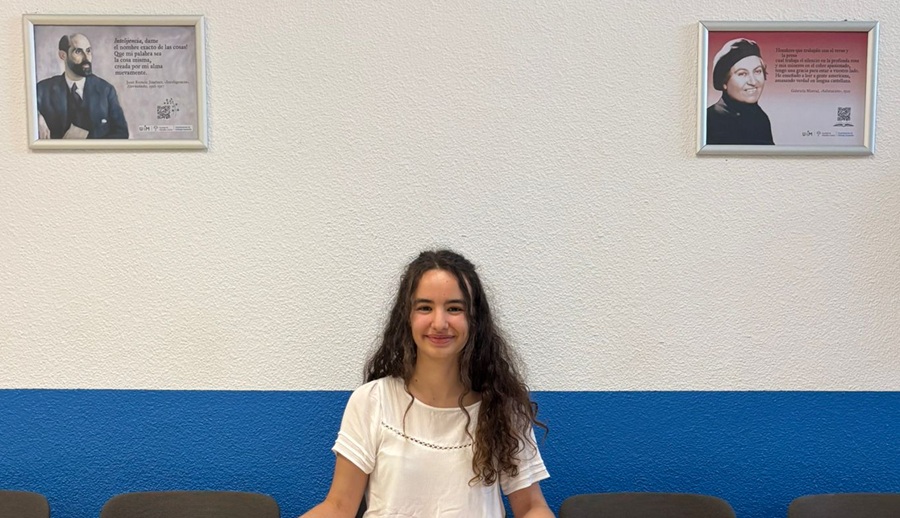
Carmen Fontaneda is writing her doctoral thesis at the Autonomous University of Madrid under the supervision of Dr Bianca Thoilliez. / Image: Giovanni Pelegi



We are looking for somewhere quiet within the faculty. It is not easy, because it is early June and the university entrance examinations are taking place, now with dystopian mobile-phone signal jammers, but also because the labyrinthine building is a maze of occupied rooms and corridors. Eventually, on a kind of mezzanine, we find some deserted benches. Talking about anti-pedagogism in none other than the Faculty of Education, we have the uneasy feeling that at some point someone is going to come over and tell us off.
Carmen Fontaneda (Madrid, 2000) holds a degree in Early Childhood Education and a Master’s in Educational Quality and Improvement (UAM), as well as a Master’s in Memory and Critique of Education (UNED and UAH). She was awarded a specialist training grant by the Ministry of Education at the National Institute of Educational Technologies and Teacher Training (INTEF). She is currently writing her doctoral thesis, also at the Autonomous University of Madrid and under the supervision of Dr Bianca Thoilliez, initially with an FPI contract from the Community of Madrid and now with an FPU fellowship from the Ministry of Science, Innovation and Universities.
Perhaps the first question I should ask you is what your thesis is about.
My doctoral thesis focuses on the Spanish anti-pedagogist movement, and more specifically on teachers’ discourse and on how teachers theorise about education. I start from the idea that, traditionally, within educational research, teachers’ voices are taken into account from an external perspective. In other words, the educational researcher goes into the classroom and asks a teacher about, for example, the concept of innovation. What is not taken into account, however, is how teachers themselves create or apply pedagogical knowledge within educational theory. Teaching practice articulates a form of pedagogical knowledge that is increasingly emerging as an educational theory in its own right. Publications from Ediciones AKAL, as well as books being written by teachers such as Alberto Royo, Pascual Gil, Olga García and Enrique Galindo, offer a critical view of the current educational reality and often theorise against the hegemonic view of education found in universities.
Is that hegemonic view what you mean by pedagogism?
Yes. Pedagogism has taken shape through policies, discourses and practices along two main lines. On the one hand, through criticism of the school as a traditional, outdated institution. That mantra of “spare the rod and spoil the child” as a criticism of the supposedly violent and authoritarian system that preceded the present one —I do not want to deny the violence that was inflicted. On the other hand, from a neoliberal perspective, by portraying the school as out of date because it supposedly fails in its function: preparing people for the labour market or for the demands of the twenty-first century.
The school is being emptied of knowledge as elementary as learning to read and write
What are the consequences of this view?
The school has lost sight of its purpose as a school; in other words, its basic, academically oriented educational aims are being rejected because the institution is taking on other functions, particularly to make up for shortcomings that other institutions are failing to address. The school has been overloaded with broad, and sometimes highly ambiguous, objectives, to the point where we have lost sight of its most basic purpose. The school is being emptied of knowledge as elementary as learning to read and write.
I take it that your thesis is a defence of the idea of teaching that is being abandoned.
Yes. Ultimately, my thesis seeks to defend the school, and that means defending knowledge and culture for people who can only find those things at school.
So, ultimately, does pedagogism generate social inequality?
A certain degree of anti-intellectualism is being promoted. There is also a devaluing of the humanities and of forms of knowledge that are not considered useful in the labour market. This increases sociocultural segregation because if certain forms of learning or certain content are not available in the state school, affluent families will pay for private tuition or send their children to elite schools so that they can access them. The child of a working-class family, however, will not be able to do so.
Pedagogism is primarily a neoliberal movement because it seeks to promote an ineffective education system
In that connection, you said that pedagogism is neoliberal, didn’t you?
Yes. Pedagogism is primarily a neoliberal movement because it seeks to promote an ineffective education system. The teacher is no longer the person who teaches, but a technician who has to apply certain methodologies. The bureaucracy that has emerged is a way of publicly justifying everything that is done, regardless of whether it is actually being done. Once the pupil is placed at the centre, we get this individualistic view of constructing one’s own learning. The teacher then comes to resemble a coach. These are mantras of the business world. Take the competency-based approach, for example: it is centred on real life, even though many important forms of learning cannot always be applied to real life, but that does not make them any less valuable.
What is “real life”?
Exactly—what is it? In our society, it means whatever is useful, whatever can make money overnight. Education becomes an instrument for training future workers, and that training implicitly involves not only skills but also a neoliberal mindset. Added to this is the drastic lowering of standards. If we lower the level in the classroom through a false egalitarianism or thematic distractions, we are devaluing things that are valuable to education, such as boredom, effort and memory.
What should we do to give the school back its “engine”? Revalue tradition? Give teachers a voice?
I think what we are seeing in education is a reflection of what is happening in society. The problem, precisely, lies in saying that the school must adapt to society. I think education should be an island. It should not adapt to society; it should be the place where schooling takes place. I am not saying that non-formal education has no value, but we need to recover the school’s educational aims. Obviously, there has never been an ideal school; schools have always had their challenges and problems. But I think it is worth rethinking education from the standpoint of the school itself. And for that, teachers’ voices seem essential to me, because someone who defends the school from this perspective is often labelled a reactionary, when teachers are frequently already applying effective and varied approaches to learning. Even so, I think it is dangerous to frame the problem as a choice between two opposing poles: traditional or innovative. Not everything innovative is good simply because it is new, nor is everything traditional bad simply because it is traditional.
I think it is dangerous to frame the problem as a choice between two opposing poles: traditional or innovative
Could we say that pedagogism is based on a negative prejudice against teachers and their work?
Absolutely. What motivated me to choose this subject for my thesis was the discontent among teachers that I saw in schools, and the accusations they face for everything that goes wrong in society. There are these narratives that “teachers don’t know what they’re doing” or “teachers need training”, coming from organisations that never set foot in a classroom: ministries, regional education departments, faculties of education, companies, people who are not in schools. Policies are put forward to persecute teachers, to justify everything they do through excessive bureaucracy, even what they think and how they reflect on their practice, while at the same time they are being deprived of the time they need to prepare their lessons. Pedagogical reflection is necessary, and I believe teachers do engage in it; the problem arises when it is used as an instrument of control.
I would like you to talk about the question of evidence in education, and the controversy over what counts as educational evidence, because pedagogism always justifies itself through its supposed evidence.
It has a great deal to do with who gets to speak about education and who writes educational laws, because we must never lose sight of the context in which educational evidence does or does not make sense. The fact that a methodology works in one context does not mean it will work for all groups, year levels, subjects, schools or teachers. Pedagogism seeks to spread and generalise methodologies. Context-specific findings are turned into universal truths. Academic freedom is denied: if you are not using gamification, you are not a good teacher. If you are not using PBL, you are not a good teacher, regardless of the year group, the class, the subject, the school, and so on. On the other hand, the evidence that is selected is highly selective. For example, people still talk about multiple intelligences even though it has been shown that they do not exist. The problem with culture of suspicion is that nothing has any foundation any more.
And then we get neuromyths.
And practices that are simply absurd as well. It is not just the emphasis on what is useful, but also the obsession with wellbeing and positive psychology, this sort of Mr Wonderful mindset. What matters is that the pupil feels good and does not become frustrated, but this produces individualistic subjects, little narcissists. Pupils are shielded from situations that might cause them frustration, and valuable learning experiences are avoided. What matters is no longer the common good of the classroom, but the selfish individual. Then there is the idea that pupils have to learn by discovery… We all look for shortcuts to make things as easy as possible. The psychology of wellbeing encourages us to avoid valuable processes such as sitting down for the first time to read a text where you may not understand a single word. But maintaining concentration and working out the meaning of the words will later enable you to tackle more complex texts. These are the processes we avoid so as not to frustrate the pupil. AI does nothing more than make processes easier, and that is not what schooling is about.
The psychology of wellbeing encourages us to avoid valuable processes such as sitting down for the first time to read a text where you may not understand a single word
What is the relationship between pedagogism and digitalisation?
Digitalisation is sold as an innovation and rolled out across all schools. What we were saying earlier about evidence applies here too: it has been shown that screen use has negative effects on children and adolescents, but that does not matter because it is new and, because it is new, it is considered good. Never mind the issue of pupils’ data being handed over to private companies such as Google. The school is helping to produce that consumer subject who rejects the idea of education as an island apart from society. Perhaps it is not desirable for the school to resemble society. Pedagogism is deeply neoliberal; at heart, its driving force is an individualistic economic mindset that is constantly thinking about innovation.
How does pedagogy define innovation?
It is an empty signifier, like “educational quality”, but one that always carries a positive meaning. It can be understood as a methodology or as a disruptive practice. It is so absurd that, nowadays, introducing a textbook or giving a traditional lecture could count as an educational innovation because it would be something new after having eliminated it. Even so, it is more closely associated with active methodologies, digitalisation and the idea of the teacher as a guide.
What has struck you most about the way teachers who work in the classroom talk about pedagogism?
Many criticise the hegemonic pedagogist discourse by defending the pupil who does not have to be extroverted or participatory. In other words, all these active methodologies marginalise the shy, quiet pupil, the one who generally wants to learn—another consequence of this anti-intellectual society. I was a shy and introverted pupil myself, and I never liked being made to take part in group-therapy sessions or having personal things discussed about me in front of everyone, because what I liked was going to class and learning. This is the profile that is now being mistreated by the system. And I think it is very important to emphasise this because pupils from lower sociocultural backgrounds are blamed for problems with behaviour at school when that does not necessarily have to be the case. Many cases of bullying involve pupils from higher socioeconomic classes who have never been set behavioural limits or even given basic academic boundaries. Problems with behaviour at school have multiplied because of this “pupil as the centre” or “pupil as customer” approach. We lose sight of the common good (if one person talks all the time, the others will not be able to learn). Responsibility for pupils’ actions is being taken away from them because teachers are made responsible for everything. Sitting still and maintaining concentration alongside your class is also a necessary part of learning.
Problems with school behaviour have multiplied because of this “pupil as the centre” or “pupil as customer” approach
What is the atmosphere in faculties of education when it comes to pedagogism and anti-pedagogism?
When I say that I am doing my thesis on the anti-pedagogist movement, people reply, “Ah, you’re doing it to criticise it”. It is a decidedly unwelcome subject within faculties. But at the doctoral conferences I presented an analysis of books dealing with pedagogism, and there were many secondary-school teachers doing their doctorates there; many of them told me that they were experiencing the teacher discontent I had been highlighting. Research is carried out, for example, into how the cell is taught in the fourth year of compulsory secondary education using one methodology or another, or using resources such as the microscope. Or ethnographic studies of how a school has improved behaviour and the school climate. I think all of this is valuable, because researching ways of improving education is always positive, without forgetting the very nature of the educational phenomenon. But some of these studies may run the risk of reproducing pedagogist mantras. And anti-pedagogism is an uncomfortable subject.
Source: educational EVIDENCE
Rights: Creative Commons