


- Cover
- 9 de October de 2026
- No Comment
- 12 minutes read
Minsky, Papert and technology education

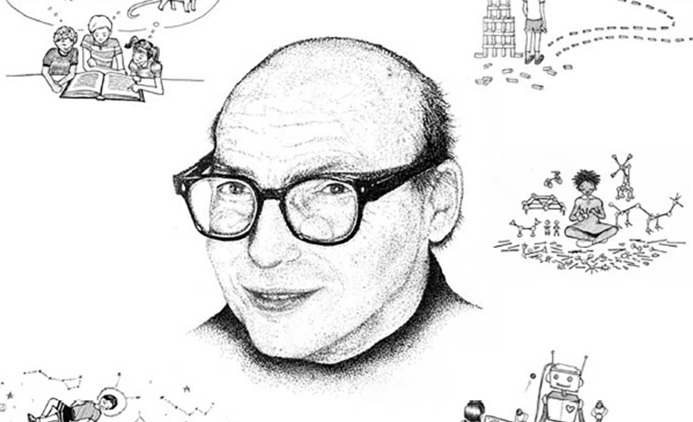
Detail from the cover of Inventive Minds


Marvin Minsky is remembered as one of the founders of artificial intelligence (AI). His name is associated with algorithmics, robotics, neural networks and his celebrated Society of Mind. However, Inventive Minds: Marvin Minsky on Education is a collection of essays on technology education that speak not only to the moment in which they were conceived, but also to problems that did not yet exist when they were written. The six essays brought together in this book, accompanied by a superb introductory essay by Mike Travers, along with other comments from Minsky’s close collaborators, reveal a Minsky far removed from the stereotype of the technician obsessed with machines. In fact, machines are merely a pretext for, in a Leonardian approach, trying to understand the human mind better.It is difficult to read these pages without hearing, between the lines, another voice inseparable from Minsky’s: that of Seymour Papert. The two shared decades of research at MIT and developed a revolutionary conception of educational computing which would eventually crystallise in projects such as Logo and in the theories of constructionism (Papert, 1980; Papert & Harel, 1991). Minsky praised the Logo language as if it were a new construction game. For him, programming was not about learning commands or syntax, but about discovering that a few basic pieces can be combined to create new universes.
Thus, with only a few elements, it is possible to build structures of almost unlimited complexity, just as ideas emerge from the interaction of simple processes organised into increasingly sophisticated architectures (Minsky, 2019). Papert carried this intuition into education through Logo, turning programming into an “intellectual construction game” in which children do not learn computing as a set of instructions, but as a new language for building models, exploring hypotheses and reflecting on their own thinking (Papert, 1980). Generative AI introduces an unexpected paradox today: while Tinkertoys, or Logo, forced students to build cognitive structures for themselves, large language models can provide the finished structure directly. The contemporary educational challenge is therefore to preserve the formative value of effort and to know how to value the tempo in the introduction of every technology. AI should become a new cognitive Tinkertoy—a tool for experimenting, modelling and understanding how we think—rather than a substitute for the intellectual effort that enables these capacities to develop.
For Papert and Minsky, intelligence is not a mysterious gift but a computational architecture. Thinking is building. In learning, mental pieces are incorporated and reorganised until new semantic and cognitive structures emerge. What matters is not so much what those pieces are made of as the relationships they establish with one another. Decades before some connectionist models, and before the cognitive sciences popularised concepts such as scaffolding, distributed representation and computational cognition, Minsky was already proposing that understanding meant connecting and reorganising internal mechanisms rather than simply accumulating information.
Papert took this intuition a step further. If the mind learns by building models, then education must provide constant opportunities to do so. The computer is not an electronic teacher but a laboratory for thinking itself. Programming is simply its language of instruction.
It is striking to see how thoroughly this idea has been forgotten. Computing and technology are marginalised in the curriculum, while their curricula are degraded into training passive users rather than creators. For decades, the introduction of computing into schools has shifted away from the great epistemological and axiological questions raised by programming towards much more modest goals, such as learning to use applications, mastering interfaces or becoming familiar with particular tools at user level. Little by little, the computer ceased to be an artefact for learning to think in the classroom and metamorphosed into a substitute for thinking, an object for entertainment and, at worst, an attention-capturing device with which to manipulate an entire new generation of passive consumer citizens, docile before screens that are no longer monochrome green.
We are now living through an even more profound transformation. Generative AI automates not merely mechanical tasks, but a large part of the intellectual processes that have been commonplace in education for decades. Writing, summarising, translating, solving problems, programming and designing are all activities that can be delegated to a machine. Paradoxically, the more sophisticated these possibilities become, the greater the risk of forgetting the question Minsky regarded as fundamental for every teacher when setting an activity: what is happening inside the student’s mind?
At this point, Inventive Minds takes on an unexpected contemporary relevance. While much of the educational debate revolves around whether we should allow or prohibit the use of AI, Minsky shifts the discussion entirely. The problem was never technology. The problem has always been what kind of mental activity that technology promotes, what is done with it, what it costs and what is given up by using it.
When he argued that children should learn “good ways of thinking about thinking”, he was not simply advocating the teaching of computing. He was advocating the teaching of metacognition through computing. The computer was valuable because it forced mental processes to be made explicit: breaking problems down, creating procedures, detecting errors, revising hypotheses, representing models and understanding how different cognitive strategies interact. This would apply to every subject. That is technological literacy.
Where once we had to think through and design an algorithm, now it is enough to write an instruction. Where once we had to break down a problem, now it is enough to request an answer. Where once the student had to develop internal representations, now almost the entire process can be externalised. Every technology changes the distribution of cognitive effort. But in order to learn, the student must still make the effort. And therein probably lies the greatest educational challenge: establishing the boundary of effort: how far should I require a student to think, and when does it cease to make sense not to use the machine? The expertise of the specialist teacher is essential to finding that complex balance between learning and technology in each subject.
Cognitive offloading is one of the most interesting, and at the same time most treacherous, phenomena in contemporary education. Externalising certain mental operations can dramatically increase our efficiency. No one is suggesting that we return to memorising logarithmic tables. However, when this externalisation reaches precisely the processes through which mental models are constructed, a different risk emerges: that we cease to develop the cognitive structures we intended to strengthen.
Minsky recognised this problem immediately. In his essays, he repeatedly insists that learning means acquiring new ways of representing the same phenomenon, changing strategy when we fail, understanding the aims that organise the discipline we are approaching through technology, and developing mechanisms for self-reflection on our own thinking. In short, learning entails work. No AI can replace this process because it is, precisely, what learning is.
This reflection connects directly with a question that is little explored in the current educational debate: time. The contemporary obsession with productivity, with speeding up every educational task, assumes that learning consists in producing results ever more quickly. Yet learning has its own temporality. And differentiated education, precisely, is grounded in the recognition that every student has their own pace. Understanding a mathematical proof, writing an essay, painting a picture or constructing a scientific model requires periods of uncertainty, micro-decisions, errors, reformulations and waiting, which are not flaws in the process, but the process itself. They are what makes us human. The machine, by contrast, has the time that humans often lack because of their biological limitations.
One of the fundamental deontological principles for incorporating AI into education is to preserve that tempo. AI reduces the time required for searching, documentation, execution and editing. But it should not eliminate the intervals during which the student reflects, hesitates and reorganises their ideas. It should never replace that process. Minsky criticises an education centred on avoiding errors, with the machine cast as an infallible problem-solver. This is not a defence of improvisation, but a vindication of the intellectual value of failure. Errors are not merely obstacles to be eliminated: they are mechanisms through which students discover new ways of thinking.
Indeed, Alan Kay, in his commentary, returns to a conception of Papert that encapsulates this philosophy: hard fun. Deep learning is rarely immediate. It is satisfying precisely because it is difficult, because it forces us to reorganise the way we think. Perhaps this is the book’s principal lesson for education in the age of AI: reaffirming the value of effort does not mean renouncing technology.
Papert and Minsky show us that computing means teaching other ways of thinking. We now run the risk of believing that teaching AI simply means teaching people to use agents or chatbots. Genuine AI literacy should not consist solely in learning to formulate good prompts. It should help us understand how these systems represent knowledge, what limitations and biases they have, how they generate inferences, what ethical conflicts they raise, why they produce plausible errors, what their apparent reasoning mechanisms are and, above all, how they resemble our cognitive processes (and how they differ from them). And, of course, whether it is worth using AI given the enormous environmental and social impact it entails on a global scale.
Inventive Minds is much more important than a collection of Minsky’s essays. It takes us back to the origins of cybernetics and reminds us that educational computing was never intended merely to teach technology, but to use technology to understand the human mind and its social impact better. Perhaps the greatest irony is that AI has reached a level of sophistication that Minsky could scarcely have imagined. Nevertheless, it is urgent to recover what he and Papert defended from the outset: the true aim of technology education was never to make people think like machines. It was to enable people to learn to think for themselves more effectively.
References:
Hernández-Fernández, A. (2026). IA en la enseñanza técnica: el riesgo de la descarga cognitiva y el «tempo» como deontología. Educational Evidence. https://educationalevidence.com/ia-en-la-ensenanza-tecnica-el-riesgo-de-la-descarga-cognitiva-y-el-tempo-como-deontologia/
Minsky, M. (1986). The Society of Mind. Simon & Schuster.
Minsky, M. (2019). Inventive Minds: Marvin Minsky on Education. MIT Press. Open-access book: https://direct.mit.edu/books/oa-edited-volume/4519/Inventive-MindsMarvin-Minsky-on-Education
Papert, S. (1980). Mindstorms: Children, Computers, and Powerful Ideas. Basic Books.
Papert, S., & Harel, I. (1991). Constructionism. Ablex Publishing.
Source: educational EVIDENCE
Rights: Creative Commons