


- Cover
- 30 de October de 2026
- No Comment
- 9 minutes read
Thirty Years of the LOGSE1. Meetingitis: A pedagogical epidemic
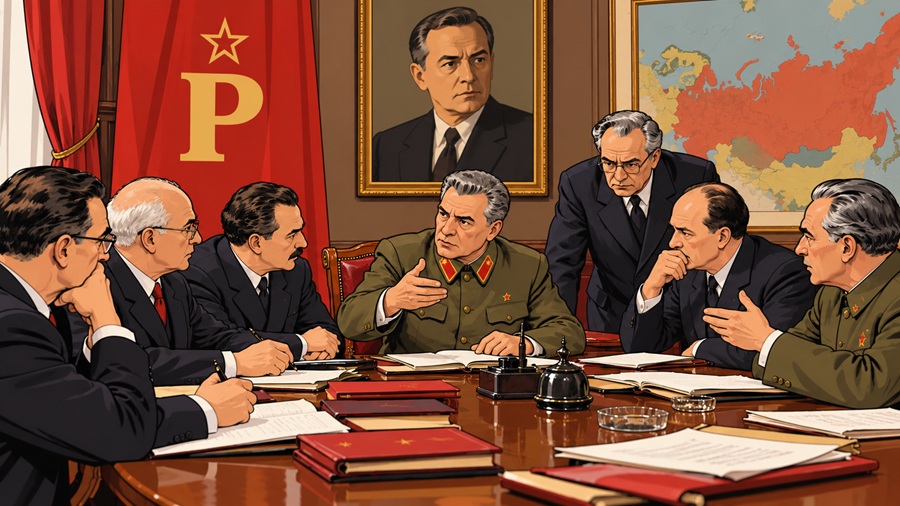
Image created using AI


Felipe J. de Vicente Algueró
The LOGSE brought us not only a torrent of concepts, theories and practices grouped under the name of pedagogism. It did not simply replace the noble profession of teaching with ‘meaningful learning’, nor did it replace the classroom with a flexible, dynamic environment centred on the student, or the teacher’s authority with a role in supporting and guiding learning. And much more besides. The LOGSE brought something else: an excessive obsession with meetingitis, with holding meetings for any reason, multiplying gatherings, many of them useless and ineffective.
Meetingitis has become a true epidemic for which there is no vaccine. Among epidemiologists specialising in pedagogical diseases, there are various theories about the origin of the epidemic, taking into account the clinical histories of the authors of the law and their enthusiastic followers. Some researchers trace its origins back to the soviets, the workers’ assemblies of the Russian Revolution, but in this case the spread came to an end when the revolutionaries came to power and there was only one meeting: that of the Communist Party’s Politburo, which took the place of all the others. But the period when everything revolved around soviets—that is, meetings—remains the point of reference for the most fervent revolutionary.
Other specialists consider that most of the authors and defenders of the LOGSE were students during and after May ’68 and took part in the continual, soporific faculty assemblies. The virus contracted at the time was not eradicated but mutated into the form of a pedagogical meeting. Such meetings are a revival of those assemblies, generally broken up by the ‘grises’ [the grey-uniformed police], at which the Internationale and ‘No serem moguts’ were sung.
Some pedagogical epidemiologists locate the source in the Yugoslav model of self-management. A very large part of the progressive left at the time admired the Yugoslav model as an alternative to rigid Soviet planning and liberal capitalism (which today would be neoliberal). In Yugoslavia at the time, businesses belonged to the workers. They decided everything; that was self-management. And a paradise of meetings. At least three: the workers’ assembly, the management board and the workers’ council, as well as the various specialised committees. And when did they work? In their free time.
All Yugoslav workers, whatever their educational background, took part in decision-making, some of it involving considerable technical complexity. Everything was discussed there, from the price of a meal in the canteen to whether to buy a crane. Workers without financial training had to vote on complex investments. And that was how things turned out. Productivity collapsed and Yugoslavia ended up with one of the world’s most inefficient economies, its inhabitants struggling to get out of the cabin: a single country gave rise to the seven that exist today.
In the model introduced by the LOGSE, there are various types of meetings. At a standard level, these include assessment meetings, group meetings, year-group meetings, department meetings and area meetings. And then there is the queen of meetings: the full staff meeting. During the worst years of the meetingitis epidemic, the full staff meeting was sovereign. Almost as sovereign as the English Parliament, which, as it is not subject to a written constitution, can do anything, even proclaim a republic. Sometimes there was little point in turning to the law. The full staff meeting stands above it.
Nothing was more reminiscent of the longed-for faculty assemblies than those full staff meetings, especially in the early years of the LOGSE’s implementation. Having lived through (or suffered) the assemblies of the past and the full staff meetings of that period, I am not surprised. In my long teaching career I have seen everything, including a full staff meeting deciding that the perimeter of the school was a ‘nuclear-free zone’. And, of course, endorsements of manifestos, declarations, strikes… that had nothing to do with teaching. Ah! And very democratic, too: if the full staff meeting decided to strike, everyone was obliged to join in, even if they had voted against it.
Today, the pendulum has swung to the other extreme and, in quite a few cases, the full staff meeting serves as cover for authoritarian decisions by school leadership teams, which rely on the votes of those who are afraid of losing their post, their privilege or suffering some form of reprisal. Thus, under the umbrella of ‘the full staff meeting has decided’, arbitrary rules of conduct are imposed, schemes of work are distorted, timetables are put into effect… contrary to the written regulations.
A separate chapter could be devoted to meetings with parents, of which there are various types. On the one hand, there are general meetings held by the leadership with all parents and, on the other, smaller meetings between teachers and the parents of a particular class. In principle, these are information meetings, but they all end with ‘what about my child?’, that is, ‘this is what is happening to my child’, and turn into a consultation service or a barricade against the complaints and laments of parents, who are always right when it comes to their children.
At a second level are the premium meetings, sometimes even with a light snack. These include meetings of area directors, meetings between directors and inspectors or with the heads of territorial services. Sometimes there is even a major figure in the education administration. But these latter meetings are not at all assemblies. You go to listen and obey what the pedagogical-administrative politburo has decided. The racket is left to the long-suffering teachers. That is where you can see that classes and hierarchies still exist. A subspecies consists of the school admissions committees, perhaps the most tedious of all.
Then there are the really top-notch meetings: those of the School Council (soviet in Russian) at school level. In addition, for the real enthusiasts there are municipal and regional school councils. And, of course, the State School Council; but at least, for attending this one, you are paid expenses covering a €15 meal and, if you come from outside Madrid, a night in a three-star hotel and economy-class travel.
As a headteacher and secretary, I have taken part in many school councils. Meetings could hardly be more varied and fascinating. People who are thoroughly honest and wonderful, but have no idea about education, making decisions about the school’s plans, curricula and budget and even whether a particular teacher teaches their classes well. And there you have the cleaner (who was usually among the most sensible), or a 13-year-old youngster, or a devoted father, none of whom knows—and none of whom needs to know—what a diagnostic, formative or formativising assessment is, or what a learning situation or the exit competence profile is. In the end, these meetings turn into a long speech by the headteacher while the other attendees look at their watches.
Some of these meetings can be useful, but not all of them, and only if they do not go on for too long—that is, if they get to the point. But this is exceptional. Gandalf (The Lord of the Rings) says: ‘All we have to decide is what to do with the time that is given us’. And time is limited, and filling it with useless meetings does not improve education. Perhaps the economist John Kenneth Galbraith was right when he said that meetings are indispensable when you do not want to do anything. Many of these meetings are linked to the oppressive bureaucratic tangle to which schools are subjected. Minutes, reports to be filled in, files… all of which require a meeting beforehand because the administration has decided so.
Economists have coined the term opportunity cost to calculate what you give up by making one decision rather than another. The opportunity cost for Yugoslav businesses of opting for continual assemblies at the expense of productive work could be calculated accurately (and there are scientific studies that have examined this in specific businesses). What is the opportunity cost of devoting so many hours to meetings, many of them long and ineffective, instead of each teacher devoting more time to their work as a teacher? Ask PISA2.
1 Spain’s Organic Law on the General Organisation of the Education System
2 PISA (Programme for International Student Assessment) is an international study conducted by the OECD that assesses the knowledge and skills of 15-year-old students in reading, mathematics and science, with a view to evaluating how well education systems prepare young people for life.
Source: educational EVIDENCE
Rights: Creative Commons