


- Opinion
- 15 de September de 2026
- No Comment
- 7 minutes read
Looking the Other Way

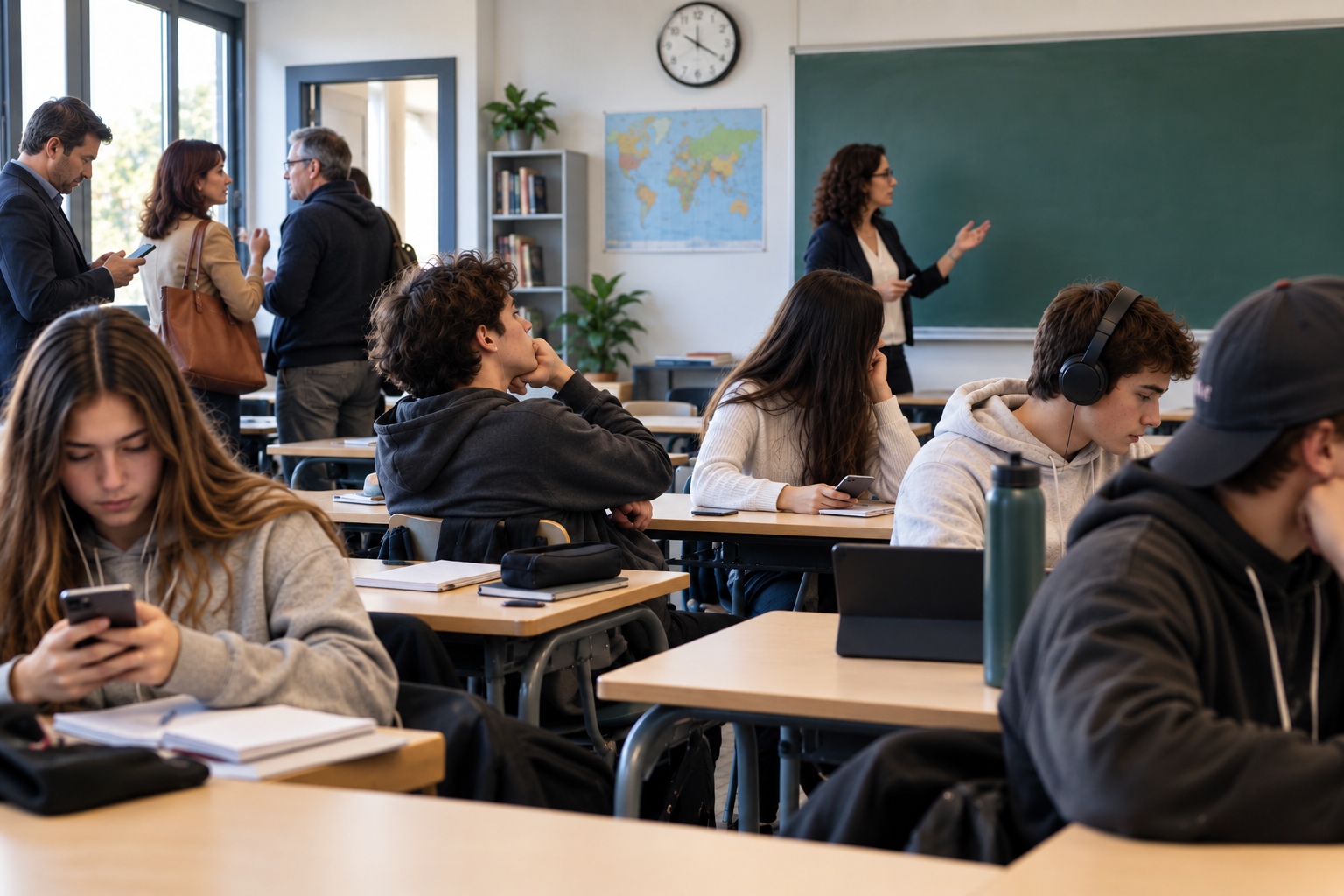
AI-generated image
THE GREAT SCAM. Opinion column by David Cerdá


On 30 May, El País published a letter by Patricia Vega Magdaleno, a secondary-school teacher, under the same title as this article. It is only a few lines long, but, importantly, it is free of the pedagogical jargon that muddies any conversation about education before it has even begun. A teacher describes what she sees: the system is deteriorating, many pupils have stopped wanting to learn, some families are at odds with teachers, and young people are being awarded qualifications despite serious gaps in their knowledge. She accuses society of tolerating it. But this is not simply the outpouring of a tired teacher; to dismiss it as such would be another way of looking the other way.
Vega speaks of “deterioration” and says it is “unstoppable”. Yes to the former, no to the latter. PISA 2022[1] found that 27% of Spanish fifteen-year-olds were below the basic level of proficiency in mathematics and 24% were below that threshold in reading; and things have continued to go downhill for four years. Since 2012, the proportion of students below the basic level has increased by six percentage points in reading. Spain is close to the OECD average, which is a rather peculiar consolation when the average is also getting worse. There is an administrative way of putting this, one that talks about the resilience of the system and the learning recovery. There is another, more direct way of putting it, and it is the one we need: one in four Spanish teenagers with a school-leaving qualification has a reading-comprehension level below that of the average student who finished primary school thirty years ago.
Vega also says that there is “an appalling proportion of pupils who do not want to learn”. If the phrase stings, it is because it introduces something that educational debate usually handles with asbestos gloves: the pupil’s willingness to learn. For years, we have developed a theory of schooling in which almost every failure demands that an adult be blamed. Teachers are expected to motivate pupils who arrive determined to be bored and to turn every lesson into a captivating experience. That is a childish view of education, because learning requires accepting that for quite some time you would rather be doing something else. The desire to learn can, of course, be cultivated. It can also be destroyed when every effort is negotiated and every difficulty is interpreted as a defect in the system. The school really began to sink when it started to regard the very idea of obligation as offensive.
The letter also turns to the family and speaks of “parents hostile to teachers’ work”. School authority now finds itself in a very strange position. Teachers are expected to set boundaries while every boundary is scrutinised as a potential slight. Some families arrive at school as if it were a service they had paid for; they do not behave as educational agents—morally, that is what they are—but as customers. If the boy fails, the product has failed. If he receives a sanction, the family launches its own investigation into the teacher. The teenager quickly works out what the game is—that there is always someone or some authority he can turn to in order to challenge the consequences of his own actions—and plays it to his advantage.
“They are awarding qualifications to functionally illiterate pupils,” Vega adds. In organisations, we know perfectly well that we are progressively separating certification from actual mastery. What happens when “inclusion” is measured by the certificate issued rather than by what has been learnt? The ones we end up cheating most are the most vulnerable. We have invented an impeccable way of making progress on paper while knowledge itself stands still. To believe that this is not one of the important reasons—I stress, just one—behind our levels of productivity and wages is to kid ourselves.
There is a social cruelty hidden in this mechanism. A pupil from a well-educated family has private resources for seeing through the fiction. Their parents know when a mark of eight out of ten is worth little. They can demand more even when the school considers the pupil’s performance satisfactory. The student who depends entirely on the school receives the certificate and believes it, because, outside the school gates, an unscrupulous politician is waiting to tell them, over and over again, what they are entitled to. Some time later they discover that the labour market has less forgiving ways of assessing them. There, a lack of competence eventually becomes apparent. The removal of academic demands is always presented as a measure in favour of the weak and ends up benefiting the strong above all, because the strong can buy outside the system what the system has decided it no longer needs to demand of them. This is precisely the systemic failure that has been worsening for years, making family cultural capital an increasingly decisive lifeline. But do not worry, reader: there will be an awakening only when those who peddle progress are no longer in power.
It is tempting to blame an education law and wait four years for another government to draft the next one. LOMLOE has been a step backwards; but no legislation on its own will fix this mess. Schools have incentives to reduce conflict, and many families are grateful for a school year that passes without incident. The pupil gains a small immediate benefit—entirely in keeping with their immaturity—and the debt keeps mounting. That explains the persistence of the problem far better than any pedagogical conspiracy. We have learned to live with the deterioration because acknowledging it would force us to reconsider our model of citizenship. Nothing less. The truth is that, if we wake up, almost nothing is unstoppable. But we will have to set aside our cowardice, look ourselves in the mirror, and then get down to fixing it.
___
[1]This article reached the Educational Evidence editorial office before 8 September, the date on which the new PISA 2025 report was published.
Source: educational EVIDENCE
Rights: Creative Commons