


- Cover
- 16 de September de 2026
- No Comment
- 10 minutes read
So, what is an education system? Dani Olmo explains
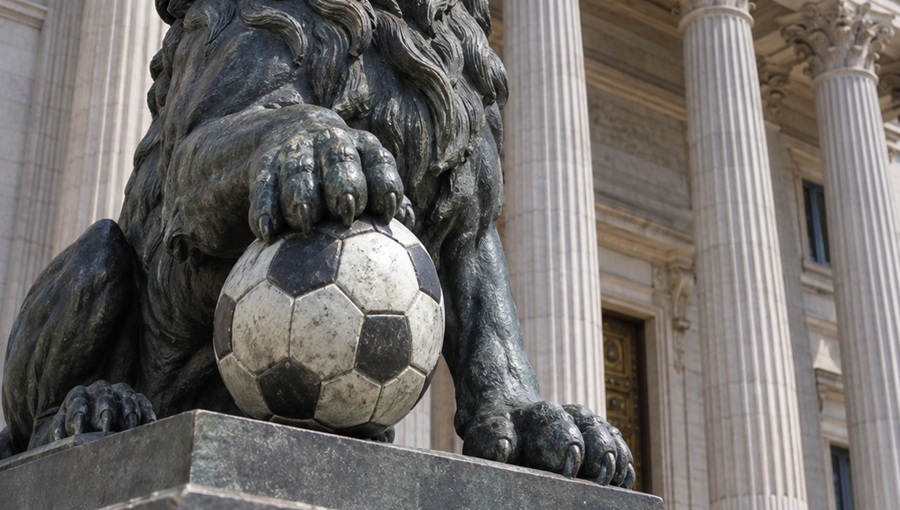
Image created using AI


Santiago García Tirado
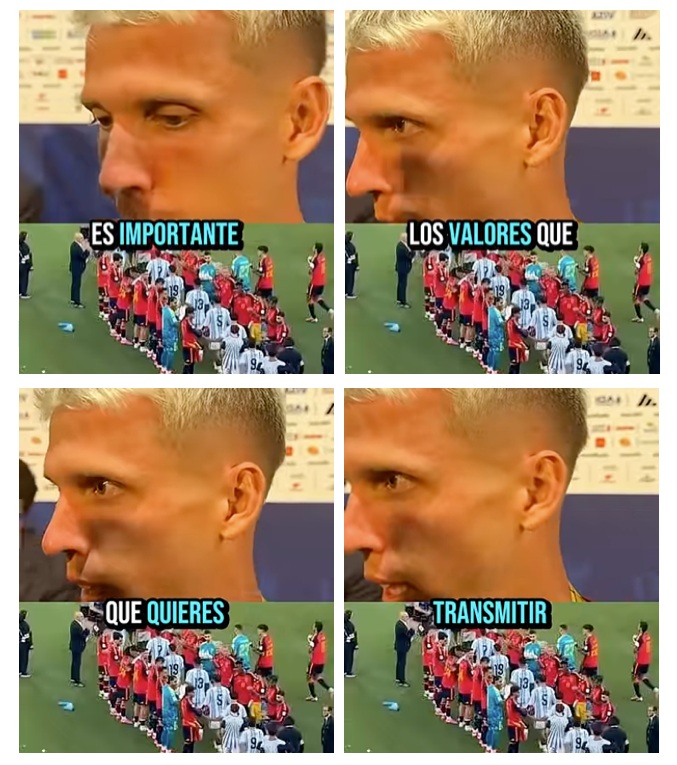
2026 World Cup. Final. Dani Olmo speaks to the media after the match and talks about education. A journalist has put him on the spot by asking him to comment on Argentina’s snub: during the trophy presentation to Spain, the Argentine team stood with their backs turned, apparently as a gesture of contempt. He says: “In the end, I think the values you want to convey are also important. We are an example to many generations, to many boys and girls”. Someone who commands admiration and also represents a country takes on part of the responsibility for educating others. Whether he wants it or not, his behaviour makes him a role model, and he accepts that responsibility.
Yes, Dani Olmo is a footballer.
Let us now consider what an education system is, how responsibilities are distributed among its different actors, who administers and oversees it, and what principles underpin it. As a democratic state, Spain—and any country, any democracy—needs to understand that educating its citizens is the only guarantee that democracy can continue to evolve: that it remains alive and continues to serve its citizens. The alternative—leaving education at the mercy of circumstances, corporate interests, directives from external organisations such as the OECD, successive educational fashions and the good vibes of educationalists—is almost like asking an entire society to play Russian roulette. Which is precisely what we have been doing here, under every government since 1978.
Of course, a short opinion piece like this cannot possibly provide all the answers to a highly complex problem such as education, but we can focus on one basic point: the idea of a system. A system is a complex mechanism in which other, simpler mechanisms perform their functions, while remaining subordinate to the needs of the larger mechanism, which must produce the intended outcome. Seen as a system serving the citizenry of a state—and not just any state, but a democratic one—education requires a range of people and institutions to take responsibility for it. Only a narrow-minded person could believe that education is the sole responsibility of schools. A society needs to educate those who will one day take on the task of sustaining it—as Hannah Arendt argues and Durkheim argued before her—and it will show its maturity to the extent that it draws on everyone and every institution available to educate them. This immense, painstaking undertaking ensures that every new citizen who joins a society, whether by birth or by coming into society, receives the education needed to become a full citizen: free, informed, critical, autonomous, socially responsible and respectful. And capable, too, of sustaining that model of society into the future.
This is precisely where the controversy arises, and it appears to be a point increasingly challenged nowadays by people who are ill-informed and by others who know exactly what they are doing and are far more calculating. It can be seen in the tendency to demand that schools relinquish functions that have traditionally been their responsibility without, in return, entrusting them to any other institution. I am referring to the kind of sweeping claim expressed as: “I have the right to say that my child must not be taught about…” It is an area where ground has been quietly conceded, sometimes through an appeal to supposed harmony and respect for minorities, and more often because teachers are afraid of getting drawn into conflicts in which, almost invariably, the state leaves them in the lurch when confronted by a mob of loudmouths. Removing certain subjects from the classroom means preventing, for example, a girl who has arrived from Pakistan from learning what her rights are and understanding her status as a free and independent person in her new host society; preventing a boy brought up on the streets of Colombia or the Dominican Republic from understanding that there are alternatives to a life governed by the law of the strongest; preventing a child brought up in a home where the various forms of pseudoscience are blindly believed from understanding that human beings have inherited a body of scientific knowledge accumulated by our species over thousands of years. Restricting or limiting the school’s remit is neither intelligent nor beneficial. In the service of a democratic society, all the knowledge accumulated across the different subjects taught in the classroom—all of it, without exception—must be made available to every pupil.
Yet the idea of a system goes much further. Schooling—the entire period of compulsory education plus subsequent education and training—is limited to a few hours a day, while there are other contexts in which this work needs to be continued by other actors. And that is where the current system falls short in distributing these responsibilities. There are other actors with the power to educate, and so far they have made poor use of their potential. I am talking about local councils, which, in these times of growing social complexity, need to start bringing the resources at their disposal into the wider education system. They need to do so urgently, moreover, to keep their streets peaceful and maintain the quality of life in their neighbourhoods. Only local councils, through youth workers, community educators and other professionals, can provide opportunities for development to pupils who cannot afford extracurricular activities; nor can these children simply be left to fend for themselves, spending whole afternoons playing video games or wandering endlessly through parks and vacant lots, where they can become prey to gangs, sects and a succession of predators looking to exploit the young. The playgrounds of primary and secondary schools, lying empty in the afternoons, are a telling sign of how little these spaces are being used at a time when we know that younger citizens need more attention and care.
There is still a third actor—alongside the school and the local council—that receives little attention in discussions of education but is crucial to the wellbeing of a society. I mean the public media system—public media, let us stress— which is another pillar of the education system in the broader sense. Radio, television and websites provide content consumed across society, not only by young people. Publicly owned media—those that belong to society and are accountable to it—are responsible for providing a balanced diet of subjects that includes, of course, entertainment, but no less importantly, culture, politics, science, ideas and, ultimately, progress.
It is a good thing that Dani Olmo, who is widely admired and has a voice that reaches a large part of the population, is the one saying that educating is the responsibility of every individual who becomes part of a society. It is wonderful to hear this from someone who, at first sight, does not seem to bear any responsibility for educating others. And yet there he is, along with other players—sporting heroes, successful and admired figures—who know that when they succeed, they become role models in their society and, for that very reason, are aware that they must take care over their behaviour on the pitch. They are not elected, but in their own way they are also representatives of the citizenry. Some display a sense of ethics considerably stronger than that of the average elected representative.
Seen in these terms, responsibility is shared, but the demands placed on each actor do not diminish. Quite the opposite. That is precisely why it is now imperative to recognise and respect the role of those entrusted with this social responsibility. To say, “Enough with all these school holidays; parents have to work”, is to reduce school to little more than the task of supervising children and teachers to little more than childcare workers, with the added expectation—if it is not asking too much—that they teach children what parents at home cannot be bothered to teach them. And little else. It is a way of degrading the education system, reducing it to something rudimentary and debased.
One day in Parliament, someone realised—without ever putting it into words—that what the elected representatives of the people do and say there also contributes to educating a country. A Conservative MP was leaving Parliament to pursue a political career in his home region. An MP from the opposite end of the ideological—and even aesthetic—spectrum then rose to speak. He had already been the subject of gossip among MPs throughout the parliamentary term. He was a Podemos MP. He took the opportunity to say a few kind words to the Conservative MP. He ended with this unexpected remark: “I think we are going to miss you. You are a good person.” The PP MP was Alfonso Candón. The Podemos MP was Alberto Rodríguez.
It was a practical lesson in decency. There should be many more, with the lesson repeated again and again, as teachers do, until pupils learn.
Source: educational EVIDENCE
Rights: Creative Commons