


- Opinion
- 12 de June de 2026
- No Comment
- 7 minutes read
Trade unionism or political posturing?

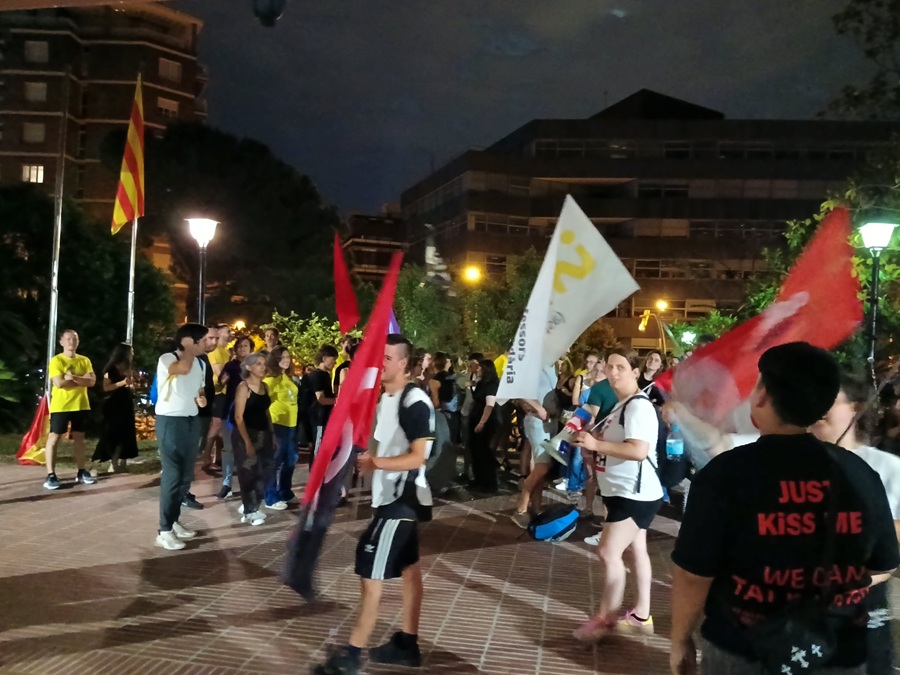
Teachers gathered at night in front of the headquarters of the Department of Education in Barcelona. / Photo: Sindicat Professors de Secundària
(On the statements made by Ms Lidón Gasull, President of AFFAC)



Lidón Gasull, President of AFFAC (Associacions Federades de Famílies d’Alumnes de Catalunya), the umbrella organisation representing parents’ associations in Catalonia, recently made a number of statements in which she expressed her opposition to the salary agreement reached between the secondary teachers’ union Professors de Secundària (ASPEPC-SPS)—which she refers to as “the secondary teachers’ union”—and the Catalan Department of Education. According to Gasull, the union is concerned only with pay and with the interests of secondary education.
She goes on to declare her support for the current inclusion model, the extension of the school year and the staffing decree—that is, the system allowing school leadership teams to hand-pick the teachers appointed to “their” schools—and argues that, as a representative of families, she should be present during negotiations concerning teachers’ salaries. The way she frames the issue suggests that she would even claim a right of veto. In her view, the salary increase agreed between the Generalitat and the “secondary teachers’ union” is irresponsible because it places an excessive burden on the public purse. She also complains that “this” union was not even required, in exchange, to accept the inclusion model and, we must assume, the staffing decree, the competency-based model, and so forth. Finally, she expresses sympathy for USTEC and the other two unions that rejected the agreement, as well as for their stated intention to continue the protests, because, she says, their opposition is not about money.
From all this we may infer that, as a matter of opinion, Ms Gasull does not believe that a trade union should concern itself with the pay and working conditions of the sector it represents. She makes this point in relation to ASPEPC-SPS, but one may reasonably assume that she would say the same of any other union in similar circumstances, whether representing primary teachers, the Mossos d’Esquadra (Catalan police), firefighters or construction workers. By contrast, she appears to approve of those unions which, according to her, are not motivated by money: those that have rejected the agreement.
That said, Gasull has not specified whether these unions rejected the pay rise because they considered it excessive or because they considered it insufficient. Nevertheless, her assertion that the continuation of their struggle is not about money would seem to suggest that they regard the increase as too generous. Yet it is so unusual for a trade union of any kind to reject a pay rise on the grounds that it is excessive that perhaps she ought first to have put the question directly to those concerned, although we do not know whether she has done so. Or perhaps, given her support for the inclusion model introduced by previous governments and for the staffing decree—which, incidentally, appears increasingly vulnerable—she believes that the continuation of the strikes is intended to preserve both. That, incidentally, is something the unions themselves should clarify.
Above all, such clarification would help avoid misunderstandings. Because if what Gasull says is true, and if she genuinely supports the unions that have rejected the agreement and decided to continue strikes and protests, then it would seem that they share her views, which are presumably also those of AFFAC. This is an issue that ought to be clarified. After all, beyond simply knowing that they have rejected the agreement, many of us would like to know precisely what these unions are proposing.
So much for Ms Gasull’s opinions and the conclusions that may be drawn from them. There is, however, a further problem. The information upon which these opinions appear to be based rests on extremely shaky ground. To put it plainly, there is a serious risk of slipping up and falling flat on one’s face, because the claims in question are demonstrably false.
Let us consider the facts. From the earliest stages of the recent strike movement, the only union that consistently sought to introduce issues beyond pay into the joint platform was precisely ASPEPC-SPS. It placed particular emphasis on the need to move away from the competency-based pedagogical model and replace it with properly structured curricula; to reinforce the role and content of academic subjects; to restore the status of teachers as subject specialists; to repeal the staffing decree; and to reconsider once and for all the disastrous inclusion model. Moreover, these positions are supported by a long record of successful legal challenges—many of them relating to curriculum matters. These range from court-imposed limits on the arbitrariness of the staffing decree and hand-picked appointments, to more recent rulings requiring the Department to introduce two mathematics pathways in the fourth year of ESO, eliminate cross-curricular areas in both the Bachillerato (upper-secondary education) and the fourth year of ESO, and guarantee the compulsory availability of a second foreign language in the Bachillerato, among other “details”. All of this, incidentally, achieved single-handedly.
It is also worth noting that, when the Department asked the other unions at the sectoral negotiating table whether they supported the curriculum reforms proposed by ASPEPC-SPS and whether these constituted a joint proposal, they responded with silence. Furthermore, ASPEPC-SPS representatives have repeatedly made it clear that the campaign for curriculum reform continues and that success will require the building of a broader social coalition extending beyond the trade union sphere alone. Put differently, society must come to recognise that the current Catalan education model is fundamentally deceptive.
Is this what Lidón Gasull dislikes? Is this what the unions opposing the agreement dislike? Do they regard the salary increase as mere “crumbs” and therefore want more, or do they consider it excessive, like AFFAC, and reject it for that reason? What educational model lies behind all this? These questions ought to be answered. Otherwise, one might conclude that what is taking place amounts to little more than posturing and political gamesmanship.
Source: educational EVIDENCE
Rights: Creative Commons