


- Uncategorized
- 17 de June de 2026
- No Comment
- 12 minutes read
Carles Lalueza-Fox: “Perhaps we shall see the emergence of transhumanism?”

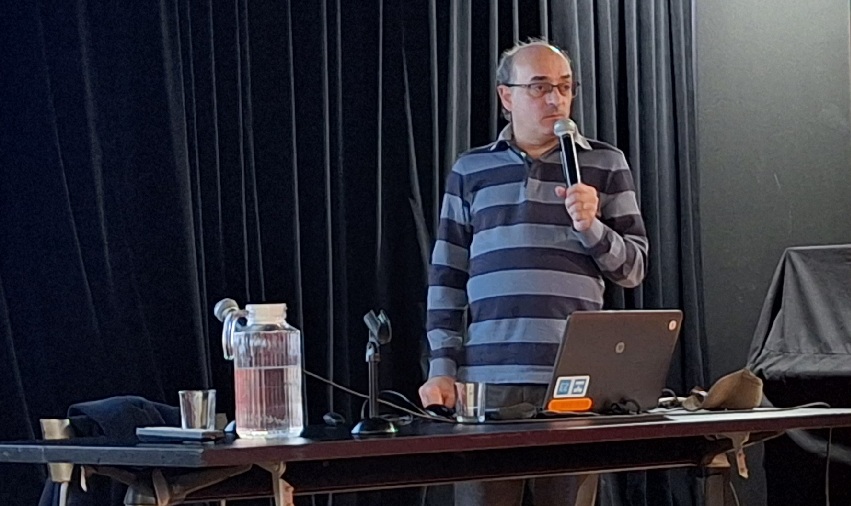
Carles Lalueza/ Photo: courtesy of the author
FACE TO FACE WITH
Carles Lalueza-Fox, one of the world’s leading specialists in palaeogenetics


I had already read some of his work before we met for this interview. It was on Monday 23 February 2026 that I finally had the opportunity to hear him speak at a lecture at the Sagrada Família Library, attended by a packed audience of well over a hundred people. His ability to convey the complexity of evolutionary genetics with both clarity and enthusiasm confirmed the scientific and public standing he had already earned through his books and articles.
Carles Lalueza-Fox (Barcelona, 1965) is one of the most internationally renowned researchers in the fields of evolutionary biology and palaeogenetics, the discipline that studies ancient DNA in order to understand human evolution and the relationship between past and present populations. His research has been instrumental in opening up new perspectives on Neanderthals, the genetic history of our species, and that of other extinct human relatives. From an early age he displayed a deep interest in the natural world, fossils and evolution, a curiosity that led him to assemble his own collection of palaeontological specimens and to develop a remarkably early awareness of humanity’s deep past. Over time, this early fascination developed into a serious scientific vocation.
In 1983 he began his university studies at a time when family influences and his intellectual environment played an important role in steering him towards the natural sciences and research. He obtained a doctorate in Biology and soon specialised in evolutionary genetics, a field that was still in its infancy as far as the study of ancient DNA was concerned. A decisive stage in his career was his time at the University of Oxford, where he broadened his training and came into contact with leading groups in genetics and human evolution. This experience consolidated his commitment to palaeogenetics and marked the beginning of a scientific career with a strong international dimension. As a researcher at the Spanish National Research Council (CSIC), he has developed some of the most influential research strands on ancient genomes.
His work has attracted considerable media attention, particularly studies relating to the Neanderthal genome, hybridisation with modern humans and the genetic interpretation of some of the most iconic fossil remains. He is currently affiliated with the Barcelona Museum of Natural Sciences, where he combines research and leadership responsibilities while actively promoting scientific communication and dialogue between science, history and society. In addition to his research activity, Lalueza-Fox has written several popular science books in which he reflects on human evolution, genetics, identity and the ethical implications of scientific knowledge. His published work has helped bring complex questions in evolutionary biology to a wider audience through a language that is both rigorous and accessible.
Looking back, how do you assess the sustained effort that has enabled you to achieve your current international standing in the field of evolutionary biology?
Well, establishing a line of research that was entirely new at the time, and building a palaeogenomics laboratory in a country like ours, where everything tends to be improvised, can be exhausting. When I started out, I honestly never imagined that there would be a technological revolution that would turn the field of ancient DNA into the major scientific phenomenon it has become today. The young people working in the field now have no idea of the technical difficulties we faced at the end of the last century, nor of how little was known at the time. Nowadays all research is carried out on an industrial scale, whereas three decades ago it was entirely artisanal. Last year, the number of recovered ancient human genomes surpassed 13,000 including, as you know, several extinct relatives such as Neanderthals and Denisovans. Although the field has advanced in extraordinary ways, I sometimes feel that we have lost a little of the sense of adventure, of venturing into the unknown, that characterised those early years.
“Nowadays all research is carried out on an industrial scale, whereas three decades ago it was entirely artisanal”
Where did your early interest in collecting fossils come from, and what did your collection mean to you?
My father was a born collector—albeit a rather chaotic one. I think I inherited that inclination from him, although I directed it towards very specific things, such as Roman imperial denarii and fossils. I was particularly interested in those fossils—trilobites have always been a favourite of mine—that displayed body plans which no longer exist. This fascination naturally evolved into a broader interest in understanding the evolutionary process.
What role did your family and upbringing play in shaping your scientific vocation?
My father was very fond of history and owned a great many books—although I rarely saw him reading, since people worked far longer hours in those days than they do now. I particularly remember a book published by Life magazine entitled Evolution. The chapter on natural selection was called, if I remember correctly, “The Theory That Shook the World”, a title that, interestingly enough, would probably still work today. I was the youngest of four children, and I suppose that also makes you mature more quickly, because you inherit everything your older siblings have already discovered before you. I was also naturally curious about how things worked, a curiosity that I think the younger generation has largely lost because they have access to too much information and obtain it far too easily.
When you began university in 1983, was your choice influenced by relatives or siblings, or was it entirely your own decision?
I did not really know what I wanted to study; that is something that still happens to young people when they finish upper secondary education. I began studying Biology somewhat unsure of my own choice, partly because my middle brother was studying it as well. At first I did not enjoy it very much, but I persevered until I came across courses on evolution, which fascinated me. Once you understand evolution, you see the natural world differently. Everything takes on a new meaning.
“Once you understand evolution, you see the natural world differently. Everything takes on a new meaning”
When and how did your interest in the relationship between human history, fossils and genetics first emerge?
I have always been interested in the past. I do not know why; I find it even more fascinating than the future. During my final year at university, news began to circulate about PCR, a technique that made it possible to recover small fragments of DNA with relative ease and which might be applicable to ancient remains. I threw myself into it wholeheartedly. In fact, I completed Spain’s first doctoral thesis on ancient DNA in 1995.
What led you to Oxford, and what did you learn there that proved decisive for your scientific career?
In fact, I went first to Cambridge, in 1997. One of the pioneers of ancient DNA research, Erika Hagelberg, was working there. The Generalitat awarded me a two-year postdoctoral fellowship. After a year, I heard that a new palaeogenetics laboratory was being established in Oxford, so I moved there in 1998. I believe it is essential for any researcher to become familiar with other laboratories and other ways of working. And, of course, you also meet fascinating people. My time at Oxford, which culminated in a publication in Nature, strengthened my determination to pursue a scientific career.
Of all your research in genetics, which do you think has had the greatest media impact, and why?
I still find that I am best known for my work on Neanderthal genetics, which culminated in my participation in the Neanderthal Genome Project. But since then I have published extensively on more recent human populations, from prehistory through to the Middle Ages. More recently, I have also worked on extinct non-human species and on pathogens. Yet it is difficult to compete with the fascination—entirely understandable, on the other hand—that Neanderthals continue to exert.
“It is difficult to compete with the fascination—entirely understandable, on the other hand—that Neanderthals continue to exert”
In 2010, how many palaeogenomes had been published? And how many are there today? How do you view the extraordinary speed at which the field has developed?
In 2010, the first three palaeogenomes were published: the Neanderthal genome, the Denisovan genome (in the very last week of the year!) and that of a Palaeo-Eskimo who lived around 5,000 years ago. Last year, the number of ancient human genomes recovered surpassed 13,000. We have now entered an industrial phase, thanks to the revolution in sequencing technologies that began in 2008. Much of what is being published today, however, has become fairly mainstream.
Why have you moved from studying very ancient genomes to increasingly recent periods of human history?
There is a great deal of competition and very few samples available. I would say, for example, that most of the Neanderthal specimens that exist worldwide have probably already been analysed—although it is worth remembering that the majority of them do not preserve any recoverable DNA. Since I remain deeply interested in more recent history, it is not surprising that my work has gradually shifted closer to the present. What I am investigating now is fascinating: for example, the genetic impact of the major migrations that took place during the collapse of the Roman Empire. It provides a source of information that is entirely different from the historical and archaeological record.
“What I am investigating now is fascinating: the genetic impact of the major migrations that took place during the collapse of the Roman Empire”
How do you see the future of genetics in relation to major economic and political interests?
Ah, that is a subject that could fill an entire book. On the one hand, we now have technologies that allow us to modify DNA—or its expression, through modifications to RNA. These technologies can be used to treat diseases that were once devastating, and I think most people would agree that this is entirely legitimate. But the tech billionaires have discovered that they cannot take their wealth with them to the grave, and they have decided that they do not want to die. If we regard ageing as a form of disease, might we then be justified in using these techniques to combat it?
Might we see the emergence of transhumanism?
Perhaps we shall.
In that case, what project excites you most at the moment?
I would like to continue working on subjects that are genuinely original. If the aim is simply to do what everyone else is doing, then younger researchers and the large laboratories will almost certainly do it better.
So what is the alternative?
You have to look for ideas that nobody else has thought of, or for samples that appear unlikely to yield results. At the moment I am studying ancient mosquitoes, some of them more than a century old, and I find it fascinating to recover viruses and other pathogens that may differ from those circulating today. I would also like to help younger researchers so that they do not have to endure the same uncertainties that people of my generation faced. We need to continue striving to build a society that is scientifically informed and socially critical. It is an enormous task, but one worth fighting for.
Source: educational EVIDENCE
Rights: Creative Commons