


- Face to face
- 10 de June de 2026
- No Comment
- 20 minutes read
Josep Santesmases i Ollé: “At home I was brought up with the habit of reading”

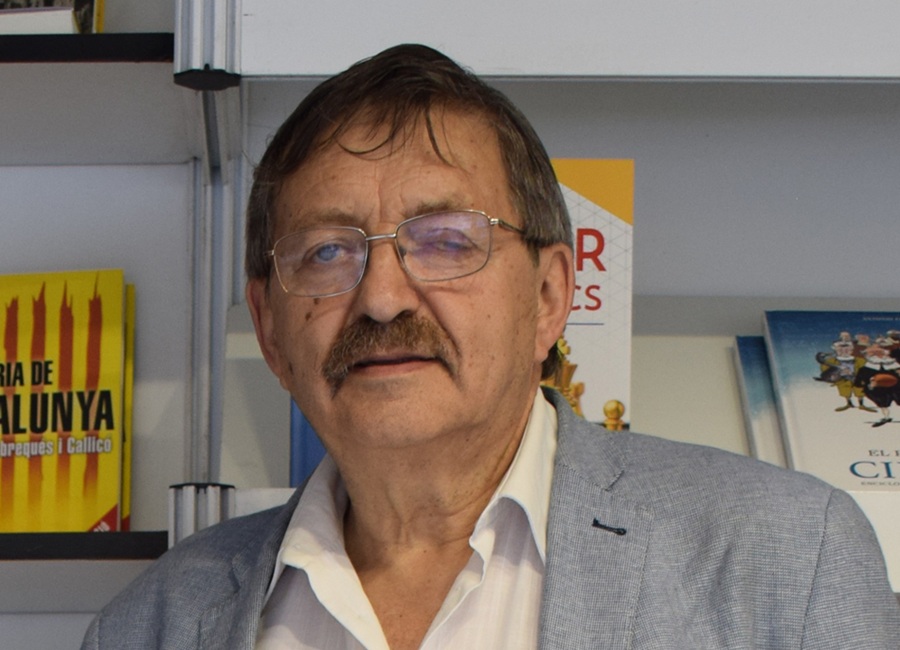
Josep Santesmases i Ollé
FACE TO FACE WITH
Josep Santesmases i Ollé, President of the Coordinadora de Centres d’Estudis de Parla Catalana from 2000 to 2024


In a country where culture has so often survived thanks to the discreet yet persistent efforts of committed individuals, the name of Josep Santesmases i Ollé occupies a prominent place. A writer, historian, columnist and cultural activist, he has forged his career outside conventional academic pathways, though with a constancy and intellectual depth that have made him one of the most respected voices in Catalan cultural life. Josep Santesmases i Ollé (Vila-rodona, Alt Camp, 1951) is a leading figure in Catalan cultural and associative circles, particularly in the fields of local historiography, cultural studies and the promotion of Catalan culture.
He is the author of more than twenty books spanning historical research, essays, poetic prose and narrative, as well as more than a hundred research articles and over eight hundred newspaper pieces written across decades devoted to literary culture and critical reflection. It is therefore hardly surprising that Santesmases served as president of the Coordinadora de Centres d’Estudis de Parla Catalana (CCEPC) between 2000 and 2024. Indeed, although his modesty and reserve would prevent him from saying so himself, Santesmases played a decisive role in expanding the organisations affiliated to the Coordinadora, promoting congresses, publications, research projects and the dissemination of the history and culture of the Catalan-speaking territories.
Alongside this path of cultural activism, he also served as vice-president of the Institut Ramon Muntaner and sat on the editorial boards of journals such as Frontissa, Plecs d’història local and the supplement Canemàs. Over time, however, Santesmases also sought to break through his own literary boundaries. As a writer, he moved beyond historical research into genres such as poetry and poetic prose. Works such as Santes Creus i les terres del Gaià, Entre el cel i la terra, and the diaries and essays Els paisatges trobats, El temps viscut. Entre la història i la memòria and Més enllà de la teva mort bear witness to this evolution. He has even ventured into science fiction with the novel Monverd, el primer planeta (2024). Taken as a whole, his work — which I have read extensively — is marked by an intense curiosity about collective history and local culture, as well as by a deep sensitivity towards the cultural heritage of the Països Catalans and the Catalan language itself. This commitment has been recognised with distinctions such as the Premi Antoni Carné of Catalan Cultural Associationalism, awarded in recognition of his career-long dedication to the promotion and defence of Catalan culture beyond academic circles.
Perhaps the most remarkable aspect of this formidable intellect is that he never passed through university education of any kind. His trajectory has instead been the product of profound and painstaking self-education, one that has enabled him to equal — and often surpass — many recognised specialists in cultural studies, historiography and literature. His editorial, research and associative activity testify to this. In short, Santesmases has built an extensive and remarkably varied body of work while also playing a key role in institutions such as the Coordinadora de Centres d’Estudis de Parla Catalana, the Institut Ramon Muntaner and a wide range of editorial and cultural organisations. We spoke with him about effort, self-education, literature, heritage, the future and cultural commitment.
What role did your family, your surroundings and your upbringing as a child and adolescent play in shaping your cultural and intellectual commitment?
During the second half of the 1960s, things began to change culturally — or at least what reached us did. There was a hopeful spirit of cultural growth developing outside the structures and constraints of the Franco regime. At home I was brought up with the habit of reading. We always had a newspaper in the house and, when I was about twelve, my family subscribed me to Cavall Fort, which I would await eagerly and read with enormous enthusiasm. Looking back on school, and especially on the teacher I had for more than five years — Francesc Cortiella i Òdena — what I value most are the activities he organised: producing a magazine, creating a museum, theatre, exhibitions, the nativity scene, excursions… A little later, towards the end of the 1960s, I subscribed to the magazine Oriflama. One particularly important influence for culturally aware young people of that period was the Nova Cançó: hearing contemporary, socially engaged songs in Catalan through records, occasionally on the radio, and at live recitals…
Your work and activities reveal a particularly acute sensitivity towards Catalan cultural heritage. Where do you think this curiosity and this attentive way of looking at territory and memory come from?
Part of it undoubtedly lies in the education one receives, both at home and at school, which instils a curiosity about culture and heritage. From the outset I combined the local sphere with influences coming from beyond it, through reading and listening. Curiosity generates questions that never quite leave you, together with a desire to understand the world around you. Knowing the local sphere well, and the wider territory of which it forms part, is one way of interpreting the world. The place where one lives is, as everywhere else, a humanised space, and therefore a place shaped by memory. From an early age I was fascinated by discovering things about the past and by recognising the value of history and memory.
“Knowing the local sphere well, and the wider territory of which it forms part, is one way of interpreting the world”
When did your deep interest in literature and writing begin? Do you remember any particular moment or book that left a lasting impression on you?
All my schooling took place in Spanish, even though everyone in the village spoke Catalan. In fact, we probably spoke Catalan with the teacher as well. Although we were never taught our own language formally, I soon began writing in it. At around nineteen, I started writing poetry — naturally in Catalan. I also began buying books. I often visited a bookshop in Valls — the Alt Camp bookshop run by Ignasi Moncunill — where I would spend hours at a time. Through the Nova Cançó, among other things, I discovered poets whose books I later went on to buy. I have never stopped reading literature. I could not point to any single literary work as having influenced me above all others: it is the accumulated residue of everything I have read that has enriched and shaped my thinking over time. That said, in the poems of my youth — which I never published — I believe I was influenced by La pell de brau by Salvador Espriu.
Your personal and professional path has clearly involved a great deal of effort. How did your journey into Catalan culture begin, and what led you to devote your professional life to it?
Until about twenty years ago, I earned my living in a craft trade.
As a carpenter, correct?
Yes — in the family carpentry workshop — alongside my involvement in a wide range of continuous cultural projects that occupied much of my free time. Increasingly, however, because of my responsibilities as president of the Coordinadora de Centres d’Estudis de Parla Catalana (CCEPC) and vice-president of the Institut Ramon Muntaner (IRMU), I found myself having to leave work in order to attend meetings or events. Around twenty years ago, worsening eyesight coincided with the growing demands of my responsibilities within the CCEPC and IRMU, which required being present throughout the Catalan-speaking territories. That was when I began dedicating myself exclusively to the cultural sphere.
Many people see your career as one shaped through self-education and perseverance. What was it like learning outside formal university structures?
It is difficult to define precisely. What matters most, however, is the desire to learn what no one has taught you, constantly asking yourself questions, wanting to delve deeper and refusing to be satisfied with the distractions offered by every age. A desire to read, to discover — for example — the literary works of authors from your own culture as well as universal writers. At the same time, I think that throughout my life I have possessed an almost innate desire to participate, to create, to commit myself, to accept proposals and to discover other cultural realities. In this way, while never abandoning local commitment, between 1987 and 1998 I served as vice-president and later president of the Institut d’Estudis Vallencs, before moving into areas of national scope, as I mentioned earlier. I never hesitated to take part in activities far from my native village. Indeed, I was generally pleased when invited, because I knew — and still know — that contact with other cultural and territorial realities enriches one enormously.
“Throughout my life I have possessed an almost innate desire to participate, to create, to commit myself, to accept proposals and to discover other cultural realities”
In relation to your early literary work, what would you say became your principal field within history, and why did you enter it?
Apart from that youthful period when I wrote poetry, at the beginning of the 1980s I began carrying out research and publishing work in the field of local history. For years I formed part of the working team at my village museum and began consulting parish and municipal archives, all of which fascinated me. In summary, I would say that I have published several books and many articles dealing with contemporary history and the later stages of the early modern period, and that my principal interest has always been understanding how ordinary people were born, lived and died: how they organised family and social life, what kinds of work they carried out, and how, in many cases, they endured and suffered the decisions imposed by higher powers.
In recent years you have written poetic prose and poetry. What led you to move from historical research and essays towards poetry and even science fiction with Monverd, el primer planeta?
People say that writers always write the same book. Historical research, together with geographical and historical knowledge of my surroundings, initially led me towards poetry, poetic prose and prose rooted in landscapes and places that I know intimately. Writing about them in literary form allows me to delve more deeply into my perceptions of what I know, to express feelings, thoughts and reflections, to articulate my convictions and to create a form of “beauty” through language — something that cannot be done in quite the same way within historical writing, since there one is bound by the interpretation of documentary sources. Nevertheless, I have never abandoned historical research. One discipline nourishes the other. It is also through opinion pieces that I reflect on my own life experience and on the world I have lived through, not from the perspective of partisan political manoeuvring but from a calm commitment that seeks to express itself freely, through austerity and depth. This eventually led, as you suggest, to the literary formulation of a utopia in the form of a novel set hypothetically on another planet.
“I have come to understand that living austerely, without lacking anything essential, gives one time, lucidity and humility — all of them deeply valuable things”
There seems to be a common thread running through all your books dealing with culture, memory and identity. How would you define it?
I imagine it is the thread implicit in my own life and convictions. Increasingly, I believe that life is a precious gift and that every human life is unique. We only live once and, for that reason, I believe that the most important thing — whatever one’s personal or historical circumstances — is to deepen the qualities of our human condition, something that can only be achieved through commitment both to oneself and to society. The system preaches the opposite: an understanding of life as an endless aspiration towards consumption and distraction of every kind. At this stage in my life, I have come to understand that living austerely, without lacking anything essential, provides time, lucidity and humility, all of them deeply precious.
One of the most impressive aspects of your work is your vast photographic and documentary archive. How did this passion for preserving images and materials from the past begin, and what has driven you to maintain it so consistently?
Photography is something partly linked to youthful interests and partly to historical research. I have been taking photographs for almost fifty-eight years and have always photographed the world around me: landscapes, my local surroundings, the activities taking place there and everything important that happens. I have always regarded photographs as unique documents. Now, when I exhibit images that are almost half a century old, one fully appreciates the value of having preserved all the negatives. Alongside that, there is all the documentation preserved within the family, as well as everything we gradually collected over the years, almost like ants storing things away. Materials which, at the moment you gather them, seem insignificant, but which with time become unique documents capable of defining an entire period.
What role has the Coordinadora de Centres d’Estudis de Parla Catalana played in promoting local culture, and how do you assess your own contribution during more than two decades as president?
Especially from the beginning of the democratic transition onwards, many local and regional study centres were created, continuing concerns that had already existed before the Civil War regarding knowledge of the country, while also drawing inspiration from post-war initiatives that sought, as far as possible, to rebuild forms of cultural association devoted to strengthening historical and geographical knowledge of local and regional environments and preserving their heritage. By the late 1980s, many study centres had emerged sharing similar concerns and difficulties. Then, at the beginning of the 1990s, following a congress held in Lleida, the foundations were laid for a federative organisation that today brings together more than 150 centres across the Catalan linguistic domain, from Elna to Guardamar and from Fraga to Maó.
Since the founding of the CCEPC, and later the creation of the Institut Ramon Muntaner in 2003 — a foundation established jointly by the Generalitat de Catalunya and the CCEPC, now also involving the Federació d’Ateneus de Catalunya — there has been extraordinary growth in the creation of associations, activities, published research and many different ways of disseminating culture, knowledge, heritage and public awareness. Numerous collective projects have emerged through conferences, congresses, publications, exhibitions and research initiatives, often in collaboration with universities, public administrations and cultural institutions. Their value has been immense and would have been unimaginable without the structures created in 1992 and 2023. Personally, I formed part of the first board of the CCEPC. After a period away, I was asked to return and, at a certain point, was asked whether I wished to stand for the presidency — something I had never even imagined hypothetically. Every four years, at the corresponding assemblies, I renewed the position. Now that it has been two years since I stepped down, I realise how enormously enriching the experience was. I met people from many different places and, for my part, I tried to carry out the role responsibly, listening to the proposals and concerns that emerged and promoting consensual community projects capable of benefiting local, national, cultural and heritage life alike.
You have also been closely associated with the Institut Ramon Muntaner and publications such as Frontissa. How has this editorial work shaped your cultural commitment?
As I mentioned earlier, the CCEPC and the IRMU work in coordination, each within its own organisational framework, to support the study centres. Looking back, having contributed to the creation of the IRMU is one of the achievements I value most highly in my life within the cultural sphere. When I became president of the CCEPC, I revived the publication of Frontissa as a bulletin, and fifty issues have now appeared. From 2021 onwards, however, we committed ourselves to a broader digital format with new sections and contributions from hundreds of people writing freely from very different places, expressing opinions, disseminating heritage, geographical and literary content, and paying tribute to individuals of immense worth who are no longer with us, from one end of the country to the other. In 2007, I was also invited to co-direct Plecs d’història local, the supplement of the journal L’Avenç, beginning with issue 124. We have now reached issue 200, and the experience has been extremely positive and, I believe, highly appreciated. On a personal level, I can only say that I have learned a great deal and that I am deeply pleased to have helped make it possible.
“In the book I ask myself: what were six or seven hundred young men doing on the island of Lanzarote?”
Your latest book, Servir a què?, what does it add to your body of work, and what message or reflection would you like readers to take from it?
Servir a què? is based on the letters I wrote to my family during the military service I was required to complete in the Canary Islands between 1973 and 1974. I spent eleven months unable to return home. The book contains transcriptions of those letters, carefully revised and corrected, accompanied by commentaries written from the present day in which I also incorporate fragments of the letters I myself received, creating a kind of dialogue between the world I had been forced to leave behind and the experiences I had to endure. As I explain in the book, it attempts to illustrate one among many possible examples of how part of your life was taken from you, how the youthful activities that fulfilled you were abruptly interrupted, and how you were forced to abandon your work. It also seeks to convey the sheer futility of what we were living through. In the book I ask myself: what were six or seven hundred young men doing on the island of Lanzarote? Even then, all this led me to believe in the values of peace rather than war, of culture rather than militarism, as the proper means of resolving humanity’s problems.
Catalan culture and heritage form the inspirational background to your work. How do you see the future of Catalan culture in a context dominated by major economic, media and political powers? What role can grassroots culture play?
I believe that grassroots culture, across all thematic and territorial spheres, already plays an important role. It is true that it could always be stronger, particularly if it received greater recognition from the media and were valued more highly by certain political sectors and public administrations. Yet the question I have sometimes asked is this: what would happen if we did not exist as communities forming this immense network of cultural associations?
Josep, thank you very much for sharing with us your experience, your reflections and this sustained commitment to Catalan culture, built through perseverance, curiosity and a deep attachment to the country. What concerns you most about the present situation?
There are certainly things that concern me. One is state legislation, which never favours this country’s culture and language; another is the political attitudes that assume anti-Catalanism easily yields electoral rewards; and then there is an entire judicial system obsessed not only with the territorial unity of the state — almost as though divinely ordained — but also with the uniformity of its citizens. From these assumptions follow interpretations and applications of the law that are often far from favourable to the promotion of linguistic and cultural diversity.
Beyond this, there are other developments that also concern me, particularly what we might call the trivialisation of culture. I shall give just one example from the literary sphere. Increasingly — and now quite openly — people speak less about literature itself and more about bestselling books and those enjoying the greatest media exposure. More and more books appear by authors who have become famous through television and certain media outlets, reflecting clear commercial strategies. These books tend to receive prizes and vastly greater publicity in the public media — at times, I would even say, free publicity. All this is tied to the decline of the humanities within education, something for which, I fear — though I sincerely hope to be mistaken — society will ultimately pay a heavy price, if indeed we are not paying it already.
Source: educational EVIDENCE
Rights: Creative Commons