


- Humanities
- 11 de June de 2026
- No Comment
- 6 minutes read
Pere Sousa and the affective conspiracy of Mail Art

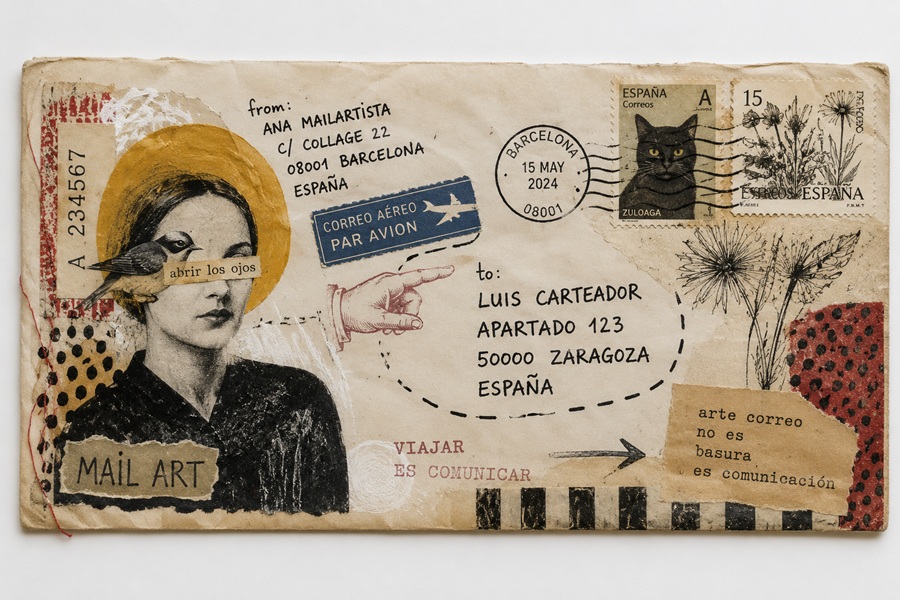
Mail art image created using AI.


Cesc Fortuny i Fabré
There is something curious about the fact that a man who criticised certain internal mechanisms of mail art so fiercely should eventually become one of its principal reference points in Spain. Perhaps that is precisely why his work feels so honest: Pere Sousa understood that every alternative artistic practice runs the risk, with time, of hardening into a bureaucratic liturgy full of labels, more-or-less consecrated names and a survival sustained largely by inertia. During the 1990s he edited the legendary magazine P.O.BOX, regarded as essential for understanding the development of Spanish mail art, while simultaneously promoting the Merz Mail Factory, a platform through which he organised meetings, publications and projects connected with experimental poetry and the historical avant-gardes.
To speak of Pere Sousa is to approach a figure who, although he never indulged in the culture of self-display so common in contemporary Spanish art, nevertheless left a powerful mark upon territories flourishing far from institutional spotlights — places where artistic creation still retains much of the spirit of human exchange and something of a friendly conspiracy. Sousa, born in El Pont de Suert in 1955 and deceased in 2023, devoted much of his life to mail art, phonetic poetry, collage and cultural agitation, disciplines which in his hands ceased to resemble separate compartments and instead began to function like a single subversive tentacle.
His career does not entirely fit the romantic image of the artist locked away in a studio. In fact, Sousa seemed far more interested in creating networks than in building prestige for himself. While others pursued galleries, he fostered international correspondence, edited photocopied magazines, assembled impossible archives and turned pirate radio into a space for sonic experimentation. For years he hosted programmes on Radio Pica devoted to phonetic poetry and experimental art, activities he combined with the Merzmail website, an immense and slightly chaotic archive that functioned as an agora for artists from half the world.
In truth, much of the value of his work lies in that almost archaeological insistence on preserving and sharing materials which would otherwise have ended up forgotten in mouldering boxes or buried away on hard drives. The documentary archive he donated to MACBA emerged precisely from decades of postal exchanges with international artists, something that today can seem almost exotic, especially in an age when the compulsory immediacy of communication has turned any form of waiting into an unbearable form of psychological aggression.
Sousa defended mail art as a practice rooted in physical contact and in the material circulation of artworks, which is why he viewed certain digital adaptations of the genre with scepticism. When asked whether email could be considered mail art, he would reply that it was not exactly the same thing, because digital systems eliminated much of the material and collaborative experience that had historically defined this form of creation. Even so, he never adopted an entirely closed purist position, since he acknowledged that as long as there were people convinced they were making mail art, the movement would continue to exist in new forms.
That balance between radicalism and flexibility appears constantly throughout his career. Although he studied Fine Arts and sculpture in Barcelona, he soon abandoned the traditional academic path in favour of much more hybrid spaces, where performances, sound poetry, collages, fanzines and improvised actions coexisted. He was also a deeply committed student of the work of Kurt Schwitters, whose influence runs through much of his own work. His interpretations of the sound poem Ursonate came to be regarded among the finest in the Spanish-speaking world, which is no small achievement if one considers that reciting Dadaist phonetic poetry for decades requires a rather peculiar combination of discipline, obsession and — if I may say so — a certain resistance to social ridicule.
Those who knew him tend to describe him as someone capable of moving naturally between promoting experimental art and creating it, without establishing excessively rigid hierarchies between the two. That attitude probably explains why his name appears linked to so many collective projects, from gatherings of independent publishers to festivals of poetic action or improvisational spaces such as Kabaret Obert, alongside the pioneer of polypoetry in Catalonia Xavier Sabater and the performer Joan Casellas, among others. The project remained active between 2002 and 2008.
Equally significant was the way he confronted illness. Lung cancer took away his voice during the final years of his life, although it never diminished his capacity to continue working. Far from withdrawing, he intensified his production of collages in both physical and digital formats. In a certain sense, that shift from orality towards image seemed entirely coherent with the trajectory of his life as a whole, because Sousa always understood art as a network of continuous circulation rather than as a rigid object.
Perhaps that is why his legacy continues to feel relevant today. Not because he invented some grand theory or achieved fame, but because he devoted his life to sustaining fragile cultural ecosystems that almost never generate economic profit or major headlines. And that, however much the art market may prefer to pretend otherwise, constitutes a very serious form of cultural resistance. For while half the world struggles to turn itself into a personal brand, Sousa continued defending something as old-fashioned as the artistic community understood literally as community. A gesture which today, amidst algorithms, compulsive self-promotion and carefully optimised online profiles, feels deeply subversive.
Source: educational EVIDENCE
Rights: Creative Commons