


- Opinion
- 15 de May de 2026
- No Comment
- 14 minutes read
Is there a geographer on our daily talk shows?

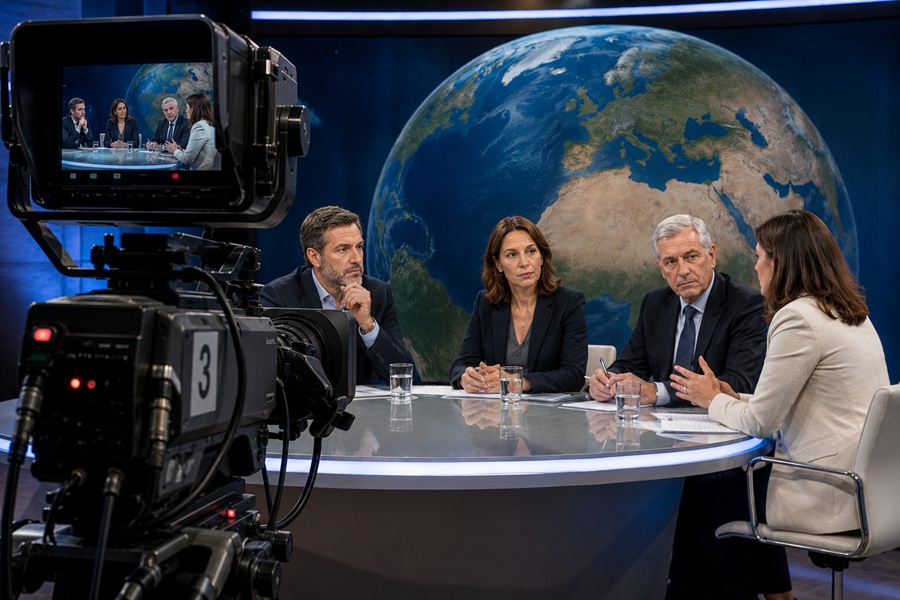
Image created by AI.


Albert Pérez Bea
Can a student complete batxillerat (upper secondary education) without knowing what the Industrial Revolution, the French Revolution or the Russian Revolution were? Quite clearly not. Another matter altogether is the depth at which these topics are taught, and the particular forms of knowledge and competences demanded within today’s — frankly absurd — framework of prescriptive pedagogy. History teachers, at least in the fourth year of ESO (Compulsory Secondary Education) and in the second year of batxillerat, may spend entire weeks on such questions, especially if they teach them with genuine passion, all while remaining perfectly faithful to the official syllabus.
But can students from that same batxillerat arrive at university unable to locate the G20 countries on a map, or incapable of interpreting a population pyramid and understanding its implications for the future of pensions? Here the answer is, with almost effortless naturalness, an emphatic yes. In an age when any smartphone equipped with Google Maps can tell us how to reach virtually any corner of the planet, actually knowing where those places are seems to have become an optional extra — decorative rather than essential.
This is hardly accidental. Geography — the discipline that links space, society and economics — has for years occupied a marginal place within upper secondary education, frequently reduced to an optional subject within curricula increasingly geared towards supposedly “practical” outcomes. Geographers, already a dwindling species, watch this trend with a mixture of irony and resignation. At the very moment when technocracy and degrees “with stronger career prospects” are endlessly celebrated, it continues to be overlooked that geography provides some of the most important tools for understanding the complex — and professional — world in which we actually live. Indeed, perhaps the real surprise is not that there are so few geography graduates, but that almost all of them nevertheless end up finding their place within a few years. Who would have imagined it? It turns out that understanding the world is still useful after all.
Whenever pupils in ESO or Batxillerat hear the word “geography”, they tend to imagine the same thing: countries, capitals, mountain ranges, rivers and so forth — a dreary encyclopaedic catalogue of names to memorise. Geography teachers themselves, often tasked with teaching both history and geography as effectively as possible, quickly realise the extent to which the subject is burdened by this narrow and excessively academic conception, while the more recognisably “human” dimensions are quietly left to history. What is needed, in good faith and without dogmatism, is to recover a more stimulating and intellectually alive vision of geography: the understanding that without it we can scarcely make sense of any of the issues dominating today’s bewilderingly complex news agenda.
Which brings me to a simple question. Can the reader — and thank you, incidentally, for having reached this point — think of a single geographer regularly present in our national culture of televised punditry? Take a moment… I shall venture the answer before the article is over: even now, as you read these lines, no name has yet come to mind. Precisely. Among the commentators and professional know-it-alls crowding television schedules and the underworld of social media, it is remarkably difficult to find a single geographer from this country who is genuinely well known or publicly influential. I challenge readers once again to name one before reaching the end of this article.
A few kilometres further north, however, beyond the Pyrenees, things look rather different. In the French Republic — though discussing standards there would require another article entirely — geographers appear regularly on television discussion programmes alongside politicians, historians, lawyers, journalists and economists. The same is true across the Anglosphere and in Italy, countries where the education system has reserved an important place for the study of Geography within schools, lycées and licei umanistici. North and east of here, geography and geographers are routinely regarded as indispensable participants in any serious public debate. And there is no shortage of such debates today: geopolitics, the climate crisis, the energy crisis, demography, food policy and water resources — and one could continue almost to the point of exhaustion. Virtually every major issue of the twenty-first century possesses an unavoidable geographical dimension. Yet in this country we persist in talking endlessly about the world while rarely locating anything properly within it — and almost never consulting the resident geographer.
France and the rise of Christophe Guilluy the provocateur
In twenty-first-century geography, two major spheres of influence can broadly be identified: the academic world and the sphere of public intellectual debate. The former includes figures such as David Harvey, Nigel Thrift and Michael Goodchild, all of whom have profoundly reshaped the discipline from within. Harvey revitalised urban theory and the critique of capitalism; Thrift introduced cultural and post-representational approaches; and Goodchild helped define geographical information science (GIScience). Their work is theoretical, methodological and globally influential within universities.
Alongside them, however, stand figures such as Emmanuel Todd and Christophe Guilluy in France, thinkers who have exercised enormous influence over territorial and social debate while largely operating outside conventional academic structures. Todd interprets family and cultural systems as deep geostructural foundations of political behaviour, while Guilluy became famous for his idea of “peripheral France”, the widening fracture between global metropolitan centres and neglected territories.
If the former group shape geography’s scientific development, the latter shape its public imagination. The interaction between these two poles — analytical rigour on the one hand, narrative power on the other — reminds us that contemporary spatial thinking is forged not only within universities, but also in the wider arena of social and cultural debate.
Three names dominate contemporary French discussions about territory and society: Christophe Guilluy, Emmanuel Todd and Jacques Lévy. Each offers a distinct interpretation of France’s social and spatial transformations, and the tensions between them reflect broader disagreements within the social sciences themselves. France, a country permanently engaged in argument with itself and structured for centuries by a deeply Cartesian intellectual culture, simply cannot conceive of public debate without according geography a central place. There is always a geographer in circulation within French public life — a bestselling author capable of exposing many of our own all-purpose television pundits for what most of them really are. I shall leave the appropriate adjective to the reader.
Guilluy rose to prominence through his thesis of la France périphérique, according to which “territorial divides now shape social divides”. His argument opposes the great globalised metropolises — which in France largely means Paris and little else — to a neglected periphery inhabited by displaced working and lower-middle classes. His language is direct, accessible and politically explosive, which explains the enormous impact he has had in the media and in interpretations of movements such as the gilets jaunes. Unsurprisingly, many academics accuse him of reducing a far more complex reality to an overly rigid dichotomy.
Todd, by contrast, works on a much longer historical timescale. His famous claim that “family structures explain ideologies” captures his broader method: understanding political and social behaviour through deep demographic and cultural continuities. Territory, in Todd’s framework, is not merely an economic space but the visible expression of long historical inheritances. He has advanced strikingly provocative hypotheses — among them the prediction of the Soviet Union’s collapse ten years before it occurred — though critics accuse him in turn of risky generalisations and methodological heterodoxy.
Lévy represents yet another tradition: a more formal, rigorous and academically grounded geography. His assertion that “space is a complex social construction” encapsulates an approach centred on networks, mobilities and interactions. He rejects simplistic binaries such as centre versus periphery and insists instead that “globalisation multiplies the ways of inhabiting the world”. From this perspective, he openly attacks Guilluy, accusing him of constructing “a narrative more ideological than scientific”.
Together, the three men embody three ways of reading the contemporary world: Guilluy through a forceful but simplifying narrative; Todd through structural and historical explanation; and Lévy through complex and relational analysis. The tension between them reveals a central dilemma of contemporary social thought: how to interpret territorial transformation without sacrificing either analytical rigour or the ability to describe lived social experience.
Let us consider a few characteristic formulations from Guilluy — “the provocateur”, who in this country would almost certainly be dismissed as a fascist before the debate had even begun; we all know how these things work here.
- “Peripheral France is the majority France, yet invisible to the elites”. This neatly summarises his central idea: that the social majority lives outside the circuits of power and representation.
- “The working classes have been expelled from the metropolises”. A striking formulation used to describe processes of gentrification and spatial exclusion.
- “Multiculturalism functions only for the dominant classes”. One of his most controversial assertions, because it directly attacks the dominant discourse surrounding diversity.
- “The elites inhabit a world that no longer resembles that of the majority”. Here he directly attacks the growing disconnect between governing elites and the wider population.
- “Globalisation has created a dual society”.
And this is precisely where he is accused of every conceivable offence, because critics claim he legitimises the visceral political reactions of those affected by globalisation, deindustrialisation and austerity policies.
The key idea in Guilluy’s thought: urban winners versus peripheral losers
These statements help explain why his work has had such impact: they are clear, forceful and politically easy to mobilise, yet many academics criticise them for compressing an enormously complex reality into slogans.
The work of Christophe Guilluy has become one of the most intensely debated contributions to European social thought in recent decades. In books such as La France périphérique and No Society: la fin de la classe moyenne occidentale, Guilluy argues that globalisation has produced a profound fracture between major metropolitan centres — integrated into global economic circuits — and a social “periphery” composed of working and lower-middle classes pushed out of urban centres and excluded from the benefits of economic growth.
According to his thesis, these groups have lost not only economic influence but political representation as well, a process that would help explain phenomena such as the rise of populism and revolts such as the gilets jaunes. Guilluy argues that urban elites live increasingly detached from this reality, while the dominant public narrative renders these social groups effectively invisible.
These ideas, however, have generated considerable controversy. Numerous academics have criticised his approach as excessively simplistic. The geographer Jacques Lévy has described the notion of “peripheral France” as a “myth”, arguing that it reduces a far more complex territorial reality to an overly neat model. Lévy also reproaches Guilluy for a certain methodological weakness: selective use of evidence and a preference for essayistic interpretation over rigorous empirical analysis. Moreover, Guilluy’s notion of “cultural insecurity” has proved especially controversial, since some critics believe it can encourage political readings associated with identitarian or anti-immigration discourses.
Despite these criticisms, Guilluy has enjoyed extraordinary media visibility, far greater than his academic recognition. International media outlets have repeatedly drawn upon his ideas in order to interpret Western social discontent, while analysts such as David Goodhart have acknowledged that he was among the first to identify the widening fracture between the “winners” and “losers” of globalisation.
Guilluy remains an awkward but undeniably influential figure. His success lies in his ability to transform a genuine social fracture into a lucid and provocative narrative, even if this often comes at the cost of simplification. More than a definitive thinker, he has become an unavoidable point of reference in contemporary debates on territory, inequality and identity.
His popularity also reveals a deeper paradox. In a media landscape saturated with highly complex analyses, the explanations that triumph are often the clearest and most immediately recognisable. Guilluy offers a narrative that is highly transmissible — almost journalistic in style — and therefore perfectly suited to the logic of public debate. Perhaps that is precisely why he inspires both fervent support and intense rejection. After all, when reality becomes confusing, many people prefer a simplified map — even one that resembles a sketch more than the territory itself.
And now, finally: can you think of any geographer who regularly appears on television debates south of the Pyrenees and genuinely shapes public discussion? Because whether explicitly acknowledged or not, many of the ideas circulating in Spanish debates — España vaciada (“emptied Spain”), “territorial divide”, “urban elites versus the periphery” — bear a striking resemblance to Guilluy’s analysis of “peripheral France”.
When railway infrastructure is discussed, for instance, how many people know who Josep Vicent Boira is? When climate change is debated, can anyone name a geographer other than Javier Martín Vide — and even that only just? And now that everything is supposedly geopolitics, is there any political geographer in Spanish public life with anything approaching the intellectual visibility enjoyed by Guilluy or Todd across the border?
It is astonishing that, in the age of satellites and GPS, geographical literacy should remain almost an endangered species. A recent survey found that many students could not locate even basic countries on a map, yet could identify the nearest café on Google Maps with surgical precision. We may not know exactly where Moldova is, but we can certainly reach it by following a reassuring blue line across a screen. Who needs geography when your battery is fully charged and roaming networks grow cheaper by the year?
Some attentive readers may by now have recalled several of the names mentioned here — perhaps others as well. In the meantime, we can continue living without properly locating half the world on a map, comforted by the thought that another bestseller by Tim Marshall (*) will always appear to remind us that the world — and geography — do, inconveniently enough, still exist.
___
*: Tim Marshal, author of worldwide bestsellers such as On the Map and Prisoners of Geography
Source: educational EVIDENCE
Rights: Creative Commons