


- Cover
- 15 de October de 2026
- No Comment
- 7 minutes read
The Power/knowledge of pedagogues

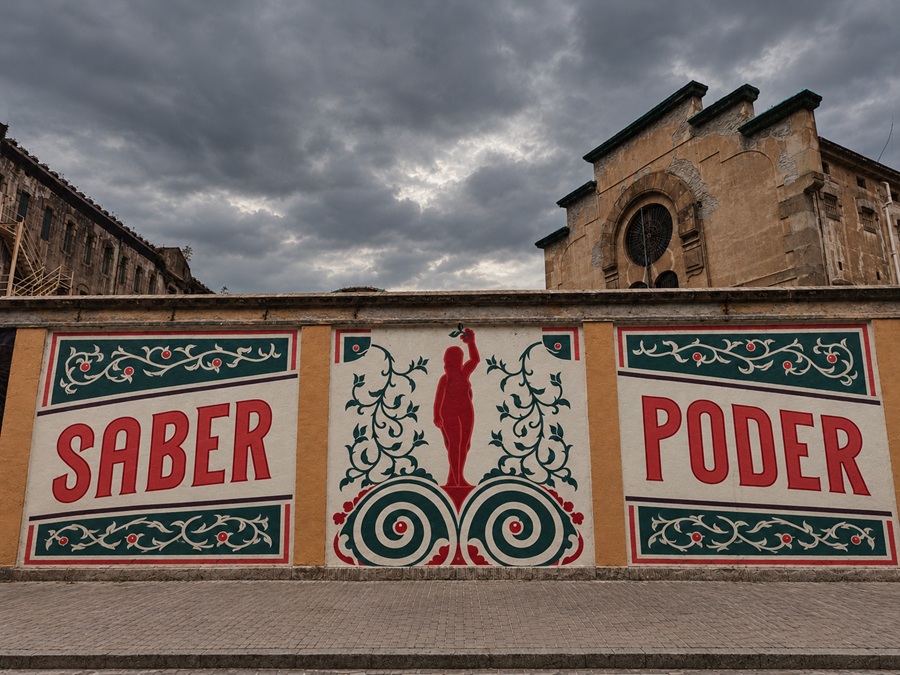
Image: Víctor Mercado


Víctor Mercado
In 1975, Michel Foucault, one of the twentieth century’s masters of suspicion and an heir to Nietzsche, discussed in Discipline and Punish relations of force, discipline exercised over bodies, the art of imposing tasks and distributing individuals, always within a closed, enclosed, isolated space, as in schools, barracks and factories. All of this was aimed at obtaining the greatest benefit with the least effort. He also referred to the control of activity, to a rhythm of time inherited from the old monastic communities, to regulated cycles of repetition in which an act is worked out or a gesture broken down, inscribed within a coercive framework that prescribes and sustains it throughout a chain of processes in which the body is traversed by time and, with it, by “power”.
But since one cannot speak of “power” in a pure state, but only as embodied in “knowledge”, Foucault would henceforth refer to that force charged with imposing any given task on a multiplicity as “power/knowledge”, with a distinction between the two categories possible only insofar as “power” is actualised in “knowledge”. How? Through the visible and the sayable. For example, a school and a statement about education. Both belong to these orders, and if we think of the pupil, the prisoner or the worker, it is easy to conclude that the same matter or substance — human, of course —, under a particular form or discipline (the school-form, the prison-form, the workshop or factory-form), has been shaped in such a way as to cease to be an arbitrary multiplicity. Thus, “knowledge” shapes; it is then stratified, which is why one can speak of archives of knowledge, which are characterised by stability and fixity, as opposed to the instability and dynamism of “power”, whose forces are captured in the fluid form of a becoming subject to constant change. This is why Foucault states that “power” refers to strategies, always changing, always modifiable.
We can see this in the post-industrial era through the latest mutation undergone by our educational centres, which are no longer that Enlightenment project of emancipation through knowledge, nor the industrial project of creating disciplined workers for factories. Indeed, the LOMLOE (Organic Law 3/2020) can be read as a tool for consolidating and refining the regulatory framework in response to the mutations that have taken place since the introduction of Compulsory Secondary Education (ESO). This is because the demands of a biopolitical script that conceives of our pupils as a demographic surplus have turned state schools into day centres, into a new hyper-bureaucratised institution of confinement where nothing is learned and the only thing that matters is keeping the “inmates”, future workers in precarious employment, occupied, pacified and entertained, since the excess of qualifications and the rise of AI are creating a bottleneck in our modern societies that is holding back the overall performance of the system. All the more reason, then, not to equip pupils in the state sector with potentially revolutionary academic capital and instead to give them a superficial education that prepares them to accept precarity. Thus, while an army of Epsilons prepares to accept an existential void which they will encounter, moreover, without any strategy of resistance, alone in the face of the market, the future “alphas” and “betas” are educated in private schools that guarantee the acquisition of the necessary academic capital and exclusive networks of contacts.
On the other hand, it is entirely legitimate and necessary to analyse inclusion as a device that can be instrumentalised, that is, as a strategy of a “power/knowledge” that serves to conceal austerity policies under the umbrella of a supposed democratisation of education with a reactionary bent, but which manages to appear to society as “progressive” and “revolutionary”. The savings made at the expense of special education, while championing the right to ordinary, non-segregated education, have justified the closure of many special-education centres, but the budgetary reality is that the financial, material and human resources that sustained those centres are never transferred to mainstream schools. Thus, low-cost inclusion does not seek the emancipation of the person with a disability, but rather their economic assimilation, since it costs less to put all pupils into the same standardised space than to sustain diverse networks of highly specialised support, from which it follows that the teacher has become a crisis-containment manager — that is, a psychologist, a “security guard” — rather than an educator.
Likewise, the proletarianisation of pupils is also transferred to teachers through the delegation of technical responsibilities that do not fall within their remit, as they are required to take on roles that blur the boundaries of their legitimate responsibilities. Small wonder that the wet dream of pedagogism should be the creation of a single body that would do away with specialisms. But there is more: if inclusion fails in the classroom, the pedagogues’ “power/knowledge” activates the mechanism of blame, shifting responsibility for the failure of the structural system onto the morality or competence of teachers who, in any case, are being suffocated by bureaucracy: as they fill in rubrics, write reports or create their own materials now that the textbook has been replaced by a screen, they lack the physical and mental time needed to exercise criticism or dissent — the latter being a form of subjugation that Foucault referred to as “governance by bureaucracy”. Therefore, inclusion can operate and does operate as a neoliberal governance strategy to make a public service cheaper, make teachers’ work more precarious and simulate an equity that, without real funding behind it, becomes a form of institutional violence against teachers and the most vulnerable pupils. A curious fact, which shows the successful strategy of the pedagogues’ “power/knowledge”, is that the hard-line trade-union core of a leftism nourished by images drawn from a long tradition of protest and its lingering rhetoric of radicalism has bought into this discourse, believing that a little more funding to perpetuate the model of inclusive schooling is the solution to the proletarianisation suffered by pupils in state schools.
In any case, the thermometer of teacher discontent gives a good indication of the effects of these mutations. Its suffocating temperature is no coincidence. Much of it has to do with the appropriation of the teachers’ voice by a “pedagogical power/knowledge” that always speaks from the top down and which has not only emptied the curriculum of content under the pretext of market-oriented pragmatism, but has also helped devalue qualifications by ensuring the unlimited promotion of pupils through a fluid system that now fulfils a strategic function of containment, far removed from the formal transmission of knowledge as we had known it since the humanist systems. For this reason, state education has been stripped of its purpose, which was above all to guarantee intergenerational social mobility—the so-called “social lift”—only to become something else.
Source: educational EVIDENCE
Rights: Creative Commons