


- Cover
- 17 de September de 2026
- No Comment
- 14 minutes read
Carlos Azagra: Just being alive is a reward!

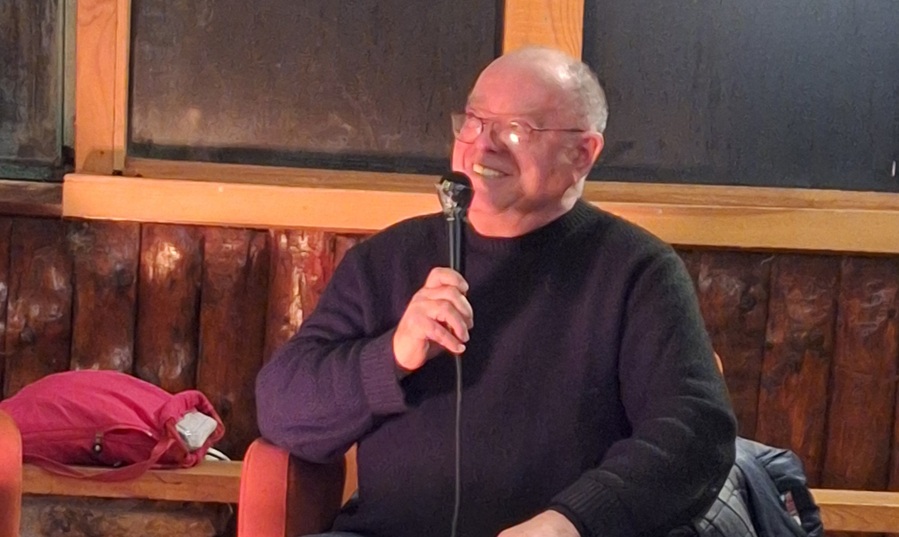
Carlos Azagra. / Photo: Courtesy of the author
FACE TO FACE WITH
Carlos Azagra, cartoonist and graphic humourist


I met Carlos Azagra during the presentation of his book Historias del Punk on Saturday 7 February 2026. In a bar at the campsite in Sort, in the Pallars Sobirà district, he was surrounded by followers and admirers. The truth is that, in Catalonia’s most sparsely populated district, the bar was packed with people. There I saw how Azagra’s sharp, ironic and inquisitive mind turned the censorship he had suffered under Franco into a source of cartooning and humour, making it clear to me that I was dealing with an author whose critical insight and sense of humour remain undiminished after decades in the profession.
Carlos Azagra García (1957) is one of the most recognisable cartoonists and graphic humourists in the satirical and political comics scene in Spain. His work is closely associated with social criticism, anti-militarism and historical memory, always expressed through a direct, popular and combative humour. In 1975 he moved to Barcelona to study Fine Arts at a time of political and cultural ferment marked by the end of the Franco regime. Very soon, his interest in politics and activism became intertwined with drawing, as he took part in youth movements and groups, including circles linked to the Unión de Juventudes Comunistas de España (Union of Communist Youth of Spain). At the same time, he began collaborating with neighbourhood associations and social movements, particularly the Federació d’Associacions de Veïns de Barcelona (FAVB) (Federation of Neighbourhood Associations of Barcelona), producing posters, cartoons and campaigning graphic material.
During the Spanish Transition and throughout the 1980s, Azagra published in fanzines and alternative magazines, many of them associated with the libertarian and trade-union movement and linked to organisations such as the CNT and, later, the CGT. In that context, his work was subjected to censorship and legal persecution, a direct legacy of the Francoist mentality that was still present in certain parts of the state apparatus. One of the best-known episodes of this censorship occurred in 1981, with a cartoon concerning the Virgen del Pilar. This led to legal problems for him and became a paradigmatic example of the limits placed on freedom of expression in those years. From these experiences, Azagra developed a particular talent for graphic and linguistic double meanings, using semantic and visual wordplay to evade censorship, such as the famous use of “chup, chup” as an apparently innocent onomatopoeia for sucking, or the ambiguity between “Ostia” (an Italian town) and “hostia” (a religious reference).
In 1984 he began collaborating with the magazine El Jueves, where he became one of its long-standing contributors, creating characters and series that would remain for decades. He also contributed to magazines such as Makoki and El Víbora, which were central to the underground and countercultural comics scene. He has lived in Santa Coloma de Gramenet for many years, a city to which he feels deeply attached and which has often provided the setting for his social and cultural commitment. Alongside his work as a graphic humourist, Azagra has also made a name for himself as a comic-book biographer of key figures in political thought and popular culture, such as Buenaventura Durruti and José Antonio Labordeta, whom he portrays from a human and political perspective, with deep respect for collective memory. And now he delights us with his new work Historias del Punk, a book that recovers experiences, characters and contexts from the punk scene from a personal, graphic and political perspective. Let us now meet this “enfant terrible”, who is approaching seventy.
Your biography says that you were born in Zaragoza, but I have come across other information.
I was born in Morón de la Frontera (Seville), but I lived in Zaragoza until I came to Barcelona to study Fine Arts.
That shows that the internet does not tell you everything.
And that shows that those of us from Bilbao are born wherever the hell we please.
Why did you decide to come to Barcelona in 1975 to study Fine Arts?
Well, fundamentally because there was no Fine Arts course in Zaragoza at the time, only a school of arts and crafts. I could have chosen Madrid, but I preferred Barcelona because it was by the sea, as well as for the underground scene, the Ramblas and that libertarian spirit that attracted me so much. In the end I only did one year of Fine Arts and soon got down to drawing wherever I could.
A drawing is the development of a condensed idea which, with a touch of humour, also entertains
When did you realise that drawing could be a tool for ideological struggle?
I soon realised that a joke reached more people. It was my old teacher Labordeta who encouraged me to follow this path. A drawing is the development of a condensed idea which, with a touch of humour, also entertains.
What role did you play in clandestine groups such as the Unión de Juventudes Comunistas de España?
It was just where I ended up; I could have been in any other organisation, but that was where I ended up. In the neighbourhood there was the PCE, some Christian groups and little else; the PSOE did not even exist, and the other left-wing groups came out of the university. In the end I left because I could not stand either the Stalinists or Santiago Carrillo.
What a bunch of bores!
Your involvement with the Federació d’Associacions de Veïns de Barcelona (FAVB) was very intense. What did the neighbourhood movement mean to you?
I already came from the neighbourhood movement and was a member of the Asociación de Cabezas de Familia (Family Heads’ Association) in my neighbourhood, Las Delicias, and I had been politically active from a very young age. So I immediately connected with the neighbourhood associations and used to go to Nou Barris a lot, where I still have many friends.
Do you remember any publication associated with trade unions such as the CNT or CGT?
Yes, of course, there were many magazines. The ones that circulated most widely were Bicicleta and Ajoblanco. The trade-union papers were more ‘underground’, mainly Solidaridad Obrera, the CNT and Rojo y Negro.
How did you experience your time at magazines such as Makoki and El Víbora?
It was a real learning experience; together with the magazine Butifarra, it was where I learned the most, with Alfons López. It was in this publication, and while I was already in Barcelona, that I faced another trial for an offence against religious freedom. As I was on parole, Miguel Gallardo went to the trial in my place. That issue of Butifarra was a special issue on religion entitled, Iglesia S.A.: un negocio por los siglos de los siglos, Amén (Church Inc.: a business for ever and ever, Amen). On the cover, a bishop could be seen hitting a bound worker, whose mouth was open, with a host shaped like a golf ball.
The Zeta collective: they seized issue number 3 and put us on trial for insulting the Catholic religion
But you did not stop. In 1981, the episode involving the Virgen del Pilar was a turning point. Can you tell us what happened?
The Zeta collective had issue number 3 seized and we were put on trial for insulting the Catholic religion. Apparently, one of the cartoonists had published an image of the Virgen del Pilar with one breast exposed and was charged. So the other seven cartoonists showed solidarity and we all went to trial. The sentence was four months in prison and seven years during which we were barred from voting, holding public office, etc. In the end we did not actually go to prison because the Minister of Justice, Francisco Fernández Ordóñez of the UCD, said we should not be sent there. The grotesque part was that one of the cartoonists was not there on the day we had to sign the pardon because he had fled to France. In other words, there were supposed to be eight of us, but there were only seven.
What did you do?
Well, we queued up to sign that we had been notified, and the first person to sign then joined the queue again and signed on behalf of the eighth. And luckily the Guardia Civil officer could not count.
How did you come to join El Jueves in 1984?
They called me; the editor wanted punks and I wanted to introduce the character Ovideo, a drunk at the bar. In the end there was a Punk and a Skin.
Pedro Pico and Pico Vena?
Yes. At the time I was living in Santa Coloma de Gramenet and there was a music bar downstairs, the 1981, where there was a band called Olor Insoportable (OI); the singer was Pedro Pico (Ñito in fact) and the drummer was Pico Vena (Diego). I asked to borrow their nicknames and they were delighted. Later they called themselves Pisando Fuerte and that was what I was aiming for: bringing punks and skins together through OI.
Another great name in drawing and humour at El Jueves was Juan Vizcarra. He was from Montblanc (Conca de Barberà) and I was from Vila-rodona (Alt Camp), but we did not meet because we were from the same area; rather, in the 1990s we happened to share the Rosellón neighbourhood gym in the Sagrada Família district of Barcelona. What impression of Juan Vizcarra, or what anecdote involving him, do you remember?
Joan was a good mate, always very into rock ’n’ roll and that sort of thing. He was, and still is, very cheerful. Well, they all were. He was always saying: “Que pacha nen?”
Citybank wanted to sack a CGT trade-union representative for using a poster featuring one of my drawings, in which a worker was shown on his knees doing something rather odd to the boss from behind
Going back to censorship: what exactly happened with the famous “chup, chup” in one of your cartoons, and how did you experience those kinds of semantic acrobatics?
Well, Citybank wanted to sack a CGT trade-union representative for using a poster featuring one of my drawings, in which a worker was shown on his knees doing something rather odd to the boss from behind.
Presumably a blowjob?
Presumably. The delegate’s defence team called me in to testify at the trial and swear that it was not a blowjob but that he was tying the boss’s shoelaces, and that the onomatopoeia should therefore have been “zip, zip” rather than “chup, chup”. The prosecutor did not know much about comics, but the judge did, because he laughed a lot. In the end, the delegate was acquitted thanks to my testimony.
What happened between “hostia” and “Ostia” in a courtroom?
A judge wanted to throw the cartoonist Ivá in jail for putting Ostia in a comic, but the cartoonist pointed out that Ostia did not refer to the consecrated host but was a town in Italy (it is “Hostia” with an H that is sacred!). In the end he was acquitted, and the judge called Ivá and asked him to draw a few little pictures for his children.
Why do you like being a biographer of figures such as Durruti and Labordeta?
They are figures who appeal to me and who are worth remembering. The scripts for the comics about Durruti and Labordeta were written by other creatives, but I connected with them very well.
What aspects of your education and family background as a young person and adolescent do you think are directly connected to your professional career?
Well, any influence can be useful, from music to what you read, to everything you have experienced. It all adds to the store of things you can later turn into anecdotes.
In this life you do not come here to make a lot of money—which is not the case for me—but to have a good time, and that is what I have achieved, despite everything
What does all those years of working against the tide mean to you?
Just being alive is a reward! In this life you do not come here to make a lot of money—which is not the case for me—but to have a good time, and that is what I have achieved, despite everything.
If you had to thank someone for the education that led you to become a cartoonist and comic-book writer, who would it be and why?
José Antonio Labordeta, always, for showing me the way; then Alfons López, for helping me learn the ropes of making comics; and above all Revuelta, my wife, for bringing colour to my life.
She colours your drawings and much more.
And much more.
Regarding your new book Historias del Punk, why did you feel the need to make it now? And if you had not told the story yourself, who do you think would have done it better… or worse?
Others would probably have done it better, with more facts and dates, but that was not my aim. I simply wanted to pay tribute to all the bands – including those that do not feature in the book– and make something entertaining that was not heavy-going, but easy to read and useful as a reference for young people who did not live through that period. Well, that is as far as we have got.
Source: educational EVIDENCE
Rights: Creative Commons