


- Humanities
- 19 de June de 2026
- No Comment
- 16 minutes read
Report: First forum of academics for evidence-informed education

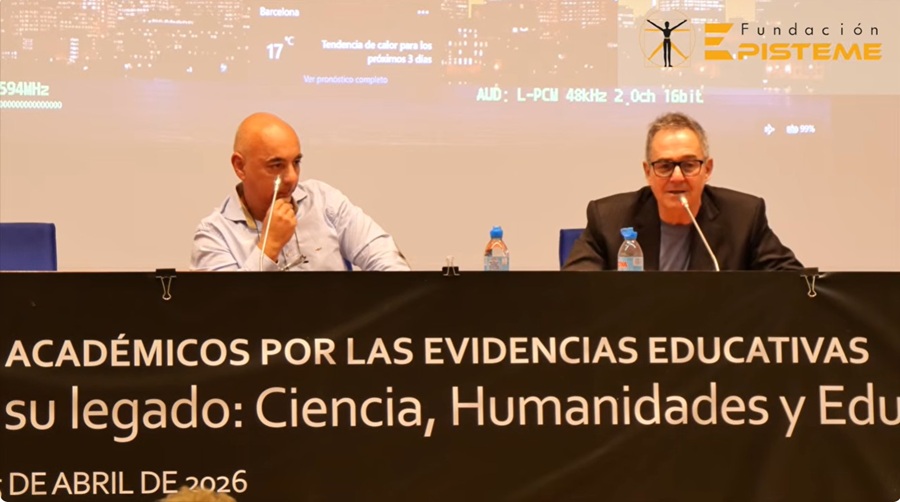
Welcome session at the Forum. Ignasi Fernández (left) and Xavier Massó. / Fundació Episteme


Joan Nonell
On 25 April 2026, the I Fòrum d’Acadèmics per les Evidències Educatives was held at the auditorium of the CSIC Researchers’ Residence in Barcelona. The event was organised by the Episteme Foundation, with the collaboration of Sindicat Professors de Secundària (ASPEPC-SPS), a secondary teachers’ union, among other organisations.
The timeliness of the event, taking place in a context of intense public debate surrounding the need for robust evidence to validate methodological changes in education, was reflected in the quality of its speakers. These were academics of considerable standing within the contemporary educational landscape, who succeeded in focusing the discussion and offering open and critical perspectives on the adoption of evidence in educational practice. Their contributions were complemented by two panel discussions drawing on classroom experience and the activism of family associations. The only thing missing, if one were to make any criticism, was the presence of representatives of the educational authorities willing to defend current educational policies, which many participants regarded as being shaped more by improvised ideas than by well-established evidence.
Former Portuguese Minister of Education and Science Nuno Crato opened proceedings with a lecture entitled Evidencias y mitos: currículo, materiales y aprendizaje profundo (Evidence and Myths: Curriculum, Materials and Deep Learning). The presentation itself provided a compelling demonstration of the importance of grounding educational practice in strategies supported by a proven historical record and firmly rooted in the European cultural tradition, namely book culture. Faithful to his experience in educational administration, Crato linked his defence of the textbook to the prior development of a well-structured curriculum organised according to principles of coherence, both vertical—incorporating knowledge and skills, but without allowing the latter to replace the former, since general skills without specific knowledge merely lead to fragmentation rather than structured understanding—and horizontal—through interconnections between different domains of knowledge that make deep learning possible.
In contrast to the current tendency to move away from the use of textbooks in education, abandoning them in favour of addressing the diverse needs of pupils, a trend that prioritises flexibility and differentiation rather than the unity and coherence capable of guaranteeing measurable cognitive achievement, Crato argued that a good textbook, insofar as it introduces pupils to the world of intelligent reading, fosters their intellectual development, brings them closer to scholarly culture and aligns them with the powerful knowledge embodied in scientific disciplines. Evidence supporting principles such as sequencing—the ordered acquisition of learning—multimedia learning—avoiding contradictions arising from the simultaneous use of verbal and visual channels in teaching—and coherence—prioritising the overall objective of an explanation over distracting details—not only makes a good textbook the most effective study aid, but also helps prevent the reliance on rote methods of non-meaningful learning into which pupils often fall when knowledge transmission lacks structure and order.
The second lecture of the morning was delivered by Francisco López Rupérez, former president of the Spanish State School Council, who, under the title El valor de las evidencias. Algunas lecciones para la educación española (The Value of Evidence: Some Lessons for Spanish Education), sought to demonstrate that a number of current educational practices run contrary to the available evidence. In this regard, he presented evidence as the key instrument for correcting dysfunctions in educational practice. From the outset, however, he acknowledged the distinction between the concept of evidencia in Spanish—a clear and manifest certainty that cannot reasonably be doubted—and evidence in English, which refers only to an indication of certainty derived from the presentation of one or more reasons in support of a belief. For this reason, the speaker advocated an education informed and guided by evidence, rather than one merely based upon it.
Drawing on the example of the application of evidence in medicine, with its six levels of depth integrating both practical experience and theoretical research, López Rupérez justified the extension of evidence-based educational policies and practices. The reasons ranged from the growing complexity of the contemporary school environment, together with the resulting decline in academic outcomes across Western countries brought about by the weakening rather than the strengthening of knowledge transmission—a tendency that runs counter to the historical success of medicine as a science—to the promotion of deontological principles capable of underpinning epistemological criteria based on the most reliable knowledge possible.
The defence of a professional code of ethics for teachers—similar to that which exists in medicine—which would distance the profession from undesirable educational outcomes that foster confusion and ignorance, would strengthen teaching itself by setting aside the heterogeneity of its knowledge base, often grounded more in ideological than in scientific approaches, in a limited body of facts and in doctrinal theoretical contributions of a philosophical nature that are difficult to verify.
The ethical principle of doing no harm to the pupil, in addition to questioning educational practices that cannot be objectively validated, would be sufficient to limit the improvised and uncritical use of innovation and ideology in education. It would encourage the necessary shift from a logic of intentions, with its culture of good intentions and lowered expectations, towards a logic of results based on rigour and academic expectations. Such a transformation would make possible a change of direction in Spanish educational policy through the replacement of a priori beliefs linked to ideological criteria with scientific knowledge that, as in the case of medicine, ought also to guide the teaching profession. We would thus move from the diffuse Educational Sciences of today towards a more clearly defined Science of Education capable of promoting and facilitating the evaluation of the impact of its findings on the long-sought improvement of education.
The morning session concluded with the first of the panel discussions. Moderated by Eva Serra, it brought together teachers with considerable experience and expertise, both in relation to the reality of Catalan classrooms and to the current legal framework, including Ignasi Fernández Daroca, David Rabadà, Otilia Dan and Jordi Osúa. Drawing on evidence from educational practice, they debated threats such as the overprotection of children in schools, the loss of teacher authority and the diminishing role of the textbook in the knowledge transmission. According to the panellists, the application of the prevailing reformist pedagogical creed has led to consequences such as an increase in psychological problems among young people (54 per cent having experienced some form of psychological difficulty), a rise in aggression against teachers (seven out of ten reporting that they have suffered some form of aggression), and a decline in reading comprehension, with 24 per cent of pupils failing to attain the expected level of competence.
The afternoon session brought a third lecture, this time delivered by Professor of Theory of Education Bianca Thoilliez, whose contribution provided a necessary critical counterpoint to the morning presentations. Under the title Más allá de lo que funciona. Evidencias, juicio pedagógico y déficit democrático en las prácticas de la enseñanza (Beyond What Works: Evidence, Pedagogical Judgement and the Democratic Deficit in Teaching Practice), the distinguished academic acknowledged that the current appeal to evidence is closely linked to the need to orient teaching towards practices that produce positive outcomes, challenging inadequate approaches and grounding educational decisions in firmer foundations than mere opinion.
However, the search for and analysis of evidence has generated epistemological tensions within the theoretical framework of pedagogy by raising doubts as to whether education constitutes a field of knowledge in its own right and, if it does, which educational practices can be objectively shown to be effective and which cannot. The ultimate aim of this line of enquiry would be the homogenisation of educational discourse and the democratisation of educational practice, making it applicable across different contexts and circumstances.
The pedagogical knowledge supposedly derived from the accumulation of evidence would make possible the generalisation of educational practices and the elevation of the discipline to scientific status. All this, however, comes into conflict with the practical reality of each classroom, situated within a specific social context that cannot be separated from educational practice itself and which conditions any attempt to generalise evidence, thereby provoking resistance among teachers to its application. Evidence may reveal effects, but not the appropriateness of the ends being pursued. Evidence therefore informs, but does not in itself possess decision-making authority. From these limitations derives the reduction of pedagogical knowledge to mere judgement: if the validity of evidence depends upon context, and context is constantly changing, then evidence must be placed at the service of educational practice as it adapts to each situation, rather than the other way round.
Within the sphere of pedagogical judgement, evidence is consequently the result of the interaction between knowledge, experience and reflection. The particularity of each educational context gives teaching a craft-like quality rather than that of a purely scientific practice, one that embraces uncertainty as a condition of good teaching. Possessing all the evidence necessary to eliminate every form of uncertainty would not only diminish the interest of daily teaching practice, understood as both challenge and opportunity, but would also place education exclusively in the hands of experts.
Drawing on the debate of the 1920s between Walter Lippmann and John Dewey concerning democracy—viewed by the former as a form of deliberation reserved for experts and therefore limiting wider civic participation, while the latter understood it as open participation available to all through the empowering effects of education—Professor Thoilliez contrasted evidence established by committees of experts, whose closest contemporary equivalent would arguably be artificial intelligence systems, with the individual judgement of each teacher, who retains both deliberative responsibility and ultimate decision-making authority. The democratic dimension of education would be short-circuited by the extension of an evidence-based programme to be implemented by teachers without any room for discussion.
All things considered, the conclusion emerging from the debate between the supposed pedagogical knowledge of experts and the educational judgement arising from classroom practice presents evidence as necessary but insufficient—more takes place within a classroom than can be measured according to criteria of effectiveness—and judgement as irreducible but not arbitrary. Consequently, what is required is the articulation of the two rather than their opposition, always placing evidence at the service of decision-making rather than the reverse, while giving prominence to, rather than replacing, the unique practice and the sound pedagogical and prudential judgement of each individual teacher, which cannot be objectively quantified.
The final lecture of the Forum was delivered by university lecturer and education inspector Miguel Ángel Tirado who, under the title Revolució tecnològica a l’escola (Technological Revolution in Schools), sought, in a deliberately provocative tone, to restore a measure of common sense to the educational world by recovering the most powerful tool available to human beings for thinking: writing. The greater part of his presentation consisted of demonstrating the evidence that supports this thesis. First, he highlighted the intrinsic and necessary relationship between competences and knowledge, taking reading comprehension as an example and showing that its attainment depends upon knowing something about what one is reading. The broader that knowledge, the greater the level of comprehension that can be achieved.
Secondly, he emphasised the importance of teaching writing in order to learn how to read, reminding the audience that the primary responsibility of the school is to promote the development of pupils’ natural intelligence. Reading, writing and engaging in reasoned conversation would constitute clear signs of the successful development of this natural intelligence, which enables us to think and which cannot be delegated to the increasingly ubiquitous artificial intelligence systems now present in schools. He then highlighted the striking absence of any concrete provisions regarding the teaching of writing in the decrees implementing Spain’s current education law, the LOMLOE. From this absence derives, contrary to all available evidence, the myth of the natural acquisition of reading and writing in children, as though these were merely extensions of speech, which we do indeed acquire through natural mechanisms.
In order to dismantle this myth, the speaker emphasised the distinction between what is natural, which develops by itself provided the appropriate conditions exist, and what is cultural, which requires teaching. Without such teaching, children are denied access to the world of knowledge and, more specifically in relation to writing, to the capacity to think for themselves. To demonstrate that writing well—which consists of structuring and connecting ideas—is equivalent to thinking well, and that this is decisive in enabling us to communicate effectively, the speaker presented the audience with an exercise designed to select and apply appropriate words in the written construction of communicative language. Under the title l’art de l’oració (The Art of the Sentence), the exercise teaches pupils how to relate sentence structures in order to expand, clarify and contextualise the statements through which they communicate their learning, using the three Ps—per què? (why?), però (but) and per (because/for)—which enable the extension of communicative content while simultaneously allowing pupils to think about it as they add new knowledge.
In conclusion, practice demonstrates that learning to write does not simply consist of acquiring a more or less mechanical technique, but rather constitutes a fundamental skill in the development of thought, an objective that has always been consistent with the aspiration to educate critical citizens capable of adapting to the changing conditions of the present. Secondly, the evidence likewise shows that the most effective policy of inclusion we can implement is to teach pupils to read and write well.
The Forum concluded with a second panel discussion, this time moderated by Xavier Massó and bringing together a diverse group of teachers, academics and representatives of family associations, including Aurora Trigo, Antoni Hernández-Fernández, Ramon Casals and Dori Huertas. Seeking to draw together the contributions made throughout the lectures and debates of the Forum, both the panellists and members of the audience reflected on the outcomes that, as compelling evidence, reveal the current state of our education system. Among the issues discussed were the stagnation of social mobility, the disruption caused by successive educational reforms in both technical and general education, the erosion of subject-based teaching, which has weakened the system, and the methodological absurdity of project-based work without the prior consolidation of knowledge, particularly in primary education.
Echoing many of the arguments advanced by the previous speakers, the call for a return to common sense would require confronting the available evidence while remaining aware of the cognitive biases that lead us to assume that a pedagogical practice that appears to work is necessarily a good one, when it must also be supported by scientific evidence. Finally, recognising the responsibility that educational practice bears for the future of the country, the participants reflected on the human capital currently being formed, drawing attention to the opportunity costs associated with lowering educational standards, the failure of a public education system incapable of compensating for pre-existing economic and social inequalities, and the deception inherent in the current misguided maximalist interpretation of the inclusive model. For all these reasons, participants in the Forum shared the conviction that the signals emerging from the current education system do not inspire optimism, offering more confusion and uncertainty than clear examples of successful educational practice.
Source: educational EVIDENCE
Rights: Creative Commons