


- Artificial intelligenceTechnology
- 9 de June de 2026
- No Comment
- 11 minutes read
Is using AI a Christian act—or a socialist one?

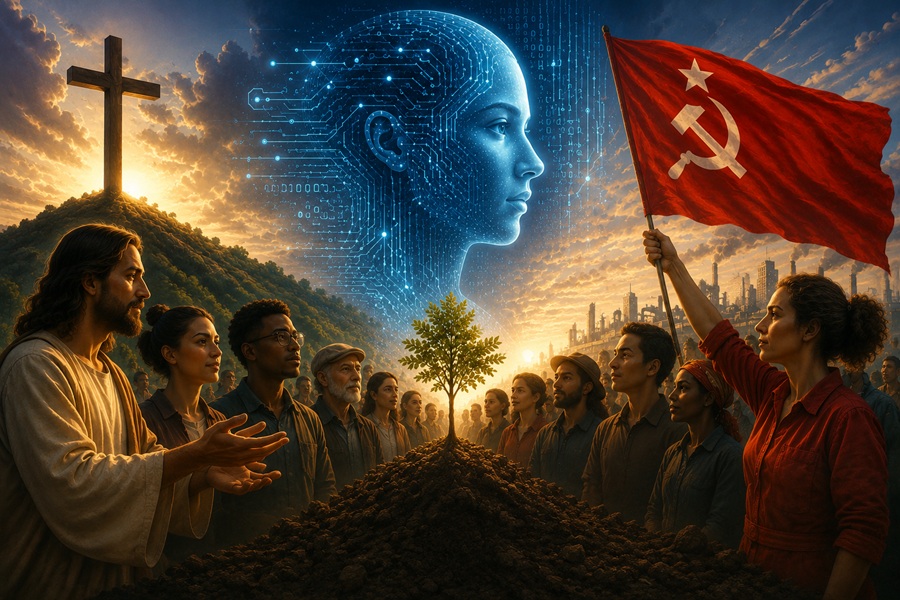
Image generated by AI


Neither science nor technology is free from ideology. The recent encyclical Magnifica Humanitas, promulgated by Pope Leo XIV, advances a position which, far from being technophobic, ought to be both uncomfortable and demanding, at least for Catholics: artificial intelligence (AI) is not intrinsically contrary to Christianity, but its use without moral discernment is (Leo XIV, 2026). Leo XIV argues that AI can amplify both human dignity and its potential degradation. For the Pope, technology is not the problem; rather, it is the conduct that underpins its development, deployment and application, together with the risk of turning society into a new Tower of Babel.
Leo XIV has articulated a critique that establishes a profound historical connection and one of considerable ecumenical significance by aligning himself with the concerns of his predecessor, Leo XIII. As early as the nineteenth century, through the encyclical Rerum Novarum, Leo XIII analysed the impact of industrial technology on the dignity of labour. In that context, marked by the rise of socialism and an increasing concentration of power in the hands of employers, the Church laid the foundations of its social doctrine in response to the challenges of modernity and the advance of capitalism (Leo XIII, 1891). Mechanisation, at that time, threatened to reduce the worker to little more than a mere cog in the industrial machine. One might even argue that the Industrial Revolution marked the beginning of a fusion between labour power and the means of production, thereby dehumanising the worker.
Today, technology continues to erode that boundary between worker and machine, but now at the cognitive level. It is no longer simply a matter of replacing manual labour or mechanising work; what was once exclusively human has also begun to be automated. The last remaining bastions of decision-making, creativity and even, as Pope Leo XIV now suggests, moral judgement are steadily disappearing. Indeed, Leo XIII embraced—implicitly, as one would expect—one of Marx’s central theses on technology, recently rediscovered by some philosophers and AI specialists as though it were an entirely new insight: the non-neutrality of the machine. According to this view, the social impact of technology does not reside in the artefact itself but in the social relations of production within which it is embedded. Under the logic of capital, what has the potential to liberate the worker is transformed into an instrument of exploitation and even a new form of slavery. That is before we even consider its global environmental impact, an issue largely absent from nineteenth-century debates and too often overlooked in contemporary ones.
The analogy—and the warning—drawn by Leo XIV is clear, though unsettling. If the Industrial Revolution dehumanised physical labour, the digital revolution may dehumanise thought and faith. Leo XIV warns that delegating ethical decisions to algorithms constitutes a form of moral abdication (Leo XIV, 2026). In this sense, the uncritical use of AI becomes a new form of technological idolatry: we place our trust in opaque systems as though they were morally neutral or even superior to human judgement and values. In a strikingly contemporary reading of the First Commandment (“You shall have no other gods before me”, Exodus 20:3), one might interpret the papal encyclical as a warning against the elevation of new forms of idolatry into absolutes, in which AI becomes a new Golden Fleece of the digital age, in a phenomenon akin to what Yuval Noah Harari termed “dataism” (Harari, 2016). AI is elevated to a governing principle of truth and authority, displacing transcendence itself and symbolically removing the divine from the centre of human affairs in favour of calculation and optimisation. Large Language Models generate words beyond the Word, reorganising human experience according to informational imperatives. One is left wondering how many religious texts have already found their way into the training datasets of LLMs.
To claim that the use of AI is inherently un-Christian would be an oversimplification, and one that would not do justice to Leo XIV’s more nuanced position. The Christian tradition does not condemn technology per se; rather, it insists that technology remain subordinate to the common good and to human dignity. And, naturally enough, to the interests of the Church itself. In theological terms, AI might be interpreted as the most ambitious expression yet of humanity’s sub-creative capacity—that dimension of the imago Dei which impels human beings to create new worlds and new forms. Yet it cannot replace human moral responsibility—a substitution against which Pope Leo XIV explicitly warns.
The concerns raised by Leo XIV are hardly new within contemporary Christian thought. More than a decade ago, Pope Francis’s encyclical Laudato Si’ denounced what it called the “technocratic paradigm”, whereby technical efficiency was displacing human values and ethical deliberation (Francis, 2015). Likewise, from a more explicitly theological perspective, Benedict XVI’s earlier Caritas in Veritate stressed that technological progress must remain subordinate to the integral development of the human person, and not the other way around (Benedict XVI, 2009). The Church makes use of technology, yet it has long been wary of the ideological forces that accompany it and of its role in the secularisation of society. Much the same could be said, however, of political parties and social movements.
From an academic standpoint, thinkers such as Jacques Ellul in The Technological Society (1964) and Neil Postman in Technopoly (1992) had already argued that technology tends to take on a cultural life of its own, imposing its own values upon society. More recently, Innerarity (2025) has likewise reflected on the risks and implications of automation in contemporary society, with AI increasingly mediating those transformations. This secular critique converges with the Church’s social doctrine: when technology ceases to be a means and becomes an end in itself, a troubling inversion of moral priorities occurs.
Viewed through the lens of Marxist political economy (Marx, 1867), one might argue that contemporary AI is reconfiguring the classical relationship between the worker and the means of production to such an extent that it is eroding both their conceptual and physical separation, giving rise to a form of cyborgised labour. If, in nineteenth-century industrial capitalism, the worker embodied labour power in confrontation with external means of production—machines, factories and tools—the growing integration of computing systems and AI into production processes has absorbed cognitive, decision-making and creative functions into the technical apparatus itself, blurring the boundary between subject and device. For AI is not merely a tool: it acts as an agent.
Within this framework, education plays a decisive role. As education increasingly shifts towards a competence-based model—instrumental, adaptive and increasingly mediated by algorithms—schools that fail to cultivate critical thinking and social awareness, together with sound technological literacy, will help produce a conformist workforce whose work has already been shaped by technical systems. This could be interpreted as a deeper form of the subsumption of labour under capital. Labouring subjectivity becomes functionally integrated into the means of production themselves rather than confronting them as something external. In the end, nobody resists. Nobody pushes back.
Paraphrasing Marx (1867), machinery—like AI today—considered in itself, shortens working time; used as capital, it lengthens the working day. In itself, it eases labour; used as capital, it intensifies it. In itself, it represents a victory over the forces of nature; used as capital, it subjects people to the yoke of those natural forces and of the artificial forces of their own making. In itself, it increases wealth; used as capital—whether environmental, cognitive, cultural or social—it impoverishes us.
The truly controversial position—and perhaps the most honest one—is this: regardless of political ideology or religious belief, using AI can be Christian, or Marxist, but using it uncritically is probably neither. Automating decisions that affect justice, truth or human dignity without ethical oversight amounts, from this perspective, to a form of moral negligence. In some contexts, it is also illegal, at least within the European Union.
Ultimately, Leo XIV does not forbid Catholics from using AI: he demystifies it. Those who idolise it sin. In doing so, he leaves us with a more uncomfortable question. The issue is not whether using AI is Christian or un-Christian, but whether those who use it do so in a genuinely Christian way. And, as opposites attract, the same reflection could equally be applied to socialism. So whose side are you on: the machine’s, or the worker’s?
References:
Benedicto XVI. (2009). Caritas in Veritate. Vatican. https://www.vatican.va/content/benedict-xvi/es/encyclicals/documents/hf_ben-xvi_enc_20090629_caritas-in-veritate.html
Ellul, J. (1964). The technological society. Vintage Books.
Francisco. (2015). Laudato Si’. Vatican. https://www.vatican.va/content/francesco/es/encyclicals/documents/papa-francesco_20150524_enciclica-laudato-si.html
Harari, Y. N. (2016). Homo Deus: A brief history of tomorrow. Random House.
Innerarity, D. (2025). Una teoría crítica de la inteligencia artificial. Galaxia Gutenberg.
León XIII. (1891). Rerum Novarum. Vatican. https://www.vatican.va/content/leo-xiii/es/encyclicals/documents/hf_l-xiii_enc_15051891_rerum-novarum.html
León XIV. (2026). Magnifica Humanitas. Vatican. https://www.vatican.va/content/leo-xiv/es/encyclicals/documents/20260515-magnifica-humanitas.html
Marx, K. (1867/1975). Capital: A Critique of Political Economy. Volume I. Penguin Books Editores. https://ia902808.us.archive.org/12/items/ElCapital.LibroPrimerovol.1K.Marx/El%20Capital.%20Libro%20primero%20%28vol.%201%29%20-%20K.%20Marx.pdf
Postman, N. (1992). Technopoly: The surrender of culture to technology. Vintage Books.
Source: educational EVIDENCE
Rights: Creative Commons