


- Opinion
- 28 de May de 2026
- No Comment
- 9 minutes read
Selectividad 100%

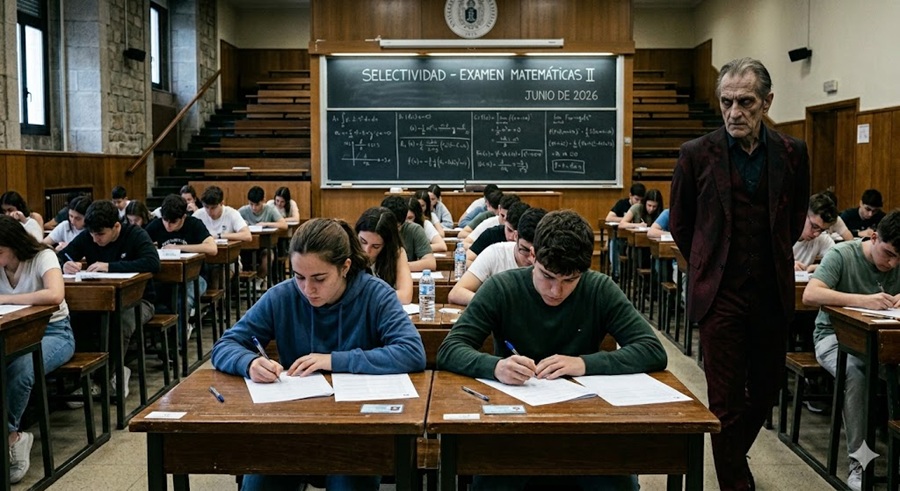
Image generated by AI (Gemini/NanoBanana)


Like Lucifer — the “Bearer of Light” before his fall — Selectividad remains the original name, and the one everybody still remembers, for Spain’s university entrance examinations. Officially, the term disappeared years ago, yet whenever the end of the academic year approaches, classrooms across the country continue to invoke it time and again above all the later acronyms.
At the recent International Forum on Education and Technology (FIET), held in Riobamba, I was particularly pleased by the contribution made during one of the round tables by Francesc Xavier Grau Vidal, former rector of Universitat Rovira i Virgili (2006–2014) and current president of the Agència per a la Qualitat del Sistema Universitari de Catalunya (AQU). What struck me most was that, in the name of equity, he defended something many of us have long argued for: university admission should depend upon an external examination entirely detached from upper-secondary school grades. And it is no small matter that this position should come from someone with deep knowledge of the university system who now leads one of Spain’s principal quality agencies. His remarks encouraged me to write these reflections.
Spain’s current university admissions model — in which 60% of the final mark derives from bachillerato (upper secondary education) grades and 40% from the university entrance examinations themselves, which, like the devil, go by many names: PAU, EBAU, PAEU and so forth — is ultimately nothing more than a numerical mechanism for ranking students in competition for a limited number of places on each degree programme. The system is both outdated and deeply unfair, essentially for two reasons: one social and the other geographical.
First, statistically speaking, many private schools — whether state-subsidised or fully independent — inflate grades significantly. As a consequence, 60% of the admissions weighting effectively becomes something that can be bought by those able to pay for it, thereby reinforcing class divisions and preserving inherited social privilege.
Second, the examinations vary from one autonomous community to another, beyond the additional papers corresponding to the co-official languages of certain regions. Yet the university admissions district is formally unified, meaning that students may theoretically apply to universities anywhere in Spain. Sitting the examinations in a region where the papers are easier therefore confers measurable advantages.
Allow me, then, to outline several proposals — ideas that have begun appearing with increasing frequency in public debate over recent years — while also acknowledging some of their limitations along the way.
To correct the class bias built into the present system, the most direct reform would be to reverse the weighting of the marks, granting the external examination 60% or more of the final score. Personally, I would go further and make it 100%. In other words — as Professor Grau Vidal himself suggested — university entrance scores should be entirely detached from bachillerato grades. Could students have a bad day? Certainly. But that possibility applies equally to everyone. By reducing — or even eliminating altogether — the importance of school records, we would reduce the incentive for schools artificially to inflate grades (let us set aside for the moment whether they are public or private, though the statistics speak for themselves) while protecting students from more academically rigorous schools who currently find themselves placed at a disadvantage. Would bachillerato continue to function primarily as preparation for university entrance examinations rather than as genuine learning? Perhaps. But that is already the case. Indeed, if school grades carried less weight — or none at all — students might actually be freer to focus on learning itself. Could wealthier families still pay for private tuition and language academies, while students from more educated households continue to enjoy advantages at home? Of course. But such social inequalities cannot simply be abolished, and having everything depend upon a single examination may at least offer opportunities that many students currently lack.
There should also be audits examining excessive discrepancies between bachillerato grades and official examination results. Such measures would introduce a degree of transparency and help ensure that the bachillerato qualification cannot be shaped by family income. Mandatory publication of comparisons between schools’ bachillerato grades and their university entrance examination results could itself act as a deterrent against artificial grade inflation. Public scrutiny might encourage poorly performing schools to react accordingly — and perhaps even to invest more seriously in attracting and retaining their best teachers. Such aggregated data should be publicly available, except in exceptional cases where student privacy could be compromised through the indirect identification of individual results. Or are we afraid of transparency?
As for the geographical imbalance, the fairest technical solution would be the establishment of a single national examination with identical content and identical marking criteria for all students. In relation to common subjects, this seems self-evident. As for the co-official languages present in certain autonomous communities, optional subject pathways could be introduced in the bachillerato curriculum of those regions where such languages are absent, with an equivalent teaching load. Students could then choose to sit examinations in two out of three languages. Thus, in some regions students might take examinations in Spanish and English (or another recognised foreign language), whereas elsewhere they could choose between those languages and the co-official language itself — Galician, Basque, Catalan or Valencian. Would it be unequal for some students to enjoy that choice while others do not? They would, after all, have earned it by taking an additional compulsory subject during bachillerato.
Indeed, one might even argue that the possibility of dispensing with the English examination would benefit students unable to afford private language academies outside the school system. Should students still learn English? Naturally. And they will have years to improve their proficiency at university, where a minimum foreign-language level is required for graduation. But again, are we discussing learning itself, or a fairer system of university admission? Moreover, why not encourage the optional study of Spain’s other co-official languages throughout all bachillerato programmes, thereby giving students who choose them not only greater flexibility within the university entrance examinations, but also broader professional opportunities in the future? The possible scenarios are numerous. Under a unified examination system, for example, a student who had moved for family reasons from an autonomous community with a co-official language could choose to sit the examination there in their mother tongue.
Such reforms would help ensure that Spain’s unified university admissions district operated according to principles closer to meritocracy — however idealised, and however frequently criticised, that notion may be in contemporary debate — whereby the same mark reflected the same level of competence regardless of a student’s geographical origin. If full centralisation proved legally or politically impossible, then at the very least a strict harmonisation of examinations and marking rubrics would be indispensable.
Restoring equity is no easy task, and perhaps it is ultimately utopian. Yet it remains worth attempting. One possible measure would involve implementing a scholarship and admissions system based upon students’ academic percentile within their own school and social context, thereby recognising the efforts of pupils who excel in difficult or vulnerable environments in contrast to those operating within highly advantaged socioeconomic settings.
Likewise, it is essential to raise the level of academic demand within the examinations themselves in order to correct the current saturation of maximum grades, thereby preventing admission to the most sought-after degree programmes from depending upon socioeconomic bias or being decided by trivial mistakes. Tougher assessment criteria would produce a more realistic distribution of grades, one capable of distinguishing genuine knowledge from the mere accumulation of immaculate school records — records that, in many cases, are effectively bought. This would help mitigate the present situation in which admission to the most competitive degree programmes has become a lottery decided by hundredths of a mark inflated by class and geographical inequalities.
Finally, I would like to wish the very best of luck to all those preparing to face this examination of a thousand names. May it prove this year not to be the fallen angel, but the bearer of light illuminating your pages and guiding your path towards university and the future ahead. And special good fortune to those who have enjoyed rather less of it in life so far — beginning with the place where they happened to be born.
Source: educational EVIDENCE
Rights: Creative Commons