


- Opinion
- 13 de May de 2026
- No Comment
- 7 minutes read
Between a botched job and wishful thinking

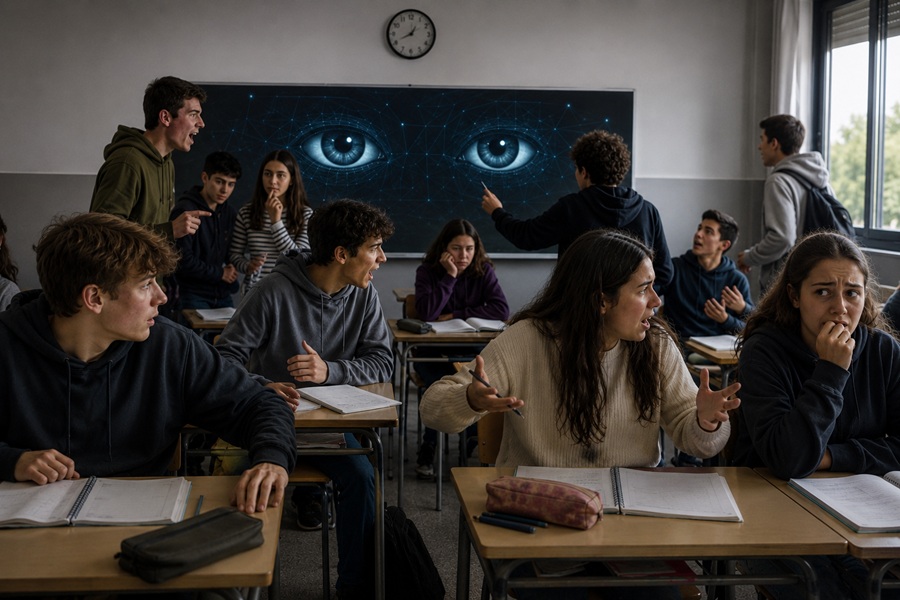
Image created by AI.


Joan Nonell
The Department of Education has once again taken the educational community by surprise with a measure that, one assumes, must have been endorsed and agreed upon by the array of eminent educationalists who advise it, as well as by the School Council of Catalonia, school leadership teams and parents’ associations. Those who have clearly not been consulted—judging by the emphatic opposition voiced by teaching staff in most of the affected secondary schools—are teachers and the trade unions that represent them. This, however, is hardly new if one considers the Ministry’s track record, not least the much-vaunted “national pact” recently signed behind the backs of the teaching profession and its principal representatives by the government and pliant trade unions, ever ready to return favours to those who fund them.
The latest initiative involves deploying plainclothes Mossos d’Esquadra (Catalonia’s regional police force) officers in those secondary schools facing the most serious disciplinary problems. It is described as a pilot scheme; yet by publicly naming only a handful of selected schools, the authorities have effectively stigmatised them overnight. One such school, Eugeni d’Ors in L’Hospitalet de Llobregat, is especially familiar to me, as I was a member of its teaching staff between 2006 and 2010, serving as Head of Studies during my final three years there. Much of my work in that period consisted in addressing both latent conflict—rooted in the social realities of the neighbourhood—and overt conflict, exacerbated by the neglect of educational authorities, who never made our task of bringing things under control any easier. Although I do not know the school’s current situation—and comparisons are always tricky—I find it hard to believe that today’s levels of conflict surpass those we faced at the time.
What was required then was the full commitment of the staff, a Behaviour and Discipline Committee meeting twice weekly, a firm resolve to use the regulatory tools at our disposal, and, above all, a willingness to pursue not only coercive but genuinely educational responses—transforming permissiveness and indiscipline, fear and hostility, into rigour and trust. The aim was to establish a climate conducive to teaching and to make the school a safe space for all pupils. With more than fifty disciplinary proceedings a year on average—some resulting in exclusion—alongside the referral of the most vulnerable pupils to the municipality’s UEC (Unitat d’Escolarització Compartida, or Shared Schooling Unit), and the creation of an internal workshop classroom offering an alternative curriculum pathway when external resources were denied to us, we sought to respond to each case individually, always in agreement with families, and without resorting to a policing approach. The police were not absent, but their role was confined to monitoring the areas around the school and assisting with investigations into crimes in the neighbourhood, at a time marked by clashes between Latin gangs competing for territory and recruits.
We were not immune to tensions and unease; we received threats, and graffiti appeared on the outer walls of the school. Yet we succeeded in shielding the institution from the climate of pressure and insecurity that others sought to impose. Nor did we win much favour with local education authorities, who were alarmed by the high number of disciplinary sanctions and increasingly promoted mediation schemes, prevention workshops and integration activities. We never refused to participate in such programmes, but neither did we yield to repeated demands to reduce disciplinary sanctions when the school rules were broken. The requirement to produce a formal School Behaviour and Community Relations Plan was the final expression of this institutional pressure before I left my post, owing to internal disagreements over how best to improve academic outcomes. More than fifteen years on, we have come full circle.
With the benefit of hindsight, the decision to hand over responsibility for school discipline and behaviour to the police is a clear sign of systemic failure—on the part of politicians, institutions and families alike. To curtail the agency of teachers, who are best placed to identify conflict and distress in the classroom, is not only illogical; it also undermines their authority and exposes them to becoming victims of school violence themselves. It is akin to asking judges to dispense with the law when issuing their rulings. The inevitable outcome is greater arbitrariness and uncertainty—conditions ill-suited not merely to teaching and learning, but to any meaningful educational interaction.
If the measure betrays anything, it is haste and short-term thinking. Yet it also appears to form part of a more calculated drift towards the gradual dismantling of the public education system. When a school community relinquishes disciplinary authority to an external body that places security above education, the boundary between school and street disappears — the very boundary that, at Eugeni d’Ors fifteen years ago, we fought to preserve at all costs in order to provide a climate of trust and stability, foster each pupil’s personal development and maturation, and offer some protection in a social context that was anything but favourable, and was marked by structural violence.
When the police enter a school, they bring with them the full weight of society’s unresolved problems, undermining the protective space pupils need if they are to succeed. What we are witnessing, then, is simply another botched response: a hurried attempt by policymakers to contain rising classroom conflict after years of encouraging schools to abandon the rigorous management of behaviour and discipline, on the naïve assumption that peace and a positive school climate, like cabbages, simply grow of their own accord, and that conflicts among pupils will somehow resolve themselves without intervention or sanctions. Between a botched job and wishful thinking — between seeing the school as a mere reflection of the neighbourhood’s hardships and imagining it as an idyllic Arcadia — we have for too long neglected the principle that has always guided education: teaching our children and adolescents how to live together. And this — not anything else — is unmistakably a teacher’s responsibility.
Source: educational EVIDENCE
Rights: Creative Commons