


- Cover
- 20 de November de 2026
- No Comment
- 12 minutes read
Education and the 29 November elections: the future of the LOMLOE divides the PSC and the PP1

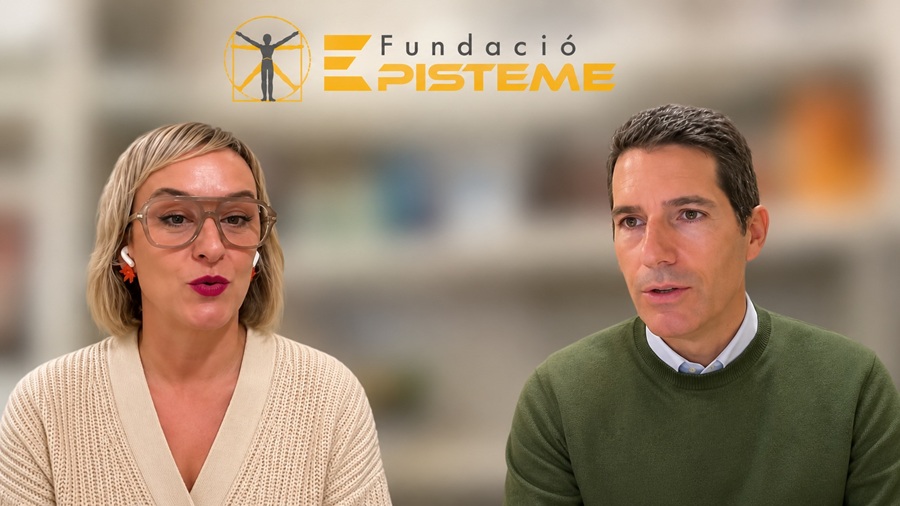
Photo: The two representatives during the debate. / Fundación Episteme
Gisela Navarro (PSC-PSOE) and Nacho Martín Blanco (PP) set out their contrasting education models


Educational Evidence
Just days before the 29 November elections, education took centre stage in a political debate. While the PP is calling for a new law that restores the importance of knowledge, merit and high academic standards, the PSC supports retaining the LOMLOE, while acknowledging that its implementation needs to be improved. These positions were set out at an online event bringing together Gisela Navarro Fuster, spokesperson for the Socialistes-Units per Avançar parliamentary group on the Education and Vocational Training Committee of the Parliament of Catalonia, and Nacho Martín Blanco, former vice-chair of the Congress of Deputies’ Education Committee and a member of parliament during the 2023–2026 legislative term. The event, organised by Fundación Episteme in collaboration with Educational Evidence, was chaired by Eva Serra.
The debate began from a shared observation: education proposals tend to be sidelined in favour of other items on the political agenda, despite their considerable social importance. The organisers explained that other parties had not been invited because of time constraints and their intention to focus the discussion on the national level, particularly the future of the LOMLOE and the alternatives that might emerge after the elections. Six themes provided a framework for examining the state of the education system, the education model, teaching methods, teachers, inclusion and the reforms needed.
PISA2: One report, two diagnoses
PISA results and the decline in performance in reading, mathematics and science set the scene for the first clash of views. For Gisela Navarro, the results are poor and should help shape public policy, but they do not justify portraying the education system as a failure. She argued for a multifactorial diagnosis that takes account of social complexity, young people’s changing habits and the influence of social media.
The Socialist representative identified reducing early school leaving and increasing participation in post-compulsory education as key challenges
The Socialist representative identified reducing early school leaving and increasing participation in post-compulsory education, both university and vocational, as key challenges. To improve learning, she proposed specifying the knowledge pupils should acquire in each school year, identifying difficulties at an early stage, and providing teachers with more resources and training.
Nacho Martín Blanco offered a much more critical assessment. He described the PISA results and other international indicators as a ‘disaster’ and argued that they could not be separated from the education policies that had been pursued. In his view, the system had sidelined knowledge, merit and a culture of hard work in favour of a model that placed excessive emphasis on competencies. He called for a return to high academic standards, discipline and the pursuit of excellence, as well as greater recognition of the teaching profession.
LOMLOE: Continuity or repeal?
The future of the LOMLOE was one of the areas of greatest disagreement. Martín Blanco unequivocally called for a new education law. He argued that literacy, mathematics and science needed to be strengthened, that a clear, common curriculum should be restored, and that academic standards should be reviewed. He also challenged the constructivist approach when, in his interpretation, it reduces the teacher’s role in transmitting knowledge.
Martín Blanco argued that new legislation should be based on scientific evidence
The new legislation, he argued, should be based on scientific evidence and involve teachers and organisations from across the education community. He did not set out a timetable for the reform, but insisted that education must be a priority for the next Government.
Navarro rejected the need for a new law. She pointed out that the LOMLOE is itself an amendment to existing legislation and argued that education needs stability, time and public policies that can be consolidated.
She acknowledged that aspects of its implementation could be improved, but highlighted the progress made in reducing early school leaving and increasing participation in post-compulsory education. For the Socialist MP, the focus should be on improving the implementation of the law and providing it with the necessary resources, rather than embarking on another succession of legislative reforms.
Pedagogical innovation: Knowledge and competencies — opposing models?
The effectiveness of the pedagogical innovations introduced in recent years prompted another significant exchange. Navarro argued that memory, knowledge and a culture of effort are entirely compatible with innovation and inclusion. She stressed the importance of autonomy for schools and teachers, and maintained that innovation only makes sense when it leads to a genuine improvement in learning.
Navarro argued that memory, knowledge and a culture of effort are entirely compatible with innovation
For her, knowledge provides the foundation on which the competencies needed to solve problems and develop critical thinking are built. She therefore rejected the idea that the two approaches are in opposition.
Martín Blanco insisted that the results made it necessary to review teaching methods and challenged an approach to schooling that, he argued, was too focused on shielding pupils from frustration. He advocated systematic teaching, memorisation and high academic standards. He cited Castile and León as an example, describing the region as a benchmark because of its educational results and reading programmes.
The contrast extended to the question of ideology in the curriculum. The PP MP denounced what he saw as an excessive ideological presence in the LOMLOE, while Navarro rejected that interpretation and defended the inclusion of female role models in science subjects to broaden opportunities for girls. Martín Blanco, for his part, challenged certain gender-based approaches and their application to academic content.
Teachers: Authority, training and recognition
There was more common ground than disagreement in this section. Both participants argued that the teaching profession needed to regain its standing and that teachers should recover the social recognition they believe they have lost.
Both participants argued that the teaching profession needed to regain its standing and that teachers should recover the social recognition they believe they have lost
Martín Blanco proposed restoring teachers’ status as public authorities in law, raising the entry requirements for degree courses leading to teaching careers, and establishing a clearly defined career structure throughout Spain, with incentives linked to improvement and excellence.
Navarro agreed that the university training of future teachers needed to be reviewed and improved, that bureaucracy should be reduced, and that teachers’ status as public authorities should be reinforced. She added, however, that authority cannot depend solely on legislation: it also requires a relationship of trust between teachers, families and society.
Inclusive schooling: The role of special education
Inclusion was one of the areas in which the two models diverged most sharply. Navarro defended inclusive schooling as a social achievement that must be protected, while acknowledging that its development had not always been matched by the necessary resources. She called for more support teachers, specialists, educational psychologists and resources to address pupils’ diverse needs. She also emphasised the role of special schools, which she considers necessary in a system that must offer different responses to different needs.
Martín Blanco shared the aspiration of an inclusive society but questioned how the model had been implemented. In his view, the LOMLOE had marginalised special schools, whose role and autonomy should be restored. He warned that poorly conceived inclusion could end up producing exclusion within mainstream classrooms.
Martín Blanco warned that poorly conceived inclusion could end up producing exclusion within mainstream classrooms
When discussing the first measures they would introduce if they came to power, Martín Blanco added the restoration of teachers’ authority and a common university entrance examination across Spain to his proposed review of the inclusion model.
Navarro, for her part, stressed the need first to listen to teachers, families, pupils and local communities. She identified early-years education for children aged zero to three, grants, vocational education and training, resources for teachers and ongoing assessment as priorities.
An education pact and assessment: The agreement still to be reached
Both representatives supported a national education pact, although they disagreed on how achievable it was. Navarro considered such a pact essential to ensuring stability and preventing each change of Government from bringing a shift in education policy. She attributed the lack of agreement to the tendency of political parties to put what divides them ahead of what they have in common.
Both representatives supported a national education pact, although they disagreed on how achievable it was
Martín Blanco also called for a major national agreement, but expressed doubts about its viability given the current polarisation into political blocs. He also called for clearer curricula, organised by subject and school year, and rigorous assessment of both the system and pupils, including external tests where necessary. Navarro pointed out that international assessments and internal tests at the middle and end of each stage already exist, and argued that data should inform public decisions.
Questions from the audience: External tests, resits and everyday problems
The question-and-answer session brought the debate down to practical issues. Antonio Jimeno asked Martín Blanco whether the PP was considering an external examination at the end of compulsory secondary education (ESO), with academic value and as a requirement for entry to the academic or vocational upper-secondary pathways. The MP confirmed that this was one of his party’s proposals and argued for a national assessment that would make it possible to compare results across Spain’s autonomous communities.
Navarro was also asked about the Socialist Party’s election manifesto and whether its proposals were sufficient to improve pupils’ knowledge and study habits. The MP replied that results depended on investment and on the resources reaching schools, and highlighted the increase in the education budget.
The audience concluded the event by praising the constructive tone of the discussion
Other contributions raised the shortage of supply teachers during staff absences, the review of state funding agreements with private schools, the decrees governing staffing and school leadership autonomy, and the possible reinstatement of September examinations. Navarro explained that in Catalonia supply teachers are appointed on a daily basis and pointed out that the decision to make a pupil repeat a year rests with the teaching team together with the family. Martín Blanco argued for the return of September examinations — or examinations at another time of year — and for retaining the genuine possibility of repeating a year when academic performance warrants it.
The discussion broadened to international models. Martín Blanco again cited Castile and León as an example, while Navarro agreed that its results deserved attention and added Estonia, highlighting its strong PISA performance and commitment to technological innovation.
Towards the end, both participants discussed artificial intelligence. Navarro argued that pupils should learn to use it with digital competence and critical judgement. Martín Blanco agreed that its potential should be harnessed, but warned of the risk of encouraging intellectual laziness and championed traditional reference tools such as dictionaries and encyclopaedias.
The audience concluded the event by praising the constructive tone of the discussion. Beyond their differences over the LOMLOE, knowledge, inclusion and assessment, the debate left one fundamental question hanging: how can we build an education system that improves its results, offers opportunities and achieves the political stability needed to sustain reforms over time?
___
1 LOMLOE: Spain’s 2020 Organic Law amending the 2006 Education Act, which provides the current legal framework for the education system.
PSC: Partit dels Socialistes de Catalunya (Socialist Party of Catalonia), the Catalan socialist party affiliated with the Spanish Socialist Workers’ Party (PSOE).
Partit dels Socialistes de Catalunya+1
PP: Partido Popular (People’s Party), Spain’s main centre-right political party.
___
2 PISA (Programme for International Student Assessment): an international study conducted by the OECD that assesses the knowledge and skills of 15-year-old students in reading, mathematics and science.
___
Watch the debate:
Special election debate: What kind of education system do we want after 29 November?
Source: educational EVIDENCE
Rights: Creative Commons