


- Opinion
- 14 de May de 2026
- No Comment
- 6 minutes read
Is Catalan dying in schools?

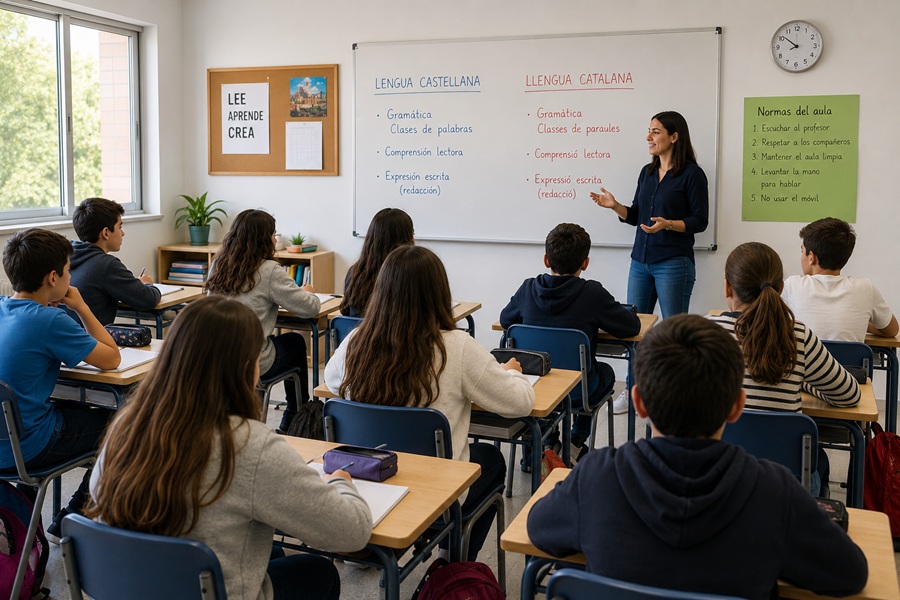
Image created by AI.


The Catalan education system, like its Spanish counterpart, shows a troubling inability to improve outcomes for pupils who struggle during ESO (compulsory secondary education). Recent work by Ismael Sanz, head of education at Funcas, shows that deficits in reading and mathematics identified at the age of ten persist into mid-adolescence, as confirmed by the Programme for International Student Assessment (PISA). This stagnation hampers pupils’ later development, even as completion rates at the end of ESO have risen—often without any corresponding improvement in linguistic competence, owing to a perceptible lowering of expectations. To this must be added the politicisation of both national and regional languages.
For more than a decade, Catalonia’s education system has been caught in a protracted dispute between the courts and the Generalitat over the legal status of language in the classroom. The result has been a dense thicket of rulings, decrees and appeals which, for all their complexity, have done little to arrest the decline in the social use of Catalan.
Although the origins of the conflict are commonly traced to the well-known “25 per cent ruling”, its roots lie in the 2010 judgment of the Constitutional Court of Spain on the Statute of Autonomy. The Court then endorsed Catalan as the “centre of gravity” of the system, in the interests of linguistic normalisation, provided that Spanish was not excluded. Yet patterns of language use have moved in the opposite direction: whereas in 2003 half the population used Catalan as their primary language, two decades later the figure has fallen to 32 per cent, with Spanish rising to 48 per cent. This led to legal challenges brought by families seeking more instruction in Spanish, who argued that the existing model discriminated against that language, culminating in the 2012 rulings of the High Court of Justice of Catalonia and the Supreme Court of Spain, which mandated a stronger presence for Spanish—though without specifying precise quotas. Under Artur Mas, the Generalitat responded with a careful balancing act, attempting to preserve Catalan while avoiding overt legal defiance, even suggesting that hours of Spanish could be accounted for through work carried out during the holidays.
The situation escalated on 16 December 2020, when the High Court of Justice of Catalonia imposed a minimum of 25 per cent of teaching in Spanish across the system. The Generalitat’s response—through Decree-Law 6/2022 and Law 8/2022—was to abandon fixed percentages altogether, in line with the reforms introduced by LOMLOE, and to devolve responsibility to individual schools, requiring them to design language policies suited to their sociolinguistic context. Although the Constitutional Court of Spain upheld this framework in 2024, it retained the ambiguous requirement of a “reasonable presence” for Spanish. Litigation has since continued on a case-by-case basis: where families bring complaints, the High Court of Justice of Catalonia has tended to require that at least one core subject area—typically mathematics or science—be taught in Spanish. A further ruling on 8 September 2025 annulled the regulations implementing the 2022 law, on the grounds that it still marginalised Spanish, and a subsequent order in March authorised its provisional enforcement, a measure which, although it does not immediately alter the overall situation across all schools, opens the door to further individual challenges.
Meanwhile, the reality within schools diverges sharply from this legal narrative. As the linguist Carme Junyent observed, Catalan arguably displayed greater vitality under Francoism—despite institutional repression—than it does today under self-government. The debate has increasingly narrowed to a semantic distinction between Catalan as a “language of instruction” or a “preferred” language, while legislative formulations remain largely disconnected from effective practice.
One of the most serious underlying problems lies in the erosion of both value and effort in learning. The C1 certificate in Catalan is now routinely awarded at the end of ESO (compulsory secondary education), often without students possessing genuine competence or any meaningful incentive to apply themselves. Teachers, moreover, are frequently left unsupported: when pupils’ command of Catalan is limited and the subject matter demanding, the pragmatic response is to switch language in order to keep pace with the syllabus, in the absence of any real institutional backing. Administrative neglect extends further still, to the point that in many Vocational Education and Training (VET) programmes there are not even textbooks available in Catalan.
What emerges, in the end, is a state of paralysis. The defence of Catalan in schools has become just that: a chronicle of inaction. Legal victories before the Constitutional Court count for little if the real battle is being lost in playgrounds and school corridors. No judicial ruling will preserve the language so long as expectations continue to fall. If Catalan—and indeed Spanish—is to function genuinely as a language of instruction, the priority must shift away from political confrontation and towards greater academic rigour in the classroom.
Source: educational EVIDENCE
Rights: Creative Commons