


- Humanities
- 11 de May de 2026
- No Comment
- 13 minutes read
Ignacio Castro Rey: “A new cultural, economic and military alliance is urgently needed”

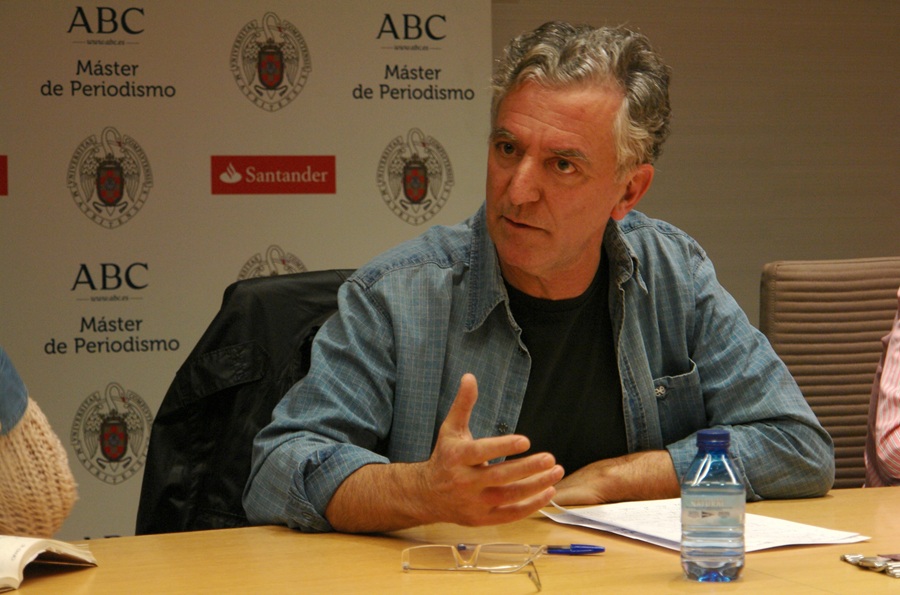
Interview with Ignacio Castro Rey, philosopher. / Photo: courtesy of the author



Ignacio Castro Rey —philosopher, film and art critic, activist and tireless lecturer—has published Antropofobia. Inteligencia artificial y crueldad calculada (Pre-Textos, 2024), Sexo y silencio (Pre-Textos, 2021) and En espera (La Oficina, 2021), among many other works.
What are Anthropophobia and Transhumanism? Are they the same thing?
Both phenomena have at least followed parallel trajectories. Technique is as old as humanity—perhaps as old as the earth itself, since animals have always made use of it. Contemporary technology is another matter altogether. Accelerating from the mid-twentieth century onwards, it emerges as a continuous plexus that capitalises on the migration of populations into large metropolises in order to inject the hope of a solution to the torments of the “human factor”: its pathological instability and the ceaseless moral dilemmas it poses. First came the “doctrine of separation” (Rudolf Steiner), with regard to the virus of the earth and its peoples—a doctrine that underpins the founding of the United States as a kind of modern Israel chosen by God. With AI and its antecedents, technology later attempts to carry that separation into the very heart of the subject, detaching intelligence from whatever pertains to the heart, the body and the affects. What is sought is an intelligence that does not depend on experience, but on an elite that handles privileged information. Transhumanism and, later, posthumanism expand this dream of definitively breaking with what is common to the human condition.
“Under the pretext of abandoning anthropocentrism, the gurus of technology in fact aim to break with what shared existence embodies in intelligence and morality”
Under the pretext of abandoning anthropocentrism, the gurus of technology in fact aim to break with what shared existence embodies in intelligence and morality—something that binds human beings together and connects them with all living creatures. Were such a plan to succeed—fortunately impossible—it would mark the end of any moral limits on the designs of the State–market. It is no coincidence that the emergence of transhumanism and posthumanism, with their transparent ambitions, coincides with dark genocides such as we had scarcely known before. We do not even know whether the sexual perversions and pornography that now permeate everything might be desperate forms of defence of a personal intimacy forced to retreat inward, besieged on all sides.
What is this “celestial vanguard” you denounce in Antropofobia? What are its ideology and its aims?
From Ray Kurzweil to Jeff Bezos, the figures leading technological agendas are bleakly pessimistic about traditional life. They would prefer populations surrendered to an untouchable vanguard, partly because, in their view, old feelings, intuitions and customs are no longer of any use. This is a key issue in contemporary programmes such as Agenda 2030: intelligence nourished by life—by the will to resist, by anger or moral indignation in the face of external pressure—must give way to a global interactivity grounded in what has been termed interpassivity. This celestial vanguard constantly invokes the promise of a tomorrow that confirms the unstoppable process to which we must submit. Time and again we are told: “This is only the beginning”.
We are assured that information technologies are still in their infancy. Curiously, this promise rests on the wasteland (precarious labour, psychological instability, wars) into which we have turned the present—a kind of anthropological desert that technology and macroeconomics have helped to intensify. And not because of fossil-fuel pollution, but owing to an informational liquidity that effectively forbids us from feeling and thinking for ourselves. “Beware of trusting your senses”, so say these latter-day enlightened sages. Popular intuition is, for them (as also for Yuval Noah Harari), an insult—since it would imply that no one needs them in order to exist and think.
What is the South?
It is a way of naming a world of intelligence and values in which affects—both communal and individual—still take precedence, along with feeling and experience. This is true in Mexico and Italy alike, quite apart from the morbid connectivity produced by the isolation injected by the Anglo-American dogma. This “South” can and should include not only Mediterranean countries, but also Latin America, China, and much of the Slavic and Muslim worlds, which still resist the anthropological cooling imposed by what is sometimes called “Anglo-Zionism”.
A new cultural, economic and military alliance is urgently needed among nations historically alien to the northern hostility towards the earth, so that technology might be used in a different way. The BRICS may be a sketch of such an alliance—or perhaps not; time will tell. What no one knows is what role Europe might play in the emerging multipolar order, given its subservience to the autistic arrogance of the United States.
What is human life like, and how might it cease to be so?
I believe it cannot cease to be so—it will never “cease to be”. That is because it does not depend on us, who may be a particularly dubious species. Human beings feed on an external and mortal life, a terrestrial existence that does not belong to our designs, however brilliant they may be. We would be dead as living, intelligent and feeling beings if we ceased to depend on an outside that is not ours, neither historical nor contemporary. Notice that everything important in life—from loving to resting, from reflecting to eating—we do while bent over, momentarily relinquishing our proud upright posture. Any intelligence, any meaningful perception, feeds on something at ground level that does not belong to us. We are intelligent by virtue of the errors and deformations that shape us.
“Generative AI is not to be criticised for its contingent flaws, but for its structural will to perfection”
From this shared truth, Generative AI is not to be criticised for its contingent flaws, but for its structural will to perfection. The sleekness, the light and elegant design of a phone or tablet are calculated to suggest a clean fluidity free of dirt and blood. That very aspiration, in a world saturated with pain and fractures, is in itself ruthless—if not insulting. What is common to humanity, and perhaps to all creatures, is an almost unconfessable relation to fear and courage, as well as to the ecstasy of wonder. In this respect, regarding the cognitive role of passions, religions have always been right. Preventing technology from serving liberal totalitarianism depends on whether we can recover a spirituality that precedes any technological invention. Only the astonishing ignorance and pessimism of AI gurus makes it possible to believe that the Singularity depends on a break with ancestral existence, in order to pass into networks controlled by a weightless elite. On the contrary, more than ever, human singularity depends on our ability to return to timeless notions and values—as the classics of literature, art, cinema and philosophy suggest. Even the peaks of science—Werner Heisenberg or Kurt Gödel, among others—point in this direction.
How do you see the Spanish left today?
Surrendered—above all spiritually. Its economic corruption is the least worrying aspect: that its leaders earn scandalous salaries or move endlessly through revolving doors. What is most depressing is that the left no longer believes in the people, just as the right no longer believes in God. Both notions, let us not forget, are metaphors of the Outside. If the left fails to commit to popular reality—to its dirty, irregular force—and instead spends its time revolving within an elitist fiction that prolongs the most urban habits, nothing good can come of it. This may be linked to a deep alignment between progressivism and the system— a form of neo-capitalism grounded in hostility to the real outside. The aggressions, crimes and genocides perpetrated by the right in recent years have been accompanied—indeed preceded—by campaigns of demonisation (Venezuela, Iran) led by the left. There are barbarities—joining NATO, dismantling Yugoslavia—that only the left can lead, at least in southern countries. Should we not rethink this sinister role of progressivism, even if such strategic thinking falls outside the electoral agenda?
What should our education system be like if it is to foster democratic renewal?Or rather: what should our democratic renewal be like if it is to foster another education system? Perhaps less servile to northern insularity, less technocratic and less anti-humanist. It may be urgent to reverse the puritanical poison injected by the Anglo-American empire—even under the guise of cultural and decolonial studies. The transcendentalist thinkers, now ignored by “America” and the global West, insisted on a natural freedom latent in individuals and communities, which must precede any instituted civil freedom. For democracy to regain its real, popular vitality, it must be limited by a life that is not democratic: no one has chosen to be born, nor to choose their name or their character.
“The left to come will be theological and populist—or it will not exist”
If democracy opposes dictatorship, then truth opposes democracy. Truths will never belong to history, society or any exclusive normativity of “human rights”. They arise from almost secret experiences that run beneath any political regime. Either we limit this sacrosanct democracy so that it attends to an existence that will never belong to history, or we are heading towards a redoubled totalitarianism that our peoples will have to endure—not only in Palestine or Cuba, but also in European populations under EU bureaucracy. The left to come will be theological and populist—or it will not exist. After Gaza, we must be this unequivocal.
How do you see our science and our universities? What are their strengths and dangers?Where is the kind of bold science and research that is free from subservience to economic power, the state, and the spectacle of communication itself? No one knows what remains of that revolutionary science called for by Thomas S. Kuhn. Similarly, the danger facing the university may be its institutional autism—the closed circuit of its arrogance. The university has become an exceedingly dull, bureaucratised place, entrenched in an inward-looking culture once again nourished by norms dictated by those who dominate Western culture. There are surely exceptions—personal and institutional islands of vitality—but I fear they are few and far between. Still, one should not be entirely pessimistic: all truths come from outside, from those we consider intruders.
“The danger facing the university may be its institutional autism—the closed circuit of its arrogance”
What are you working on at the moment? What are you writing, reading, plotting?First, I try to survive—with a degree of humour, calm and naivety—in these democracies given over to a mass, rhizomatic behaviourism. Even friends no longer seek out other sources of information—most of them effectively prohibited. Let alone feeling and thinking in silence, alone, which is something entirely different from information. As a result of this existential imperative, I have completed Los odios y los días, a book on religion that will soon be in bookshops. Another, on aesthetics—El clamor de lo feo—is almost ready and awaiting publication next winter. In between, there are a thousand smaller things, since I rarely say no to what is offered to me. Projects are not lacking, as you can see. The underlying problem is the vital humus on which they rest, increasingly besieged. Following Martin Heidegger, I would say: “Only a god can save us”.
Which living essayists would you recommend, and why?The Defeat of the West by Emmanuel Todd struck me as superb over a year ago. Before that, the anonymous The Conspiracist Manifesto. And then The Self-Righteous by Sahra Wagenknecht. All three have been ignored by progressive audiences, who are largely reconciled to the current state of affairs and are also rather thin-skinned. There must be many other living authors I do not know. Christian Bobin—dismissed as sentimental by some academics—seems to me indispensable. He died recently… yet I feel him alive, daring and unpredictable: a free man in this meticulously regulated brothel of ours.
Peter Handke is still alive—an essayist and writer to whom I owe many hours at the limit. And I could name a hundred more. But we must remember that, despite being prisoners of what Simone Weil termed the “superstition of chronology”, many thinkers who have passed away are still very much alive. Alan Watts and Ivan Illich, to name just two, are far more alive than the mediocre Markus Gabriel. Above all, I hold Giorgio Agamben in the highest regard. His blend of historical apocalypse and messianic confidence seems invaluable, especially in these times of mass obedience. For me, his best book, The Coming Community, allows for a reconciliation with vulgarity—with the fatal destiny of being nobody, whatever one does—which is immensely liberating. The fact that academic philosophy, from its tedious Foucauldian routines, collectively despises Agamben strikes me as the best possible omen.
Source: educational EVIDENCE
Rights: Creative Commons