


- Cover
- 30 de September de 2026
- No Comment
- 11 minutes read
Questioning AI as the new educational panacea

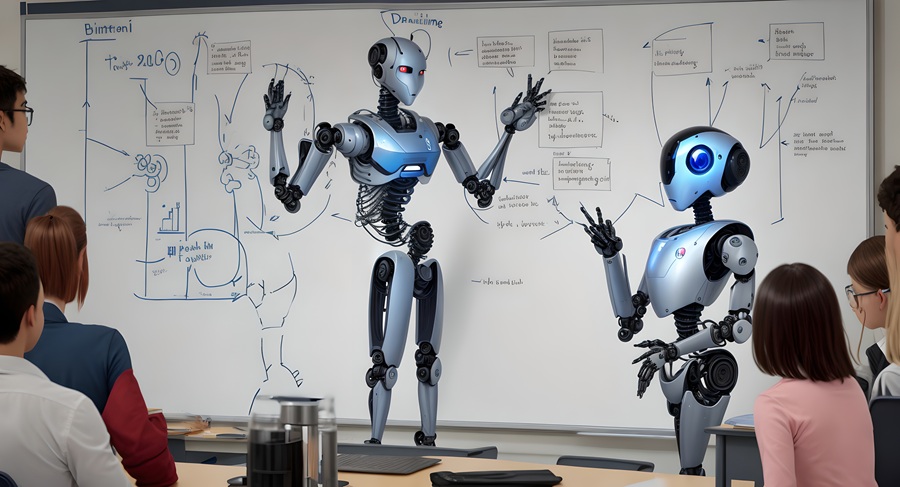
Image created using AI


Joan Nonell
The former Minister for Education who oversaw what became known as the Celaá Law (LOMLOE, in its rather grander guise), Pilar Alegría, was already playing down the decline in the content taught across the different subjects in the education curriculum in March 2023, justifying it on the grounds of the inevitable advance of Artificial Intelligence. Indeed, she described the law as the response to the need to rethink the new ways of learning and teaching posed by this ghostly digital presence. The minister said, literally: “It is one thing to work on memory, and quite another to think that simply accumulating knowledge is enough for our students to understand the reality of the world” [1]. Well, now that the results of the 2025 PISA tests have once again highlighted the decline in pupils’ reading, mathematical and scientific skills, partly as a result of the application of these “new ways of learning and teaching”, this seems a good moment to establish correlations between the rollout of the new educational practices promoted by the law and the supposed capacity they give learners to “understand the reality of the world”—undoubtedly one of the objectives PISA seeks to assess.
Project-Based Learning (PBL) and the curriculum organised around Learning Situations (LS), introduced by the law in question, require teachers and pupils to devote considerable time to exploring the topic under consideration in depth, which may be appropriate if the aim is to develop particular skills. The problem is that all this time, selectively invested in one particular aspect of the myriad of content covered by the curriculum, is time we no longer have to address and cover, with a minimum of coherence, the rest of the knowledge contained in the subject. The result is a discontinuous, fragmented and disjointed form of learning across much of the curriculum, in which knowledge is subordinated to the whims of publishers, to school projects that prioritise social needs, or to the interests of outside corporations that see in the school’s disorder and teachers’ confusion an opportunity to make money.
One need not be a social analyst to understand that these “new ways of learning and teaching” would present the problems we have described in the short term. In other words, Pilar Alegría and her advisers already anticipated that the gaps in understanding the reality of the world that the new pedagogies embedded in LOMLOE would create for whole generations of pupils were looming like dark clouds over the bright reformist educational landscape that pedagogism presented as the solution to the crisis of the traditional, republican, socially egalitarian school—a school that had helped drive social mobility. But they had an ace up their sleeve to tackle the problem and dispel the storm. That ace was the deployment of Artificial Intelligence in education. The first thing this technology can do is personalise teaching. The idea is that, following an initial cognitive assessment of pupils, it can offer each of them a programme of activities and study and learning materials designed to persevere with their individual characteristics, thereby guaranteeing their academic success, while also allowing teachers and schools to create all kinds of tools and support materials to reinforce identified shortcomings or broaden the knowledge sidelined by projects and other innovative methodologies applied throughout the different stages of education.
The guiding principle underlying the use of this technology makes it sufficiently attractive to supporters of educational reform to be adopted with little concern for the risks and threats it may pose: AI places the pupil at the centre of the learning process. What is more, AI has the blessing of science, technological progress and social approval, with society looking on in a mixture of fascination and fear, as though it were a new Sphinx. As though that were not enough, we are told that generative AI, through its adaptive processes for acquiring new learning by assimilating data, imitates the workings of human biological intelligence, thereby gaining the approval of the neurosciences—disciplines held almost as articles of faith within pedagogism—for use in schools. Possessing a technology supposedly capable of replicating and improving the brain’s cognitive mechanisms is highly attractive to those looking for shortcuts to overcome pupils’ learning difficulties and lack of motivation. Finally, another of the reformist mantras of recent years says that schools cannot turn their backs on the changes and transformations taking place in society and the world. AI is the most paradigmatic expression of these changes, which is why preventing schools from using it appears almost heretical.
In the name of this infallible ultra-modern and utilitarian approach to education, classrooms and teacher-training courses have been filled with AI-based generative tools that facilitate the creation of mind maps, summaries, outlines, presentations and activities, developed by the major technology corporations and readily and indiscriminately used, without any clear structure or oversight, in a kind of vast socio-educational experiment that follows the innovationist principle that anything new is inherently beneficial simply because it is new. It is a self-deploying programme sustained by the complicity of teachers who have to contend daily with the frustrating reality of their pupils’ disengagement and apathy, while at the same time being seduced by the subtle promise of salvation offered by these tools, with the necessary support of the educational authorities who, like Pilar Alegría herself at the time, have placed all their faith in AI’s ability to substitute for human effort and in its effectiveness.
As Éric Sadin describes in his essay “La inteligencia artificial o el desafío del siglo” [2], the wave of digitalisation we are experiencing feeds on the belief that behind the algorithmic impulse governing AI lies an invisible automated hand that corrects society, eliminating disorder and driving out vulnerability. Under the principle of comparing everything with everything else, made possible by the data economy in order to drive cognitive capitalism, and the promise of self-optimisation that the development of AI is supposed to bring us, we sacrifice every reservation and critical precaution, convinced of the cumulative corrective benefits inherent in the deployment of this technology. The old Enlightenment trap of unlimited progress lies hidden behind the acceptance and confident optimism displayed by educationalists, politicians and technologists in the face of AI’s incursion into schools. Faced with this vulnerability, which has found fertile ground in the crisis and declining prestige of the humanities—the first victims of the utilitarian rise of technological development—we must build a wall to protect schools from the commercial assault and ideological appropriation being carried out by digital platforms through AI.
Rearming and resisting means clarifying the principles that lie at the very heart of the school. Just as the humanities are not economically productive but are essential to keeping democracy healthy and active, as Martha Nussbaum’s work demonstrates [3], schools should not seek to become an exact mirror of the society in which they exist. Rather, they should preserve the values and cultural goods that ensure the full development of the human condition. Paraphrasing Hannah Arendt, we must accept that “conservatism, understood as preservation, is the very essence of education”. [4]. The school’s primary task is to shelter and protect what is valuable—the child from the world, what already exists from what is new—in order to help it grow and eventually stand on its own feet as an autonomous being.
One of the paradoxes revealed by the analysis of the recent PISA results is that, unexpectedly, pupils from more advantaged backgrounds are the ones whose performance has deteriorated most [5]. One plausible explanation is that these pupils, from higher socioeconomic backgrounds, have regular and continuous access to technological tools, including generative artificial intelligence. However, the intensive use of these tools puts them at a clear disadvantage compared with more disadvantaged pupils who do not use them because they cannot afford to. In light of Hannah Arendt’s conservative precaution, we can conclude that regular engagement with printed books, which foster sustained attention, active writing practices that develop and mature thought, together with mastery of calculation tools, are the most effective means not only of achieving the best results in PISA tests but, above all, of acquiring the much sought-after critical reasoning that enables students to “understand the reality of the world in which they live”. Protecting them from themselves and fostering creativity and reflective practice is the best service the school can offer them. Only in this way can it equip them to make their own decisions in a society increasingly governed by autonomous systems and market-driven criteria. Precisely what the former minister intended to place in the hands of AI algorithms, created to fill the gaps caused by the new ways of learning and teaching, stripped of content and focused on the automation of action rather than the freedom of knowing. The lesson PISA gives us this time is that idolising innovation and applying it without the necessary caution is not a solution to education, but an exacerbation of its tragedy.
References:
[1] https://exitoeducativo.net/pilar-alegria-educar-acumulando-contenidos-ya-no-sirve/
[2] Éric Sadin, La inteligencia artificial o el desafío del siglo. Anatomía de un antihumanismo radical, Ed. Caja Negra, Buenos Aires, 2020.
[3] Martha C. Nussbaum, Sin fines de lucro. Por qué la democracia necesita de las humanidades, Ed. Katz, Buenos Aires, 2012.
[4] Hannah Arendt, Entre el pasado y el futuro. Ocho ejercicios sobre la reflexión política, Ed. Península, Barcelona, 1996.
[5] https://www.ara.cat/societat/educacio/pisa-espanya-alumnes-rics-han-perdut-mes-nivell-vulnerables_1_5844016.html
Source: educational EVIDENCE
Rights: Creative Commons