


- Opinion
- 9 de September de 2026
- No Comment
- 9 minutes read
The Hen, the aspirin and PISA

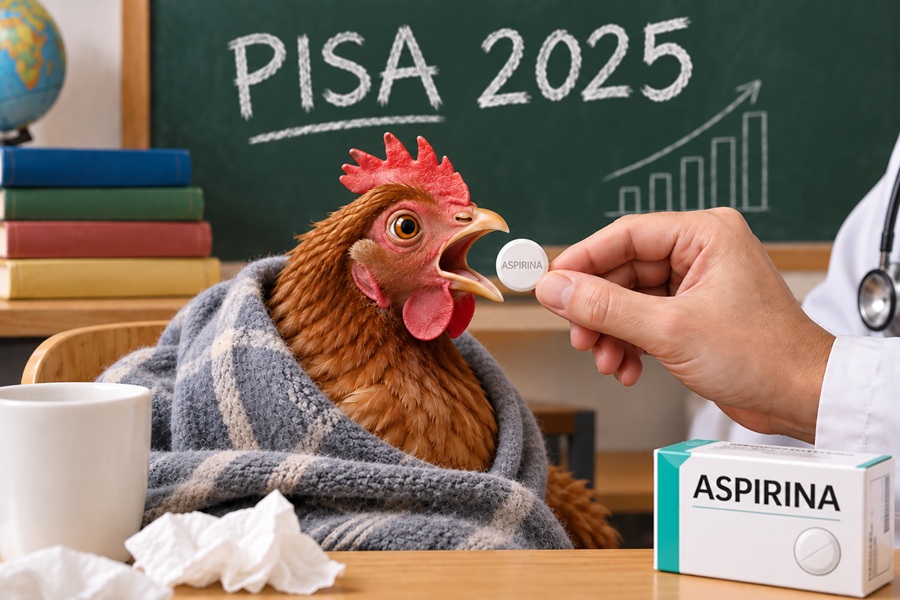
Image created using AI


Miguel Ángel Tirado
LOMLOE was passed in December 2020. According to its preamble, the law was supposed to “improve pupils’ educational outcomes”. Now PISA is back to tell us how we are doing. And with it come the reports on the state of our education, reflections on why things are as they are, and the inevitable blame game. It will last a few days. Perhaps weeks. And then, if the usual pattern holds, inaction will once again set in (or frantic activity with no agreed direction), along with a lack of self-criticism and the familiar “nothing has happened here” attitude. Until a few years have passed and the cycle starts all over again, with education probably in an even worse state if nothing is done.
The reader should not expect an analysis of the causes, consequences or possible solutions. The purpose of this article is much more modest: to get some idea of what it means when a fifteen-year-old pupil does not reach the level that PISA regards as the minimum.
Let us grasp the seriousness of the situation. According to PISA, 32% of our fifteen-year-olds fail to reach Level 2. On its own, the figure tells us little. What can a pupil who reaches it actually do? But above all, what can they not do? One point needs clarifying: PISA goes up to Level 6. Level 2 is therefore not an overly ambitious target, but the minimum threshold a fifteen-year-old is expected to have reached in order to participate fully in society.
Let us put ourselves to the test. Inma has a hen that has injured one of its legs. The bird seems to be in a lot of pain, but Inma cannot take it to the vet until Monday. So she goes onto an Internet forum and asks whether she can give it aspirin. She receives several replies:
Nuria explains that she always consults a vet before giving any medication to her birds, because some medicines that are safe for people can be dangerous for them. Mónica says that she once gave aspirin to one of her hens without any problems, although she warns that exceeding the dose can be dangerous. Among the replies there is also an advertisement for bird products: “Hello! Don’t forget to check out my great deals on all our bird products. We’ve got some great discounts at the moment!” Bruno takes the opportunity to ask how he can tell whether a bird is ill and, finally, Francisco, who introduces himself as a vet specialising in birds, explains that aspirin can be given to birds when they show signs of pain and gives the appropriate dosage. Which of these posts are relevant to Inma’s problem, and which are not?
This is an example of Level 2 reading in PISA. As we can see, it does not require an understanding of syntactically complex sentences, the interpretation of metaphors or knowledge of less common words. Nor does it require much reading. All you need to do is understand a simple situation, expressed in very basic vocabulary (I would even say overly basic), keep in mind what information you are looking for, and distinguish which parts of the text are relevant to answering the question.
Therein lies the problem. And, moreover, these results are not evenly distributed. PISA’s own report once again shows a clear link between socioeconomic background and attainment: pupils from more disadvantaged backgrounds perform worse on average. Behind these percentages, then, lies a question of equity.
Let us now look at what happens in mathematics, where 34% of students fail to reach Level 2. Try this Level 2 problem: Tania wants to buy a car and would like to know how much it will cost her to buy and run it during the first year. She estimates that she will drive 20,000 kilometres, that fuel will cost 1.54 zeds per litre, and that she will spend 250 zeds on maintenance. She has four options, shown in a table. Car A costs 8,000 and consumes 18.9 litres per 100 kilometres. B costs 8,700 and consumes 15.7. C costs 9,900 and consumes 12.4. And D costs 10,500 and consumes 14.1.
The question is: which of the four cars will cost her the least during the first year? To make the task easier, there is no need to do any calculations by hand or decide which operations to use: PISA provides a cost calculator in which you simply enter the price and fuel consumption for each car and press “Calculate” (like those websites that compare insurance or mortgages after you enter a couple of details). Again, we are not dealing with advanced algebra or one of those questions we justify by saying that “mathematics is very difficult”. You do not even have to work out the result: you only have to interpret it.
Now the percentages begin to mean something. Almost one in three Spanish students is below Level 2 in reading, and slightly more than one in three is below it in mathematics. We can now get a better sense of what we are talking about. It does not simply mean that our country has lost a few points, that one autonomous community is a few places above another, or that we are falling further behind Finland, Estonia or whatever other country happens to be cited that year.
The paradox is that this figure coexists with another, far more positive one: more than 80% of our students complete compulsory secondary education (ESO). In other words, while PISA warns us that a significant proportion of pupils struggle with tasks as basic as those we have just seen, our education system certifies that the overwhelming majority have achieved the Perfil de Salida (exit profile) expected at the end of basic education.
PISA has many limitations. Of course it does not measure everything that matters in education, nor can an international assessment on its own summarise the quality of an education system. But the fact that PISA does not measure everything that matters does not mean that what it does measure matters little. How is it possible that, after a decade of compulsory schooling, so many pupils have still not consolidated learning of this kind?
At this point, the usual search for explanations and the apportioning of responsibility begins. The preamble to LOMLOE itself has already provided a possible explanation for a scenario like this: “results will not change unless educational practice changes profoundly”. There will therefore be no shortage of people arguing that the problem lies not in the law, but in the fact that its principles have not really reached the classroom; that teachers lack the training, support or preparation needed to put its educational approach into practice.
An education law should not be judged solely by the merits of its aims or by how appealing its principles sound. We should also ask whether the decisions it takes really help pupils to learn more and learn better. And, above all, whether, after years of schooling, we succeed in ensuring that all of them acquire, at the very least, the learning we regard as basic and what we call general knowledge. The kind that enables us to understand the world and think for ourselves. The common knowledge we share as a society, which the school cannot relinquish if it is to continue calling itself a school.
Meanwhile, the injured hen is still waiting for an aspirin.
Notes:
- Data from PISA 2025 come from the Instituto Nacional de Evaluación Educativa (INEE), Ministry of Education, Vocational Training and Sport, PISA 2025, where the Spanish Report and the rest of the study documentation can be consulted: https://www.educacionfpydeportes.gob.es/inee/ca/evaluaciones-internacionales/pisa/pisa-2025.html
- The examples “Bird Forum” and “Buying a Car” are taken from the PISA released items published by the Instituto Nacional de Evaluación Educativa (INEE), Ministry of Education, Vocational Training and Sport, in the section “Interactive PISA released items”: https://www.educacionfpydeportes.gob.es/inee/publicaciones/items-liberados/items-liberados-interactivos-pisa.html
Source: educational EVIDENCE
Rights: Creative Commons