


- Humanities
- 18 de May de 2026
- No Comment
- 6 minutes read
Beyond evidence: Reflections on Bianca Thoilliez’s lecture
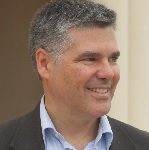
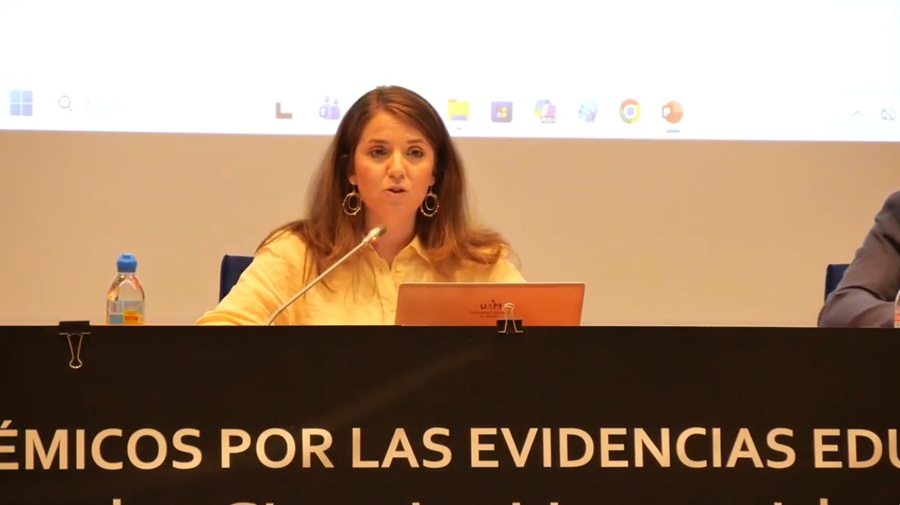
The pedagogy scholar Bianca Thoilliez, of the Autonomous University of Madrid, speaking during her lecture at the Forum de Académicos organised by the Fundación Episteme.


Josep Oton
I Fórum de Académicos, organised by the Fundación Episteme, was devoted to the question of educational evidence. On 25 April 2026, a substantial gathering of experts and education professionals met in the assembly hall of the CSIC Researchers’ Residence in Barcelona to debate the extent to which today’s fashionable pedagogical innovations are genuinely supported by rigorous research findings — in other words, whether there is sufficient evidence to justify the educational transformations currently being pursued.
Dr Bianca Thoilliez, professor of pedagogy at the Autonomous University of Madrid, offered an important counterpoint, intended to guard against the scientistic bias that can easily emerge in a field such as education, whose intellectual foundations remain deeply indebted to the humanist tradition.
In a deliberately provocative lecture entitled Beyond “what works”: evidence, pedagogical judgement and democratic deficit in teaching practices, she began from a simple observation: educational practice often ignores research findings—that is, the available evidence. The reasons are straightforward enough. Educational systems are frequently guided by ideological assumptions or passing pedagogical fashions, while overlooking practices that have been properly tested and shown to be more effective. This inconsistency becomes especially serious in socially vulnerable contexts, where families and the wider social environment are unable to compensate for shortcomings within the school system. More often than not, the burden falls upon schools themselves to compensate for wider social deficits.
Yet while the critique of a pedagogy detached from evidence is entirely valid, it is also incomplete. The real issue is not whether education should or should not be evidence-based, but rather what authority evidence ought to possess and where its normative limits lie. Evidence may inform decisions, but it cannot make them.
It is here that Dr Thoilliez introduces the notion of pedagogical judgement as an indispensable counterweight. This is not a defence of arbitrariness or subjectivism, but of a form of practical rationality, grounded in reality itself, capable of mediating between evidence, values, context and human relationships.
Teaching is a complex activity, shaped by uncertainty and embedded within particular circumstances. It cannot be reduced to a merely technical intervention. It involves relationships between individuals, each possessing their own identity and experience. In this sense, teaching retains an essentially “craft-based” dimension, in which practical know-how, accumulated experience and reflective judgement all converge.
For that very reason, we must resist the temptation to turn evidence into a substitute for pedagogical judgement. Evidence should never become a protocol applied mechanically and without reflection. At times, appeals to evidence conceal a desire for false certainty — an attempt to escape the uncertainty inevitably involved in confronting educational dilemmas.
Taken to excess, an emphasis on evidence risks transforming teachers into little more than executors of pre-designed programmes, with their professional responsibility reduced to the mere implementation of externally imposed instructions.
Nor is this merely a pedagogical question. It is, fundamentally, a political one. At stake, ultimately, is the question of who gets to decide. We are witnessing a growing expansion of educational governance, marked by the proliferation of expert networks and global evaluation tools that increasingly redefine both educational problems and their supposed solutions. The decisive question therefore becomes: who decides how teaching should be carried out?
In addressing this issue, Dr Thoilliez referred to the well-known debate between Walter Lippmann and John Dewey. For Lippmann, decision-making properly belongs to experts, with the consequence that the role of citizens becomes necessarily limited. By contrast, Dewey regarded knowledge as a public good that sustains democratic deliberation.
From this perspective, overreliance on evidence may produce a genuine democratic deficit, insofar as deliberation is delegated to experts whose authority, in turn, rests upon the legitimisation of decisions through evidence. The deeper consequence is the gradual expropriation of teachers’ professional judgement and the delegitimisation of their experience and expertise as meaningful contributions to educational decision-making. The question “What ought to be done?” is quietly replaced by the narrower question “What works?”, whose answer is assumed to lie in the evidence. In such circumstances, teachers’ judgement risks being overridden by evidence produced in highly decontextualised settings.
Studies on class sizes provide a revealing example. The evidence suggests that the number of pupils per teacher has only a limited impact on academic outcomes. Put simply, smaller class sizes do not automatically guarantee improved attainment. But does that evidence therefore justify maintaining overcrowded classrooms? Clearly not. Decisions about appropriate class sizes must take account of many other considerations besides the findings of quantitative studies alone.
In the end, evidence is necessary, but never sufficient. It is a valuable resource that can help make educational decision-making more reliable and better informed. Yet it cannot replace the importance of teachers’ professional judgement. Otherwise, educational policy risks being reduced to a purely normative framework constructed exclusively from expert knowledge. The result would be a weakening of genuine participation in decision-making and, with it, an erosion of the democratic procedures upon which both education and society ultimately depend.
Source: educational EVIDENCE
Rights: Creative Commons