


- TEACHER TALES
- 7 de May de 2026
- No Comment
- 8 minutes read
Vocational Education and Training (VET) in the mirror: between change and stigma

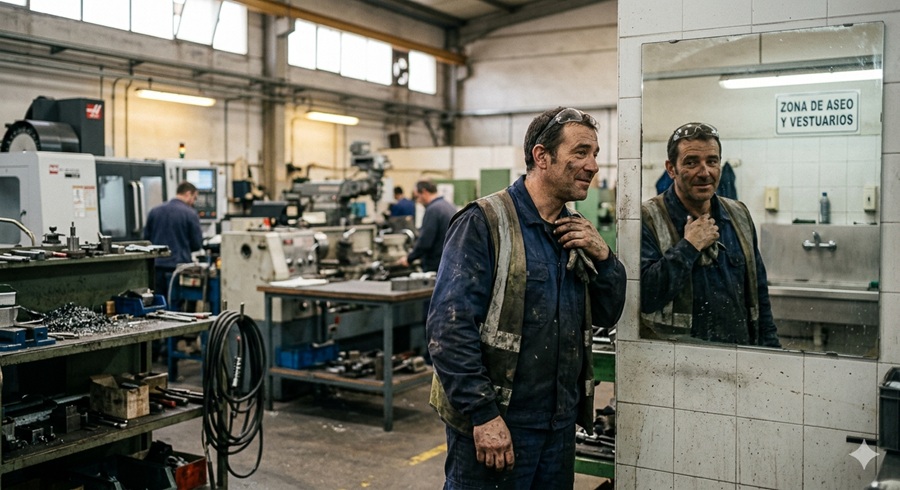
Student of machining in a VET workshop. AI-generated (Nano Banana, Google Gemini), author prompting.


We have been told for years that Vocational Education and Training (VET) “has changed dramatically”. And indeed it has. But perhaps not as much—or as quickly—as the socio-economic context demands. Above all, what has scarcely shifted is how people still think about it.
A recent study published in the Journal of Applied Youth Studies by three researchers from the University of Barcelona (UB), the Polytechnic University of Catalonia (UPC) and the Autonomous University of Barcelona (UAB) presents findings that deserve close attention (Valls et al., 2026). Tracking more than 2,000 students in Barcelona as they move from compulsory secondary education (ESO) into post-compulsory pathways, the authors reach a conclusion that runs counter to a deeply ingrained assumption: students who enter VET do not disengage from education—if anything, quite the opposite happens. Their behavioural engagement in the classroom increases, as does their self-perceived academic performance, and more sharply than among those who opt for the academic track (the Spanish bachillerato, the main university-preparatory route).
In other words, VET does not lead young people away from schooling, nor does it push them towards early school leaving. For many, it rekindles their willingness to learn. It offers a route to continue their education in a labour market where—admittedly—in many sectors an intermediate qualification is only a first step, often followed by progression to higher-level VET.
These findings, in the Catalan context, refine a long tradition in the sociology of education—from Hargreaves (1967) to Van Houtte (2016)—which tended to portray vocational pathways as routes marked by resignation and detachment. And yet the stigma remains. Why?
“If you’re good, you go academic; if not, you go to VET”
Many teachers will have heard this phrase. Some, perhaps, have even used it. It encapsulates a quiet but persistent hierarchy that continues to shape educational guidance in Spain at the end of compulsory schooling. The academic route is widely seen as the preserve of the most able; VET, as the default option for those who fall short.
This is not merely a cultural issue. It is structural. As Valls et al. (2026) show, students entering VET are more likely to come from families with lower levels of educational attainment, are disproportionately from immigrant backgrounds, and tend to have weaker prior academic results. In their sample, 53% of VET students had parents without post-compulsory qualifications, compared with 23% in the academic track. Only 13% came from university-educated families—far fewer than among their peers in the bachillerato (51%).
In practice, this means that a student from a less educated household often faces an uphill struggle if they wish to pursue the academic route and later university. Conversely, families with university experience tend to resist the idea of their children enrolling in intermediate VET programmes—frequently invoking the familiar fallback logic: try the academic route first; VET can always come later.
What is often missing is a clear and confident explanation that higher-level VET can be just as valid a route as a university degree—and in many technical fields, a highly remunerated one, particularly in occupations less exposed to automation and AI (Moreno-Izquierdo and Torres-Penalva, 2025). One cannot help wondering—though the Valls et al. study (2026) does not address it—how many students steered towards the academic track ultimately struggle or fail there.
This is not accidental. It is a case of social reproduction. Families with less cultural and economic capital tend to gravitate towards VET—not necessarily because it is the best option, but because it appears the most accessible: less costly, more predictable, and more closely aligned with their expectations regarding completion and employment. Above all, it is often the only pathway that has been meaningfully presented to them.
What has improved—and what still happens in classrooms
None of this should obscure how much VET has, in fact, improved. Dual VET has expanded in Spain, bringing training closer to the workplace and enhancing employability. New programmes in areas such as cybersecurity, artificial intelligence, electric mobility, renewable energy, healthcare and social care respond directly to pressing labour market needs. According to the Spanish VET Observatory, employment outcomes in some vocational fields far outperform those of many university degrees.
Recent reforms have also sought to make pathways more flexible, improve permeability between VET and higher education, and recognise prior professional experience. These are important advances. So too is the possibility of entering higher-level VET from the academic track—an often overlooked but valuable bridge.
And yet, when a Year 11 pupil meets with a tutor or careers adviser, the question is still frequently the same: “Have you considered trying the academic route?”
One of the study’s most useful contributions for everyday teaching lies elsewhere. Behavioural engagement at the end of compulsory schooling is a strong predictor of academic performance in the first year of bachillerato. This may sound self-evident—but education needs evidence, and we would do well to insist on it. Habits matter: attending lessons, avoiding disruption, engaging actively with learning. They matter a great deal.
For teachers, the implication is clear. Fostering engagement in the final years of compulsory education is not simply a matter of classroom order or day-to-day survival. It is an investment in students’ future trajectories—whatever path they ultimately take.
Not every student thrives in the academic track. Not always because of a lack of ability, but sometimes because it offers them little sense of purpose. For some, the right training leads instead to a profession—and perhaps a vocation—that genuinely motivates them, and from which they can make a living: something akin to the Japanese notion of ikigai.
It would also help to have a system of grants that genuinely enables disadvantaged students to choose freely, rather than within the constraints of inherited expectations.
VET does not simply need more funding or better public messaging. It requires a shift among secondary teachers themselves: a willingness to stop presenting it—explicitly or implicitly—as a second-best option. It also requires educational guidance in secondary schools to function as it should: to cease being a mechanism of drift—a legacy of the twentieth-century divide between VET and the academic track—and to become a space for genuine reflection on, and exploration of, each student’s interests and circumstances. The evidence presented by Valls et al. (2026) is clear: many young people who arrive in VET with a diminished academic self-concept go on to flourish there—not despite their choice, but because of it, and thanks to the professionals who sustain it.
References:
Hargreaves, D. (1967). Social relations in a secondary school. Routledge. https://doi.org/10.4324/9780203001837
Moreno-Izquierdo, L. y Torres-Penalva, A. (2025). Inteligencia artificial y empleo: una reflexión aplicada al mercado laboral español. Información Comercial Española (ICE), Revista de Economía, (938), 131-143. https://doi.org/10.32796/ice.2025.938.7892
Valls, O., Sánchez-Gelabert, A. y Merino, R. (2026). Youth Transition to Upper Tracked Secondary School in Barcelona: a Longitudinal Analysis of Behavioural Engagement and Achievement. Journal of Applied Youth Studies. https://doi.org/10.1007/s43151-025-00193-y
Van Houtte, M.(2016). Lower-track students’ sense of academic futility: selection or effect? Journal of Sociology, 52(4):874–889. https://doi.org/10.1177/1440783315600802
Source: educational EVIDENCE
Rights: Creative Commons