


- Science
- 5 de May de 2026
- No Comment
- 8 minutes read
The Disappearance of science and how to reverse it

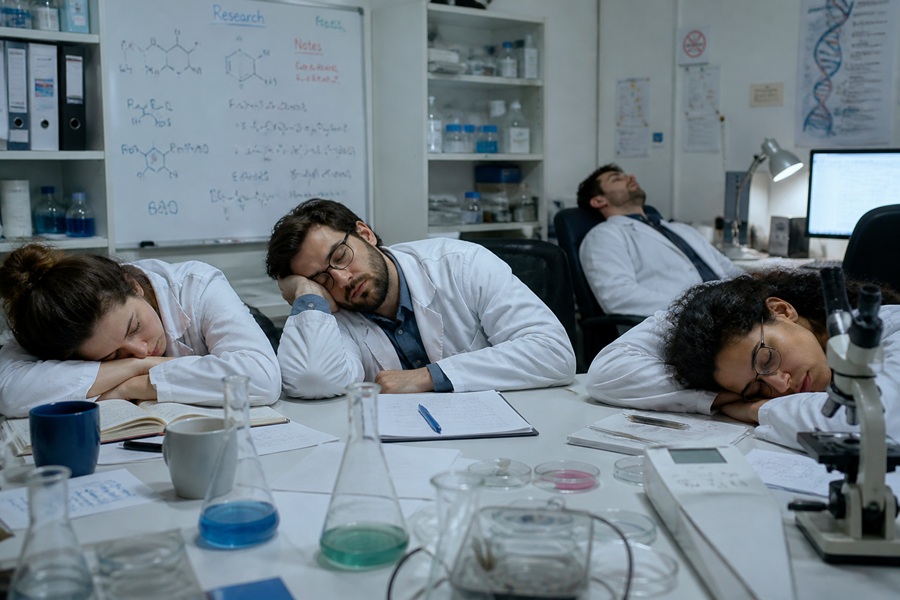
Image created using AI.


Professionals and society at large are becoming increasingly poorly educated in science. In our schools, it is becoming increasingly evident that scientific knowledge is losing ground within the curriculum. Geology, for instance, if it is taught at all, is confined to a single term across the four years of compulsory secondary education (ESO). Unsurprisingly, international indicators show that our pupils possess ever weaker scientific knowledge. It is therefore striking that education policy appears to be pushing science to the margins of the curriculum. At this rate, we may soon find ourselves believing that the Earth is flat—or that Creationism counts as science.
For decades, science subjects have been steadily losing both teaching hours and curricular weight within our education system. From the LOGSE of the 1990s to the current LOMLOE, one discipline after another has seen its place eroded, displaced by emotional education programmes, optional subjects of dubious substance, or pedagogical approaches whose effectiveness remains unproven. A telling example has been the merging of science subjects in upper secondary education and the sharp reduction in the hours allocated to them. In Catalonia, an agreement has already been reached to reduce the time devoted to science—something other regions are likely to follow—so as to make room for a broader range of options chosen by students. This has been met with a mixture of bewilderment and frustration among many secondary and university teachers, particularly as some experts argue that optional subjects should take precedence over core, compulsory disciplines. Some claim that the aim is to teach less and entertain more; but we can surely agree that school is not meant to be a theme park.
The expansion of optional subjects at the expense of core knowledge was already implemented in the 1990s under a law of a similar nature—the LOGSE itself. The results were deeply unsatisfactory, as general knowledge in mathematics, languages, science and the humanities declined markedly among pupils. It is also worth noting that, from the LOGSE through the LOCE, the LOE, the LOMCE, and finally the LOMLOE, Spain’s performance in science has steadily deteriorated in international assessments such as PISA and TIMSS. Despite this, policy continues to move in the same direction: fewer core subjects, more optional ones. In effect, scientific disciplines have been progressively sidelined in the curriculum.
Consider, for example, geology—the fourth experimental science, on a par with physics, chemistry and biology. It has nonetheless been almost entirely pushed out of our educational programmes in favour of so-called competency-based and area-based teaching. Since the LOGSE of the 1990s, through the LOCE of 2003, to the current LOMLOE, these approaches have encouraged the erosion of both scientific and humanistic specialisation among teachers. The underlying assumption is that pupils can learn independently, without the need for subject specialists.
“Everything is online”, some pedagogues insist, “and information is just a click away”. Yet what is readily accessible is not knowledge or mastery, but rather a vast and largely unfiltered mass of material. The LOCE of 2003—running to more than fifty pages in the Official State Gazette—was already steeped in this grand rhetoric, as was the LOGSE before it: both extolled the supposed innate capacity of pupils to learn autonomously, without the guidance of expert teachers. This is the familiar student-centred model grounded in constructivism and competency-based learning—an approach that remains unproven.
To a considerable extent, each new education law introduced during Spain’s democratic period has had something of an electoral flavour, lacking a firm and sustained social commitment. What we see instead is a recurring rhetoric of student-centredness and the promise that competency-based education represents the most modern and effective model—an assertion that is, in truth, misleading, since it draws on long-standing economic doctrines rather than genuine pedagogical innovation. It is therefore hardly surprising that many teachers have opposed these ideas, from the LOGSE to its present-day counterpart, the LOMLOE. Among them are associations such as Geología en Lucha (Geology in Struggle), Fundación Episteme, Asociación de Catedráticos de Catalunya (Association of Senior Teachers of Catalonia), Ciencias en Peligro (Science in Danger), Professors de Secundària (Secondary Teachers’ Union), Asociación OCRE, Plataforma per l’Educació de Qualitat (Platform for Quality Education), and the geological society SIGMADOT.
If we are to restore the place of disciplines such as geology and biology within secondary education, we need a strategy that reaches beyond the classroom and reconnects science with society. To that end, a plan based on three complementary lines of action may be proposed.
First, a recognised scientific body—or a consortium of such bodies, such as the Colegio Oficial de Geólogos and other learned societies—should establish a specialised press office. Its role would be to build sustained and trustworthy relationships with media outlets, journalists and science communicators. This office would issue clear, engaging and accessible press releases whenever a nationally significant scientific discovery is made, or when an important geological or mineralogical site is brought to public attention. By professionalising this relationship with the media, scientific content could maintain a consistent presence in the public sphere through regular press briefings.
Second, these institutions should promote an attractive, modern and family-oriented television or radio programme combining scientific rigour with genuine entertainment. This format should move away from more academic models such as El Escarabajo Verde, Órbita Laika or Què, Qui, Com, and instead adopt a dynamic, accessible and emotionally engaging style. It could feature a distinctive and charismatic scientist, joined each week by a well-known figure, a child representing the curiosity of students, and members of the public contributing spontaneous questions and reactions. The central focus would be national scientific discoveries and key sites of natural heritage, presented as compelling, relatable stories.
Finally, effective science communication strategies should be developed, drawing inspiration from the successful model of the Atapuerca Research Team. This would involve briefing the press in advance to allow for more in-depth coverage, assigning memorable common names to fossils or minerals—such as El Cid for a newly discovered skull at Atapuerca or Catalanita for a new mineral in the Pyrenees—and linking discoveries to regional or national identities, thereby fostering a sense of shared pride. Announcements could also be staged gradually, building anticipation and encouraging both social and educational engagement. In this respect, the Atapuerca team offers a particularly effective model.
In short, this set of proposals would strengthen the social standing of science and contribute to its recovery within our education system, while also enhancing students’ motivation to engage with fundamental scientific disciplines from an early age. What remains is for someone to take the initiative.
Without a solid foundation of scientific literacy in both society and politics, the risk of catastrophe rises sharply: the more than two hundred deaths caused by the Valencia floods (DANA), the hundreds of homes destroyed by the eruption of the Tajogaite volcano in La Palma, or the collapse of the Carmel neighbourhood in Barcelona following tunnelling works carried out without sufficient geological knowledge. Such disasters might have been mitigated through better prevention and a stronger scientific culture. We must therefore ask whether removing geology from our curricula is truly worth the cost, given that scientific literacy saves lives, protects property and reduces public expenditure. Otherwise, we risk lending credence to flat-earthers and mistaking a dinosaur fossil for a medieval excavation—something that, in fact, already happens. Flat-earthism may well be only the beginning of this particular form of political hypocrisy.
Source: educational EVIDENCE
Rights: Creative Commons