


- Face to face
- 27 de March de 2026
- No Comment
- 22 minutes read
Joan Carles Marset: “Schools should not be spaces for ideological formation”

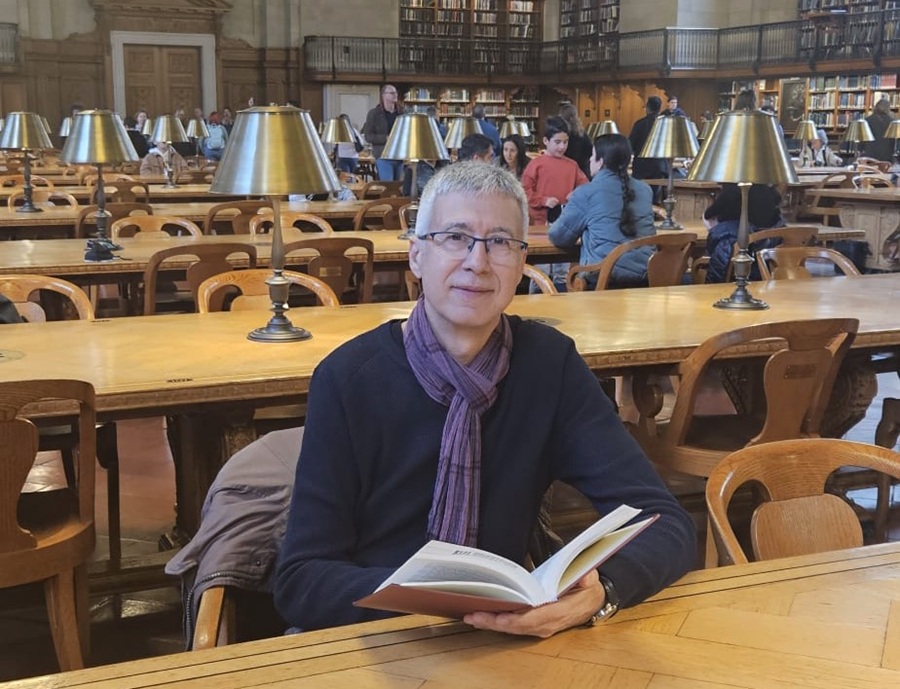
Joan Carles Marset at the New York Public Library, 2025. / Photo courtesy of the author
FACE TO FACE WITH
Joan Carles Marset, director of the Publications Service of the UAB


Joan Carles Marset is a geologist and editor who has developed his professional career in the publishing sector. He serves as Director of the Publications Service at the Universitat Autònoma de Barcelona (UAB), where he coordinates the production of the University’s academic and scientific publications and oversees institutional editorial projects. Alongside his professional work in the university sphere, he is also a prominent figure in the secular and atheist movement in Catalonia, noted for his contribution to the dissemination of atheism, the promotion of critical thinking, the defence of freedom of conscience, and the advocacy of secular public institutions.
He has been Vice-President of Ateus de Catalunya (Atheists of Catalonia) and a member of the Consell Executiu de la Unió d’Ateus i Lliurepensadors d’Espanya (Union of Atheists and Freethinkers of Spain), and is the author of several essays, among which Ateísmo y laicidad (Los Libros de la Catarata, 2008) stands out. In this work, he argues that secularism is the only coherent framework for social and political organisation from an atheist interpretation of reality, while also addressing issues such as the separation between the State and religious institutions, freedom of conscience, and the impact of secularism on contemporary society. He is also the co-author—together with Gabriel García Voltà—of Probablemente Dios no existe (Ediciones del Bronce, 2009), where he examines the foundations of atheist thought and explores the implications of a worldview free from religious beliefs and supernatural elements. Speaking with him is like entering a space of calm, clarity and knowledge.
What led you to become Director of the UAB Publications Service?
I have always had very diverse interests, and at certain points the most difficult thing for me was choosing a specific field to devote myself to, because it inevitably meant setting aside others that I found equally appealing. At the time, I studied geology, philosophy and music, and in the world of books I found a kind of balance between some of these varied—and at times contrasting—interests.
In publishing, you have the opportunity to work with literary works, essays on a wide range of topics and, of course, scientific and academic books, particularly within the university sphere. It is a type of work that fits well with this more transversal way of approaching things, perhaps somewhat “Renaissance-like”. I should also acknowledge that books carry a very appealing cultural aura—this idea of dedicating oneself to the dissemination of knowledge. Perhaps this is less evident today, given the proliferation of channels for transmitting content, but when I was younger, working in publishing was undoubtedly a direct way of entering the world of culture.
As for my own trajectory, I initially began my professional activity as a teacher of natural sciences and music for a couple of years. However, thanks to my scientific training, I was given the opportunity to work in a technical journals publisher and, after a few brief experiences in commercial publishing, I joined the UAB in 1989 as Head of Publications Production. Over time, I completed a Master’s degree in Publishing at the Universitat de Barcelona and another in University Management at the UAB. Finally, in 2008, I was appointed Director of the Publications Service.
What criteria should a good editor apply when selecting a work?
The first thing an editor must consider when choosing a work is the originality and quality of its content. One must ask what that work contributes in relation to what has already been published, and why it is genuinely worth publishing. With time and experience, you develop a certain intuition for identifying quality—you learn to separate the wheat from the chaff—but in order to make a sound decision, what you primarily need is the support of experts who, while they may not know as much about publishing, do have expertise in the subject matter of the book in question.
It is therefore essential to rely on a strong team of collaborators who can advise you on the specific content of each work, because you can never know enough about everything.
“Evaluating a literary work—where style, rhythm, vocabulary and plot must be considered—is not the same as assessing an essay, a technical book, a university textbook or a scientific work”
In the academic and university sphere, for instance, it is essential that a work undergo peer review, so that experts can identify aspects requiring improvement or reject its publication if it fails to meet minimum standards of rigour. This may seem fairly obvious, but it is not always so straightforward. Evaluating a literary work—where one must consider style, rhythm, vocabulary and plot—is not the same as assessing an essay, a technical book, a university textbook or a scientific work, where clarity and precision are paramount.
That said, if a work ultimately proves dull and monotonous, it will not fulfil its function either. Here again, the editor plays a key role: beyond the content, they must be able to judge whether the work will engage its intended readership.
How do you integrate—if at all—your experience with Ateus de Catalunya into your professional work?
Experience across different fields and activities always helps to enrich one’s perspective and provides a broader outlook. In that sense, having collaborated on numerous projects related to the dissemination of atheism and the defence of secularism has no doubt given me additional nuance and knowledge.
That said, I have always made a conscious effort to keep my work and my personal convictions entirely separate, so that my ideas or activism do not interfere with my professional activity. It would not seem honest—or ethical—to use my position at the University to promote my personal beliefs. I work for a plural and democratic institution, with legitimate governing bodies that set policy, and my duty is to carry out my work professionally and without political or ideological bias.
Does atheism bring a plural perspective to the academic sphere?
There has always been a more or less explicit presence in academia of individuals who openly identify with their religious beliefs, particularly Catholic ones. When I was a student, I remember some classmates from Opus Dei who would discreetly approach others in an attempt to share their faith—clearly with a proselytising aim—but those conversations sometimes led to friendships and even to interesting exchanges.
In my view, in response to this, it is not only appropriate but advisable to make visible within academia that there are also non-believers. Society is plural, and it is therefore important to normalise the fact that atheists or non-believers are present across all sectors—and, indeed, that they constitute one of the largest groups.
There is also an interesting point to consider: in academia, individuals without religious beliefs are overrepresented relative to the general population. Numerous rigorous studies published in reputable scientific journals show that academics—and particularly scientists—tend, on average, to be significantly less religious than the wider population.
“There is a clear bias: the higher a person’s level of education, the lower their level of religiosity tends to be”
There is a clear bias in the sense that the higher a person’s level of education, the lower their level of religiosity tends to be. Therefore, making this fact visible—which reflects a well-established reality—should be seen as entirely normal. This does not, of course, detract from the fact that within universities, and indeed everywhere, there are individuals with deeply held religious convictions who are excellent scientists and researchers, and people of remarkable integrity.
How did you become an atheist? Did you move away from religion, or was it the result of personal reflection?
Unlike many atheists or non-believers I have met and debated with over time—particularly during my years of activism—I cannot say that I was ever truly a believer and later abandoned religion. There is undoubtedly a generational component to this, because many convinced atheists I have known distanced themselves from religion during the Franco regime, when the influence of the Catholic Church on society was very strong—even suffocating—and they came to realise that that discourse did not align with their own ideas. However, I was still very young when the dictator died, and I am convinced that all of this had little influence on me.
In my case, my convictions as a non-believer are primarily grounded in reason. I remember that, as a child, I attended some catechism classes in preparation for my First Communion, and everything we were told about Jesus and the Church seemed incomprehensible and incoherent to me… to believe it all, one needed something they called faith. But that faith felt too intangible for me—I was looking for intelligible answers. My first readings of passages from the Gospels convinced me that something there did not quite add up, and I never truly felt comfortable in that setting.
I was left wanting to explore the matter further, and over the years certain readings—such as Les douze preuves de l’inexistence de Dieu by the anarchist Sébastien Faure (essentially a work of elementary logic that requires no extensive prior training), or the works of Sartre and Nietzsche, among others—confirmed what I had suspected: that, from a rational standpoint, the idea of God does not hold up.
“Religion clearly has no rational foundation but an emotional one—as do most of the important things in life—and that is precisely why it is capable of mobilising large numbers of people”
Over time, I have come to understand that religion does not have a rational foundation but an emotional one, as is the case with most important things in life, and that this is precisely why it is capable of mobilising large numbers of people. Human beings are, at heart, more emotional than rational, but that does not make religious claims true. Religion can be useful in difficult moments, helping to address some of the most fundamental human concerns—such as death—and it has also historically served to create social cohesion, which largely explains its success.
However, if we truly wish to build a better future, we must move beyond simple and narcotic formulas and be willing to face reality: to acknowledge that there is no God, that death is our end and that there is no afterlife; that only human beings can help one another; that prayer is an empty prayer into the void; that we must strive to realise our projects and aspirations in this life; that we must work together to build a more just world in which we can live in harmony—or, at the very least, tolerate one another.
We must begin from a factual understanding of reality if we are to move forward, because dreams, desires or faith in a transcendent realm may provide temporary comfort, but they will never solve humanity’s real problems.
Spain defines itself as a non-confessional state. What is the difference between a secular state and a non-confessional state?
The main difference is that a secular state considers religion to be a private matter for individuals and therefore outside its remit, beyond guaranteeing the right to practise religion, provided that it respects the rights and freedoms of all citizens. Nor does it grant believers any form of privilege simply for holding particular beliefs.
A non-confessional state, by contrast, does not promote or endorse any specific religion, but does consider religious beliefs to be of social value and therefore establishes forms of cooperation with different religious groups. This is the current model in Spain, where Article 16.3 of the Constitution clearly states that “no religion shall have a state character”, but then goes on to say that “public authorities shall take into account the religious beliefs of Spanish society and shall maintain appropriate relations of cooperation with the Catholic Church and other denominations”.
“Spain cannot, under any circumstances, be considered a secular state”
From a rigorous reading, one might even question whether the explicit mention of the Catholic Church—and the constitutional requirement of cooperation with it—brings Spain closer to a confessional model, with the Catholic Church in a privileged position, than to a genuinely non-confessional one. Spain cannot, under any circumstances, be considered a secular state. I will not go into detail regarding the agreements between the Spanish State and the Holy See, which formalise the privileges of the Catholic Church within the legal framework through international treaties, nor the 1980 Organic Law on Religious Freedom, which extends some of these privileges to other denominations.
That said, we should also remember that some countries we often regard as democratic benchmarks are explicitly confessional—for example, England, where the monarch is the head of the Anglican Church, or Denmark, where Article 4 of the Constitution states that “the Evangelical Lutheran Church shall be the established Church of Denmark and, as such, shall be supported by the State”. One might reasonably ask whether such arrangements are compatible with a genuinely democratic system, and where this leaves the rights of non-believers, agnostics or atheists.
How should critical thinking and freedom of conscience be given greater presence in curricula?
Critical thinking is the ability to question accepted truths and to seek the most sensible and reasonable explanation for any phenomenon, setting aside all forms of prejudice; it is therefore the very foundation of knowledge. Only where there is freedom to think can progress be made in understanding reality. Conversely, the absence of critical thinking leads to dogma and, ultimately, to obscurantism and the denial of freedom.
“In academia, critical thinking is the cornerstone of any research process and the generation of new knowledge”
In academia, critical thinking is the cornerstone of any research process and the generation of new knowledge—in short, of contributing to social progress and human well-being. Freedom of conscience, for its part, is the right of individuals to hold their own beliefs or convictions without interference from any external authority. John Stuart Mill defined it as “the liberty of thought and feeling in the most comprehensive sense; absolute freedom of opinion and sentiment on all subjects, practical or speculative, scientific, moral or theological”.
For this reason, all academic and scientific disciplines should foster critical thinking and freedom of conscience within their curricula, because without openness of mind and freedom of thought, without the capacity for critical analysis, all that remains is dogma, ignorance, and submission to the most reactionary and intolerant forms of fundamentalism.
Do you believe that the transmission of real and verified knowledge is essential for students to develop sound critical thinking?
Undoubtedly. In my view, we can only speak of “real” knowledge when it is verified; otherwise, we are dealing with beliefs, intuitions or opinions—more or less well-founded—but not knowledge. If a claim cannot be proven, if we do not have genuinely solid arguments to support it, then we have no reason to uphold it. Bertrand Russell once observed that “the fact that an opinion has been widely held is no evidence whatever that it is not utterly absurd”, and he was right.
Indeed, it is often easier for an absurd idea—especially if it is striking—to spread than a sensible one, as we can see today on social media. For this reason, it is essential that students learn to work with scientific criteria and to be rigorous in their research, and that they are not afraid to ask why things are the way they are. As Kant put it: “dare to think!”—the unofficial motto of the Enlightenment.
What is the difference between religion and atheism?
The difference between religion and atheism stems precisely from this contrast. Atheism is not the position of someone who “believes” that God does not exist—as Dostoevsky suggested in Demons—but rather of someone who considers that there is no reasonable evidence to support the existence of God. Religions, by contrast, base their belief on faith, which does not require evidence because it lies beyond reason. It is a radical, methodological difference. The conclusion is clear for those willing to see it…
How would you describe the importance of secularism in education?
Promoting secular education is essential if we are to form individuals with a critical spirit and an open mind. The education system should equip students with positive knowledge and with civic and democratic values that form part of our shared social heritage. Schools should not be spaces for ideological formation.
“As far as possible, we should ensure that schools—and educational institutions more broadly—are not held captive by ideology”
For what reasons?
Fundamentally for two reasons. First, if we turn education into a battleground between competing ideologies, it will never be possible to reach even a minimal consensus on how to educate our children and young people, and we will all bear the consequences. Second, we must recognise that education will never be entirely free from ideological influence, but as far as possible we should ensure that schools—and educational institutions more broadly—are not held captive by ideology.
At school, in secondary education and even at university, the religious phenomenon should of course be studied—just like atheist thought, for example in philosophy classes. But that is very different from imposing a confessional religious subject taught by teachers who must themselves embody that faith, selected by bishops, with the sole purpose of transmitting specific beliefs and moral values that are not necessarily shared by all.
The Church may claim otherwise—that it teaches about all religions and promotes universal values—but what would we say if there were a subject on communism taught by someone appointed by the Central Committee of the relevant Communist Party? An absurdity, surely. Well, this is essentially the same situation.
It is sometimes said that one cannot understand history or art without the contribution of the Catholic Church. That is certainly true—but studying history or art is one thing, and promoting a particular religion in the classroom, while overlooking its darker aspects, is quite another. One must read, listen to different viewpoints and compare arguments.
If we speak about religion, we must also address the Church’s misogyny, the Inquisition, the Crusades—such as the siege of Béziers during the Albigensian Crusade, when the papal legate is said to have declared, “Kill them all; God will know his own!”, after which around 10,000 people, men, women and children, were massacred without mercy.
Of course, atrocities have been committed on all sides. In countries that declared themselves “atheist”, such as the former USSR or Maoist China, the scale of violence was no less severe than that committed in the name of religion.
So what should be taught in schools?
In schools, we should teach history, art, chemistry, economics, and civic and democratic values—and leave beliefs aside.
Let me put a dilemma to you: freedom of religious expression or institutional secularism?
I do not see any dilemma here. Freedom of expression encompasses both religious and non-religious spheres. Therefore, anyone who genuinely defends secularism must also uphold the right of religious individuals to express their beliefs. This should not be confused with attempts by some religious groups to impose religious teaching within the educational sphere, which by definition should be secular—that is, free from both religious and non-religious interference.
“Institutional secularism is the principal mechanism for guaranteeing freedom of expression for everyone, regardless of their beliefs and convictions”
Institutional secularism is the principal mechanism for guaranteeing freedom of expression for everyone, regardless of their beliefs and convictions. Secularism is based on three fundamental principles: equality of rights for all citizens, freedom of conscience, which, of course, allows everyone to form their own convictions, whether religious or not, and the strict separation between the State and the Church.
What advice would you give university students to improve their professional and personal future?
It is a difficult question to answer because it is so broad, but I would say that, if they make good use of it, the experience of studying at university is a wonderful stage in which they can acquire specialised knowledge, develop broader skills, immerse themselves in a vibrant social life, grow as individuals, and prepare for a more fulfilling—or even outstanding—professional career in the future.
In short, it is an opportunity to open the door to a better and more satisfying life. It is therefore a unique opportunity that they should make the most of.
A more personal recommendation—something I myself was unable to enjoy at the time simply because it did not exist—would be to take advantage of the opportunity to spend time abroad through programmes such as Erasmus. It opens the door to encountering different realities, meeting people from other countries and cultures, discovering new ways of learning and, if all goes well, living an extraordinary experience they will remember for the rest of their lives, and taking their first steps towards independence.
In short, they should make every effort to get the most out of it and enjoy the opportunity to study, which can be demanding but also tremendously rewarding.
Finally, do you have any professional projects in your immediate future?
Well, I should say that in just under a year I will be retiring and, at this stage, my main professional aspiration is not so much to embark on major new projects as to bring to completion those I currently have underway.
Essentially, this involves reorganising UAB’s publishing operations in order to improve production processes and ensure that the books we publish can qualify for the academic publishing quality label—a recognition that certifies both the quality of the content and of the editorial process. In this way, our authors—most of whom are academics—will be able to use their publications as recognised merits when applying for accreditation from official research evaluation agencies such as the Spanish National Agency for Quality Assessment and Accreditation (ANECA) and the Catalan University Quality Assurance Agency (AQU).
Beyond that, the truth is that I also have many personal projects in mind for this new stage of life that is approaching: writing several books on atheism, genealogy and family history—another of my interests. I would also like to write a book explaining, from my perspective, what we are doing in this world and how social and political organisation can contribute to shaping a better future for the human species, in harmony with other living beings, of course.
Finally, once I have completed these more immediate projects, I might even be encouraged to write a novel. After a lifetime working with books, I somewhat regret not having had more time to devote to writing myself everything I would have liked, and I hope to be able to do so in the near future.
Source: educational EVIDENCE
Rights: Creative Commons