


- Cover
- 25 de November de 2026
- No Comment
- 5 minutes read
Teachers under attack and left unprotected

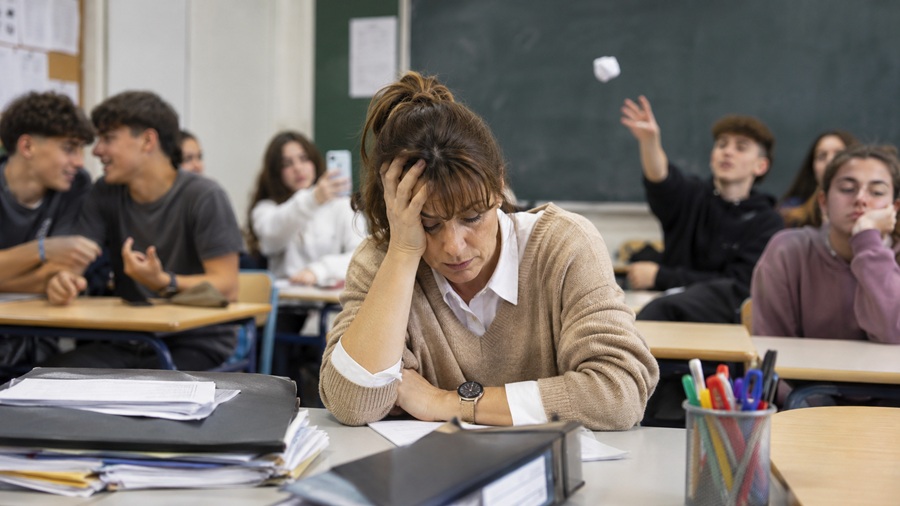
Image generated using AI.


Catalan schools face an untenable paradox: teachers are expected to manage increasingly complex classrooms, yet the current legal and administrative framework leaves them unprotected in the face of violent behaviour. The Catalan’s Government’s proposed Public Authority Bill and its reform of the Catalan Education Act (Llei d’Educació de Catalunya, LEC) must amount to more than a merely symbolic gesture. What is needed is a clear and robust legal definition that safeguards teachers, establishes clear consequences and finally puts an end to the current bureaucratic maze.
First, the forthcoming statutory definition of teachers’ authority must ensure that teachers are fully protected against any assault, whether committed by pupils or by any other member of the education community. The precedents are clear: in previous negotiations, the protocol of the Joint Health and Safety Committee (Paritària de Salut) was watered down when demands for clear consequences and redress for the harm caused were made; the wording was softened and assaults by pupils were excluded. Despite the Department of Education’s reluctance, the LEC must explicitly stipulate that a pupil who assaults a teacher is immediately removed from that teacher’s class, so that the teacher is not required to teach that pupil again. This measure not only protects the teacher’s physical safety but also sends a clear and necessary message about the boundaries of acceptable behaviour, while helping the perpetrators themselves to learn to control their own behaviour.
It is essential that the legal framework allow no exclusions of any kind. In the past, and possibly still today, the Department of Education has sought to exclude assaults by pupils with special educational needs (SEN), ignoring the fact that the most serious incidents have occurred precisely in special schools, where one response was to offer teachers a 30-hour aikido course. Protection for teachers should be universal, with no exceptions based on pupils’ needs or the educational setting.
Another key priority is to address the regulatory gap and the way the current protocols refer back to one another, with the result that there is effectively no protocol for pupils assaulting teachers. The current system is a vicious circle: the procedure for dealing with serious misconduct refers staff to the protocol on violence against employees, while that document states that it does not apply when the perpetrator is a pupil from the same school. This leaves teachers at the mercy of each school’s internal rules and very limited sanctions, which often depend on the family’s agreement, while denying school leadership teams the resources available to them when violence occurs between pupils. Furthermore, unlike the systems in other autonomous communities, the online reporting system — REVA, the register of violence against pupils — effectively prevents incidents of violence against teachers from being recorded. The problem is even more acute in Integrated Support Classrooms (Aules Integrals de Suport, AIS), where pupils are not enrolled at the mainstream school and no assaults can be registered. As a result, violence against teachers in these settings has often become normalised. Staff working in these settings are particularly vulnerable, and many are temporary teachers who are afraid to report incidents to the police.
Finally, the legislation establishing teachers’ authority should also empower school leadership teams to act on their own initiative when a teacher is afraid to report an assault, without the administrative procedure being suspended. The law must therefore guarantee that teachers receive unequivocal support, without their accounts being called into question, from inspectors, regional education services and families. Teachers’ authority is no privilege; it is a basic condition for restoring dignity to education and protecting the entire community.
Source: educational EVIDENCE
Rights: Creative Commons