


- Cover
- 18 de November de 2026
- No Comment
- 18 minutes read
Federico Malpica: “According to the learning sciences, how do we learn this?”

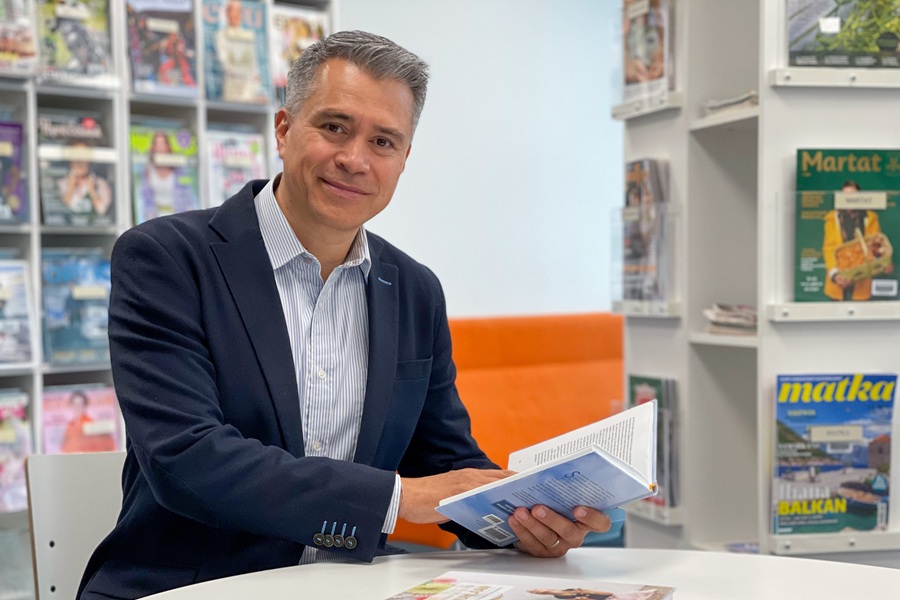
Image kindly provided by the author
FACE TO FACE WITH
Federico Malpica, Chief Executive Officer of Sinapsia Group Finland Oy


He speaks to me from Finland, where he lives, and I discover that we both knew the educationalist Xavier Melgarejo personally and remember him fondly. Melgarejo studied the Finnish education system at a time when little was known about it. Talking to Federico Malpica Basurto is a delight, particularly because, much to my surprise, he switches to Catalan, speaking with a gentle, calm and warm Mexican accent. His roots, then, lie in the Americas, while his studies took him to Barcelona, among other places.
He holds a PhD in Education from the Autonomous University of Barcelona, specialising in educational quality and innovation processes. From the outset of his professional career, his work has focused on improving education systems, the strategic management of organisations, leadership, change management and teacher professional development. Since 1998, he has worked as a researcher, consultant, visiting lecturer and trainer, collaborating with educational institutions in various countries to promote pedagogical transformation grounded in research and innovation. He subsequently founded the Escalae Institute, where he promoted the development of the Escalae System, a methodology designed to improve the quality of teaching and learning in schools. He later created TeachersPro, an international community and online platform dedicated to the professional development of teachers.
He is currently the founder and Chief Executive Officer of Sinapsia Group Finland Oy, an organisation based in Finland that researches, develops and implements solutions to improve education and strengthen the teaching profession. I had the opportunity to have a learned, incisive and intense conversation with him, during which I was struck by his profound understanding of educational transformation, his analytical ability and his enduring commitment to evidence-informed education and continuous improvement. As he points out, we need to ask ourselves what we want our students to be like when they complete their education. In this interview, I find myself asking the same question of myself.
Your career has taken you from the classroom to leading international organisations dedicated to educational innovation and improvement, with university research along the way. You mentioned that your father founded a school in Mexico, where, as a child, you helped him clean blackboards, playgrounds and so on. But if we look further back into your past, which teacher has had the greatest influence on the way you understand education?
Probably Antoni Zabala, director of Graó Publishing and one of the most profound educational thinkers I know. He is a true architect of learning who has devoted his life to developing an evidence-based teaching profession, as reflected in Graó’s approach and in his many publications, lectures and contributions. He has also been a mentor to me, helping me gain a deeper understanding of teaching and learning processes, the role of an educationalist, and how to make sense of my earlier research into educational organisations as complex systems. Together, we developed the fundamental principles underpinning Escalae and TeachersPro. We also forged a deep friendship that has endured despite the distance. We are compadres: I am godfather to his youngest child, and his wife is godmother to my youngest.
“What do we expect of our students when they complete their education? What should they have learnt?”
We live at a time when social media exposes us to more data and opinions than verified knowledge in our everyday lives. Should schools focus more on digital innovation, or should they remain places where knowledge is transmitted?
For me, school should essentially be a place where people come together to discover their purpose. But how can we help our students discover their purpose if, as a collective, we are not clear about our own? The first question we ask should not be about the curriculum (what we teach), methodologies (how we teach and assess), or organisational matters (what technology to use, how to organise things, and so on), because all these are means, not ends in themselves. Rather, they should serve a greater good, the only thing that gives meaning to everything else: what do we expect our students to be like when they complete their education? What should they have learnt? Once we are clear about what they should know, be able to do and be, and agree on the purposes of learning, we can begin to ask: according to the learning sciences, how do we learn this? The answers can then be translated into the content, methodologies, technologies, organisational arrangements and teacher profiles needed to ensure that we are working towards this profile for every student.
Your doctoral studies in Education have been closely linked to educational quality and innovation. You say that schools should serve learning, but how would you define educational quality in three adjectives?
For me, educational quality can be summed up in three adjectives: coherent, continuous and measurable.
Why coherent?
Coherent, because educational quality means consistency between what we promise our students they will learn by the end of their education (the intended learning outcomes) and what we actually do in every classroom, in every year group and across the institution as a whole to fulfil that promise. This consistency cannot be based on intuition or passing ideas: it must be supported by scientific evidence that our intervention can be effective. It is not enough for one classroom to work well; coherence requires the same commitment to be sustained throughout the institution.
“Quality is not a place you arrive at, but a road you travel. There is no finishing line where you can say, ‘We are now a quality institution’ and stop there”
And continuous?
Continuous, because quality is not a destination you reach, but a road you travel. There is no finishing line where you can say, ‘We are now a quality institution’ and stop there. It is about establishing a culture of continuous improvement that affects educational practice, organisational arrangements and teacher profiles, so that each year we move a little closer to the intended outcomes for our students. It is a process, not a state.
And measurable?
Measurable, because you cannot improve what you do not measure. This means having a system of indicators at two levels: performance indicators, which show how we are carrying out processes, and impact indicators, which show what results we are achieving. Without such a system, it is impossible to know clearly whether continuous improvement is working or whether we merely believe it is.
Throughout your career, you have worked with schools in different countries. Can you name one country that you believe has a successful education system, and explain why?
I would say Finland. Not because it is fashionable to talk about education there, or because I live here, but because it is the only model I know that succeeds as a whole system, rather than just in certain schools or with particular students.
What is the first thing the Finnish education system achieves?
The first thing that stands out is that it achieves this with fewer teaching hours than most countries, and it does more than achieve good PISA results. It develops clear competences for life and helps every student find their purpose: the intersection between their passion and their talent.
But some education systems now outperform Finland in the PISA tests.
But in every case, they achieve this with more teaching hours and a wider gap between high achievers and those who fall behind. Finland enables everyone to reach a good academic level and also to find their place in the world. Few systems achieve that combination of excellence and equity. I say this from direct experience, too: my children attend the nearest state school to where we live, and what I see there is exactly what I have observed in the dozens of schools I have visited across the country. It is not a showcase designed for international rankings. It is an approach to education that runs through the entire system, without exception.
“The Finnish Ministry of Education has just published its vision for basic education up to 2045. A twenty-year horizon”
And what about teacher training?
In Finland, teachers are trained to identify learning difficulties before they become problems, without relying on nationwide standardised tests to detect them. As a result, fewer than 1% of students repeat a year. They do not wait for an exam before taking action. There is something else I find revealing: the Finnish Ministry of Education has just published its vision for basic education up to 2045. It looks twenty years ahead, with a clarity about the kind of people it wants to educate that I have rarely seen in other systems. Its central idea is that school is not a place where you learn for the future, but a place where you learn for life. For me, that sums up why this model works: it has an absolutely clear sense of direction, and the whole system—curriculum, teacher training and assessment—is designed in line with it.
You established the Escalae Institute to support continuous improvement in schools. What were the project’s founding objectives?
The Escalae Institute was founded with three objectives, each addressing a different question. The first concerns the model. The Institute’s methodology invites us to look at education in reverse: not as inputs–process–outputs, but as outputs–process–inputs. In other words, instead of saying, ‘I design my educational offer, deliver it and see what results I get’, we say, ‘We commit to specific learning outcomes (the student exit profile), design a process capable of delivering them, and then identify the inputs we need.’ This shift may seem simple, but it completely changes how an institution makes decisions.
“Human intelligence is designed to be collective. Individual intelligence will always be very limited”
And the second objective?
The second objective concerns how to embed that model in real practice. Here we start from a conviction: human intelligence is designed to be collective. Individual intelligence will always be very limited. That is why, from the outset, we backed professional learning communities as the most powerful way to sustain improvement—far more so than isolated training or the individual talent of a few teachers.
Let’s move on to the third objective.
The third objective is actually what gives meaning to everything that comes before it: why it is worth devoting an entire career to this work. At the Escalae Institute, we have a motto that sums it up better than any explanation I could give: ‘There is no problem more complex than revolutionising learning, nor any whose solution is more worthwhile’. These three objectives—changing the model, changing the way we work and sustaining the purpose—have guided the Escalae Institute since its foundation and remain the same today.
You later promoted TeachersPro and now lead Sinapsia Group Finland Oy. It is clear that teachers need to know how to teach what they know, but what else are your initiatives aiming for? Subject specialists who teach their own discipline, or generalist teachers who guide students to learn independently?
Basically, these initiatives aim to raise the teaching profession to the level required to meet the challenge we face—and will continue to face—in the twenty-first century. It is about professionalising our work, just as medicine did in the last century.
I don’t understand.
At the beginning of the twentieth century, doctors carried their own medical bags and each had their own remedies, sharing very little with one another. Back then, if you were lucky with the doctor you got, you lived; if you were unlucky, you died. Today, doctors base their practice on scientific evidence; they are reflective and collaborative, and they continually improve what they do. I was impressed during the COVID-19 pandemic by how they developed care protocols that were adopted around the world and found treatments in months, not years. In education, meanwhile, some studies suggest that more than sixty years can pass between the learning sciences discovering something that works in the classroom and that finding becoming widespread practice.
“In a world where human capabilities are increasingly our only unlimited resource, I believe teaching will be our highest calling”
So what are your initiatives aiming to achieve?
Our initiatives aim for a future in which teachers are treated as doctors are today: trained like athletes and conducting research like scientists. They should become masters of learning, in a profession that everyone wants to join. In a world where human capabilities are increasingly our only unlimited resource, I believe teaching will be our highest calling. This is already happening in the best schools and education systems in the world. In Finland, for example, teachers are proud, autonomous and highly trained professionals, true masters of the art of teaching. Seeing how they welcomed my children and helped them integrate into the school and the culture, supporting them despite the language barrier, is the best evidence I can offer for what I am saying.
And who will be the best teachers of the future?
The best teachers in the world are those who can make their students think, unlock their intrinsic motivation and inspire them to aim higher than they thought possible. But they do not work magic, nor were they born that way. They learnt how. They have mastered the science of cognitive development, the practice of building communities, the psychology of motivation and a deep knowledge of their subject. I do not think the debate is about specialists versus generalists: it is this combination that can, and should, be developed. That is why, at TeachersPro, teachers develop their teaching skills while also building their capacity for evidence-based reflection and collaborative learning. We believe it is important for these two skills to be visible and to have their own metrics: Reflective Capacity and Collaborative Learning. If we truly want teachers to become masters of learning, knowing their subject is not enough. They need to think about their own practice, and to know how to do so as part of a community.
Educational innovation is a widely used term, although it does not always mean the same thing. From your perspective, what conditions must be met for an innovation to be genuinely transformative and help improve students’ deep learning?
There are many kinds of innovation, such as open or disruptive innovation, and innovation is sometimes understood as creating entirely new knowledge or inventing something from scratch. But that is very difficult to achieve and, above all, does not necessarily transform students’ deep learning. For me, innovation is a much more practical concept: the ability to create new collective knowledge within an educational institution in order to do its work better. I am not talking about innovation in general, but about what is innovative for a particular school. Many schools may already use project-based learning, for example, but it can be deeply innovative in our school if we have never implemented it collectively and followed through on all its implications.
“Only what is done collectively is innovative, because that consistency contains the seeds of genuinely transforming student learning”
And how can innovation become genuinely transformative?
In my experience, for innovation to be genuinely transformative, it must meet two conditions. First, it must serve a shared learning goal. Second, it must be implemented by all the teaching staff, not just a few people. From the perspective of students and their deep learning, what is the point of some teachers at an institution receiving an innovation award if many students will never be taught by them? That is why I would never give individual innovation awards. To me, that is not innovation; it is anecdotal. Only what is done collectively is innovative, because that consistency contains the seeds of genuinely transforming student learning. I say this with complete conviction after more than twenty years in the field: I know of no educator, however brilliant or experienced, who has a greater impact on students than a well-organised group of teachers.
Finally, which research projects, publications or educational initiatives are you most excited to be working on at the moment?
The first is the development of TeachersPro into what we call a TPI, a Teacher Performance Infrastructure. Until now, even the best teacher-development systems have depended on someone—a mentor, coordinator or trainer—having time to observe each teacher’s actual practice and provide meaningful feedback. And that ‘someone’s time’ is precisely what educational institutions never have enough of. We are now building an infrastructure that combines real evidence from teaching practice with artificial intelligence, so that every teacher receives genuinely personalised feedback: not generic feedback, but feedback based on their own development, patterns and classroom context. This is not just theoretical. We have a study under way in Brazil, where we are piloting the platform in technical and vocational education and training, to give practising teachers a much more flexible way to train and develop their pedagogical skills without leaving the classroom or waiting for the next course to be offered. We have also submitted a European project to be implemented in Ukraine and other countries facing complex situations, with the aim of helping teachers strengthen their resilience in circumstances that are far from normal. Training in these settings cannot follow the usual model: it needs to support teachers in extreme conditions, with a degree of sensitivity and personalisation that only an infrastructure like this can deliver at scale. We want to extend this approach to other equally difficult settings, where teachers are sustaining education in very adverse circumstances.
The second project is at an earlier stage, but perhaps it is the one that excites me most in the long term. We are beginning to design a different model of higher education, starting in the field of education but with ambitions to go much further. The central idea is to replace the traditional classroom–curriculum–qualification model with one based on learning through real work: training future professionals, starting with teachers themselves, in authentic work settings, with real performance evidence at the heart of learning rather than credits accumulated in a classroom.
And what will it be called?
It is too early to announce a name publicly, but I can say that it combines everything we have learnt over two decades about professional learning communities, institutional architecture and, now, artificial intelligence applied to human development. If it works as I believe it can, we will not simply be talking about how an institution trains its teachers. We will be talking about a new model of higher education.
Source: educational EVIDENCE
Rights: Creative Commons