


- Opinion
- 16 de March de 2026
- No Comment
- 7 minutes read
Secondary school teachers—but not secondary

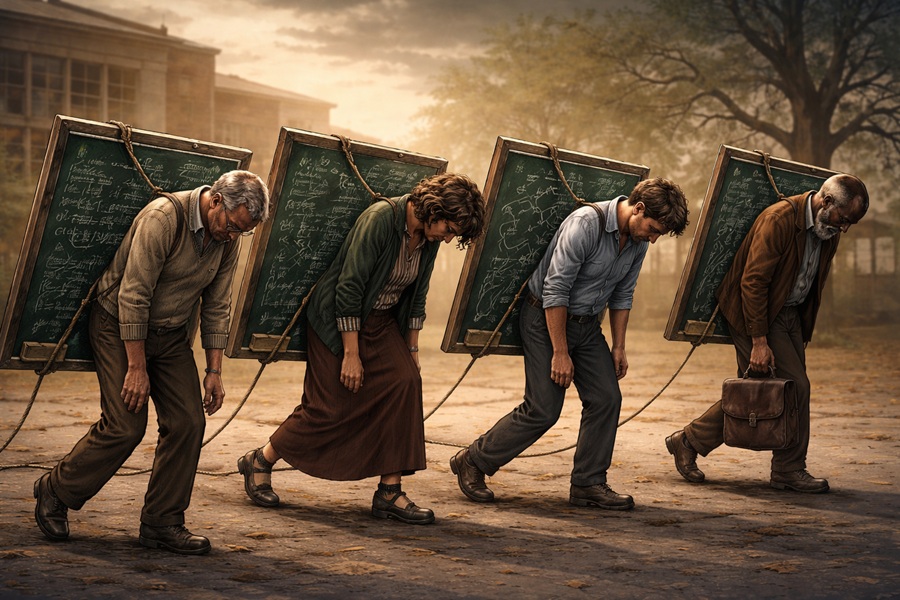



Precarity—the great economic malaise of our neoliberal present, marked by poorly paid jobs and by the absence of shared horizons, promises of prosperity and collective supports—is everywhere, including in the public sector. For while those who are institutionally supposed to protect us enjoy the highest salaries in the country, secondary school teachers in Catalonia rank among the lowest in terms of purchasing power. For years now we have lived trapped, as Massimo Recalcati has put it, in a triple form of precarity: economic, social and symbolic.
First comes economic precarity. Much has been said about this in recent months in the context of the current wave of strikes and trade-union mobilisation. The most thorough study is the one produced by Aurora Trigo and Núria Gascó, which clearly sets out the causes of the decline in the purchasing power of secondary school teachers in Catalonia and the unjust nature of their situation compared with other civil servants of the Catalan government. All of them? Not quite. The Mossos d’Esquadra1 have not needed to mobilise and have nonetheless secured a substantial pay rise. If there were still any doubt, yes: this is a matter of priorities.
Our economic precarity, besides being unjust—since, like everyone else, we feel the effects of inflation and the profound absurdity of an economy that grows in terms of GDP while none of that growth is felt in people’s pockets—also exposes the hypocrisy surrounding the supposed added value of our work. The point is obvious: without knowledge there can be no knowledge-based economy, nor jobs requiring high levels of qualification. This is why GDP growth does not translate into higher GDP per capita: because growth is being driven by the creation of precarious, low-value jobs that produce a deceptive form of economic expansion. In other words, we are indirect economic victims of the way in which public authorities (mis)understand the added value created by our work. If we detach the economy from knowledge and base it, for example, on tourism, we lose economically as a society—and, by extension, in salary and professional terms as teachers.
This brings me to our second major form of precarity: social precarity. As suggested above, it is impossible to gain social recognition without the economic recognition we deserve. Salary is purchasing power, but it is also a sign of the value attached to an important profession, to years of study, to a demanding selection process and to the role teachers play in what we rather abstractly call “order”—a much-maligned word these days. Speaking of order, it will be impossible to overcome social precarity without a renewed sense of teacher authority. In a republic—in the etymological sense of the word—teaching is the primary means by which societies equalise opportunity: through the transmission of knowledge. For this to work, we must ensure that our voices are heard: in the classroom, in staff meetings and in society at large. We must work to rebuild a form of professional sovereignty and social respect comparable to that enjoyed by doctors, judges and the police—and which, in truth, should be enjoyed by all professional groups. By this I mean that asking for respect and authority within our professional field is very far removed from classism, military-style authoritarianism or punitive discipline. How might we rebuild that teacherly sovereignty? Four measures come to mind straight away: the return of a clear disciplinary framework in classrooms (based, of course, on proportionate, fair and non-violent rules), the restoration of academic rigour, formal recognition of teachers’ authority in the exercise of their duties and the abolition of decrees that limit the sovereignty of teaching staff bodies.
Finally, there is symbolic precarity—the most complex, most fluid and slowest to correct of the three. It contains elements of economic and social precarity, of course, but it has a distinctive feature: it is directly proportional to the lack of clarity about the aims of education. As Daniel Bernabé points out, the fewer possibilities there are for transforming material reality, the greater the burden of symbolic demands that must be assumed—in our case—by the education system. The intangible nature of the social value of education plunges the institutions responsible for providing it into symbolic precarity. All of this is the result of the atomisation of their public mission. In other words, the more tasks teachers are expected to perform, the more bureaucracy they face, the more unreflective digitalisation is imposed upon them, the more opaque the curriculum becomes and the less institutional backing they receive—as is currently the case—the more symbolically precarious their work becomes.
Those of us who see this clearly believe in the republican function of the school: we believe in a pedagogy of the redistribution of knowledge as the engine of equal opportunities, as opposed to a pedagogy of representation that treats education as a field of individual self-affirmation, as Bianca Thoilliez explains (all the references in this article come from her book Conservar la Educación).
We believe in our social function because we have a sense of vocation, yes—but we also know that one cannot live on vocation alone, and that it only makes sense when it forms part of a broader framework of social and economic recognition. In other words, we want to be secondary school teachers and we want to be able to teach—but we do not want to be secondary teachers.
___
1 Mossos d’Esquadra is the police force of Catalonia, under the authority of the Catalan government.
Source: educational EVIDENCE
Rights: Creative Commons