


- Cover
- 27 de November de 2026
- No Comment
- 7 minutes read
Towards a VAR for politics? Lies subject to instant review

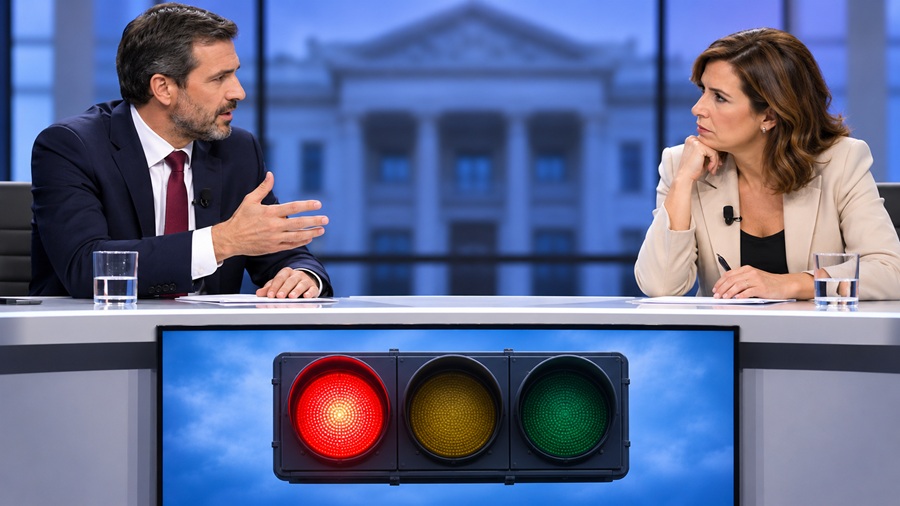
Image created using AI.


Allow me to move from Educational Evidence to Political Evidence. The idea was put to me by Jordi Mazón, a fellow Physics teacher at the UPC, who, incidentally, is no relation of the former president of the Valencian regional government. And although it may sound like a flight of fancy, it is worth giving some thought to: what would a political debate look like if we could check the truthfulness of what politicians say in real time? Something like football’s VAR, but applied to arguments and words.
Imagine an election debate in which the candidates stand at their lecterns, the cameras focus on them, and screens behind the candidates and in viewers’ homes display their contributions. Whenever someone makes a verifiable claim, a small marker appears. An independent team of fact-checkers, assisted by artificial intelligence systems and connected to official databases, statistics, documents and reliable sources, checks each assertion. Within seconds, the screen lights up with one of three results, following the example of some media outlets that have fact-checked recent election debates. The results are presented in three traffic-light-style categories: TRUE (green), FALSE (red) or UNCERTAIN/NEEDS CONTEXT (amber).
A candidate may say: ‘We have halved unemployment’. The screen responds: FALSE. Unemployment has fallen by 12 per cent, not 50 per cent. The politician retorts that they are referring to a particular age group, or comparing the figure with that under the previous administration, but the system adds warnings, perhaps Kahneman-style biases: MISLEADING THROUGH GENERALISATION or LACK OF CONTEXT. The candidate smiles, perhaps corrects themselves, and carries on, somewhat awkwardly. The moderator does not need to interrupt. The screen has already done so. The warning appears automatically on viewers’ screens.
Naturally, the system would not be infallible. Figures can be interpreted in different ways, statistics may depend on how they are compiled, and statements are not always propositions that can be reduced to a yes or no. That is why there would be a third category, perhaps the most interesting of all: UNCERTAIN / NEEDS CONTEXT. It would probably also be the one politicians used most, as they would quickly discover that almost any statement can be wrapped in enough context to survive in the amber glow of ideological uncertainty.
Safeguards would have to be established, as in any fact-checking system: public sources, transparent criteria, the possibility of challenging results and independent audits. More than one system could be presented at the same time, and the public would receive that information immediately. TRUE according to source X, UNCERTAIN according to source Y… The aim would not be to replace political debate with a quiz show, or to give an algorithm the authority to decide what is true. It would be to make it harder for anyone to present an opinion as a fact, a promise as an achievement, or a mere correlation as a causal relationship.
Perhaps the most interesting thing would be to observe how the candidates’ behaviour changed. Some would learn to speak more precisely. They would need training. Others would avoid figures for fear of VAR. The more experienced might develop a new rhetorical skill: formulating statements that were not exactly false, but could not be verified either. A kind of art of smoke and equivocation would emerge. Political advisers, for their part, would bring in specialists in dodging VAR and its AI sidekicks, bringing Cicero up to date for the twenty-first century.
The role of the viewer would change too. Instead of watching an exchange of accusations, slogans and carefully rehearsed soundbites, they could assess claims and distinguish between facts, interpretations and promises, which the machine would detect. That is, if they were not too knackered from work. They might even discover that some politicians they distrusted say things that are true, while others they regarded as reliable build their speeches on, at best, half-truths. But how can they guard against their own biases and ideology?
However, the problem with politics is not simply that people lie. It is the normalisation of lying without consequences. Something is wrong when a false claim, repeated ad nauseam, eventually takes on the appearance of truth and, when someone debunks it, the rebuttal reaches a far smaller audience than the original lie. Perhaps it is no longer news, lost amid the media frenzy and noise; perhaps the debate took place yesterday and the public remembers the personality, the forcefulness of the impossible promise, or simply prefers the lie. And it is always easier to doubt the rebuttal than to change our mental frameworks or admit that we have been deceived.
Political VAR would, of course, always have its detractors. Some would denounce a conspiracy among the fact-checkers; others would speak of censorship, ideological persecution or technological manipulation. There would be no shortage of people demanding a review of the review, or calling for VAR for VAR, in an endless chain. It already happens in football. Some candidate would probably claim that the system was rigged because it always flags them. And perhaps, on occasion, they would be right. Would a VAR error kill the political system or spark an uprising—or is it already dead?
But let us imagine, for a moment, that we reach that future. Picture a debate in which it was not enough to speak louder, interrupt one’s opponent or repeat a falsehood with sufficient conviction. A world in which words had to answer to facts. It would not solve the problems facing democracy, because truth does not guarantee justice, data do not replace ideas, and a good leader cannot be judged solely by the accuracy of their statements. But it would be a first step towards renewal, allowing critical thinking and reason to gain some ground against irrationality. A little more seny (good sense) and a little less sheer rauxa (reckless impulse), as we Catalans would say.
After all, in football we accept that a decision can be reviewed because we know that the (human) referee can make mistakes. In politics, by contrast, we have agreed that the referees, the players, the spectators and even the scoreboard can say (almost) whatever they like. And nothing happens.
Has the time come to install a few more cameras? Perhaps we do not need more technology, but something far more revolutionary: politicians who have to answer for what they say and face the consequences of what they fail to do.
Source: educational EVIDENCE
Rights: Creative Commons