


- Opinion
- 22 de April de 2026
- No Comment
- 11 minutes read
Of swine, pearls and books

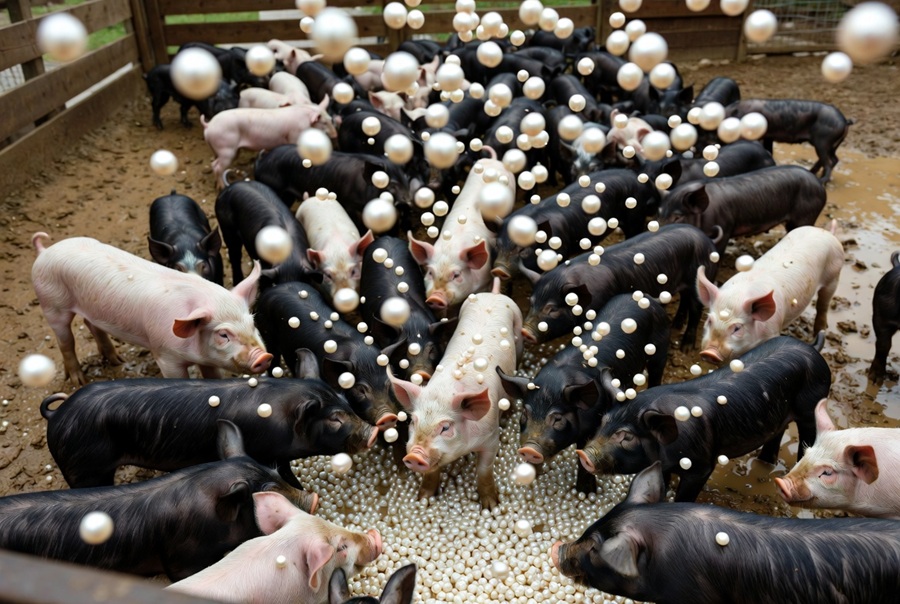
The saying “Do not cast your pearls before swine” (Matthew 7:6). / Image generated using AI


In a recent piece in El País, Joan Burdeus took aim at a certain way of approaching literature: a kind of writing built on “taking a selfie next to the great names” and producing a constant stream of stimuli so that language never quite interrupts the reader’s emotional inertia. Burdeus was referring to a specific case—David Uclés’s mediation of Rodoreda—but the formulation is so precise that it is hard not to see in it something more than a passing critique. It condenses a strikingly perceptive intuition about contemporary literature—and, if I may, about its slow, methodical degradation. A timely subject, with Sant Jordi just around the corner.
This intuition is not confined to the cultural supplements. It also surfaces—more crudely and caricatured—in certain corners of social media. Not long ago, a whole parade of booktubers began complaining that they could not understand Wuthering Heights, just as a new film adaptation was being announced. Hilarious. There is always something faintly amusing about watching someone suddenly discover that literature is not a friendly extension of their feed, and that Emily Brontë—unlike a podcast—does not come in fifteen-minute instalments. But the problem is not that there are readers who fail to understand Emily Brontë; that has always been the case, and it is perfectly respectable. The problem is that this difficulty is experienced as a personal affront—as though a book written nearly two centuries ago had somehow failed for not adapting to the expectations of a fragile reader, shaped by speed, transparency and instant gratification. As though Wuthering Heights were—God forbid—a defective product.
What lies behind this, I suspect, is not merely a shift in taste but a deeper transformation in the kind of reader a society produces. The issue is not the democratisation of literature. Bernard Stiegler spoke of a proletarianisation of knowledge—not a loss of material wealth, but a loss of savoir-faire, of knowing how to live, and ultimately of knowing how to feel. The contemporary recipient is not simply a less educated reader (though that too); they are a subject from whom the very conditions that make a non-Pavlovian aesthetic experience possible have been systematically eroded. This affects literature, certainly—but not literature alone. It has to do with the model of education currently being contested in the streets, with the media, with cultural institutions, and with the kind of temporality that structures collective experience: an accelerated temporality.
Hartmut Rosa understood social acceleration not as a mere feeling of haste, but as a structural logic of late modernity—an acceleration of technology, of social change and of the pace of life. The problem, in this framework, is not simply that everything moves faster, but that this acceleration erodes our capacity to sustain forms of delay without which there can be no deep reading, no sedimentation, no dense experience of language. A speeding up of time that paradoxically “freezes” it. Byung-Chul Han, for his part, has described this condition as a poverty of experience: an excess of unfiltered positive stimuli that does not enrich but flattens perception, reducing it to a succession of things one either likes or does not like—an infinite scroll applied to life as a whole. Yes or no. Right or left. A Tinderisation of culture.
An accelerated society has little tolerance for latency; it cannot stomach it. It has no patience for what does not yield itself immediately, for what requires us to go back, to reread, to digest, to allow meaning to settle. And a genuine book—a book with ambiguity, with density, with dark zones—always demands some measure of all this. What was once a natural condition of reading has now become an intolerable nuisance, as though any form of friction were a manufacturing defect rather than a constitutive property of literature worth reading.
This situation invites us to revisit an old idea. In his Arte nuevo de hacer comedias, Lope de Vega famously wrote that, since the common audience pays, it is “right to speak to them foolishly so as to please them”. Read hastily, the line seems to grant carte blanche to any form of dumbing down. If the people want entertainment, then give them entertainment: bread, circuses, football—and writers in hats. The bigger, the better. Let there always be hats; they look intellectual. The whole mechanism recalls rather too closely that Ponga un pobre en su mesa which Berlanga turned into satire. Here, however, the poor are not invited in; instead, the book is paraded across social media to soothe the conscience.
But let us not underestimate the “vulgo” of the Spanish Golden Age. Lope’s “vulgo” was not the contemporary audience manufactured by platforms, screens and circuits of instant validation. It was not a symbolically devastated public. It may have been non-academic, heterogeneous, noisy, full of contradictory tastes—but it still belonged to a society with more street life, more orality, more shared memory, more collective friction than the unfortunate individual who today cannot understand what they read.
This is why a distinction is needed—one that is not merely rhetorical but political. Not all audiences are the same. A reader who may not yet possess the keys to a work but is willing to be transformed by it is not the same as a recipient trained to assess it solely in terms of how easily it is digested, whether it keeps them hooked, or whether it allows for a quick reaction online. Nor is a living popular audience the same as an accelerated one on the verge of disintegration, squabbling on social media over Mendoza taking a swipe at Sant Jordi while entirely missing what is at stake.
The disarray is there for all to see. Prizes, recommendation lists, promotional campaigns, cultural conversations… everything seems to favour an increasingly sterile literature—ever more functional, ever more docile. Books with contrived mysteries, in the vein of The Housemaid—fairground noir—rise to prominence. Others offer prefabricated emotions and a pseudo-hippie protagonist to whom trivialities constantly happen, all experienced as egocentric cataclysms of supposed mystical significance. The language is accessible; the themes, ostensibly “important”, are treated with minimal depth but high emotional yield; and everything is peppered with references to films and television, as though literature could not stand on its own without transmedia Easter eggs. A widespread fear of metaphor, lest it unsettle the reader. What we have before us is precisely the inverse of what Martha Nussbaum described: a literature that simulates empathy while neutralising it.
It would be wrong to claim that these works are necessarily bad; some are competent, effective, even respectable. What is striking is the obscene ease with which works designed primarily for rapid consumption come to be treated as major literary events—fit for the world literary canon. It is not commercial success that surprises, but the leap in legitimacy. What would once have been read as solid entertainment now appears surrounded by an aura of exceptionality, inevitability—even destiny—as though its very expansion were proof of its value. McDonald’s is accepted for what it is: a fast-food chain, functional and entirely legitimate in its place. Yet we have not (touch wood) reached the point where it earns Michelin stars and global awards. And here irony gives way to a certain indignation. For if one looks beyond our immediate context, one sees that demanding literature has not disappeared from either the map or recognition: writers such as Han Kang or Mircea Cărtărescu remind us that dense, uncomfortable and ambitious writing can still be read, rewarded and debated. In comparison, it is hard not to feel somewhere between saddened and cheated by the Catalan literary landscape.
This is where one must take a firm stand and address a topic that few wish to touch. The coincidence between this entire opera buffa and the rebranding of the Catalan Corporation of Audiovisual Media—and, more broadly, of many major media groups, newspapers and television channels—no longer seems entirely innocent. Perhaps it is coincidence. But perhaps not. Perhaps what becomes visible here is not merely a change of image, but a deeper mutation of cultural criteria—or what Gramsci would have recognised as an operation of hegemony. Where once the writer could exert pressure on the medium, today—at least in Catalonia—it is increasingly the medium that pressures the writer. Where once a work could displace taste, unsettle it, expand it, force it to mature, now the work too often reaches the reader already domesticated by the system’s demands for visibility. What is required is less the force of language than compatibility with an ecosystem that needs products, not books—because products sell. And here the contradiction becomes almost obscene: in the morning, the leading Catalan channel lectures us on educational decline, on the devastating impact of social media addiction, on the loss of attention; in the afternoon, it plays along with the opposite logic, saturating children’s programming with gatekeepers—because, of course, they are not going to be the only fools to lose money. The masquerade is revealing. It is not that the public has chosen; it is that it has been prepared to choose precisely this.
Let us end with a second image, this time biblical. The expression “casting pearls before swine” does not come from Lope but from Matthew 7:6, where one is warned not to throw pearls before swine lest they trample them. The interplay between Lope and Matthew is not philologically exact, but conceptually fertile. Between “speaking to the masses” and “not casting pearls before swine” lies, at bottom, the same question: what kind of recipient does an age produce? And, above all, who benefits from that recipient being precisely this kind? An uncomfortable doubt emerges. To what extent does the writer who adapts to this logic know perfectly well what they are doing? And to what extent, on the contrary, are they so blind as to believe they have transcended when they have merely been used? I am not sure which would be worse.
Put bluntly—deliberately so, but usefully—there are swine and swine. If one must be a swine, perhaps it is better to be among those who still know how to sniff out truffles than among those wallowing in the mud, chuckling along with the one who leads them to the slaughterhouse.
Happy Sant Jordi.
Source: educational EVIDENCE
Rights: Creative Commons