


- Opinion
- 21 de January de 2026
- No Comment
- 8 minutes read
The racket of the split school day and the convent school

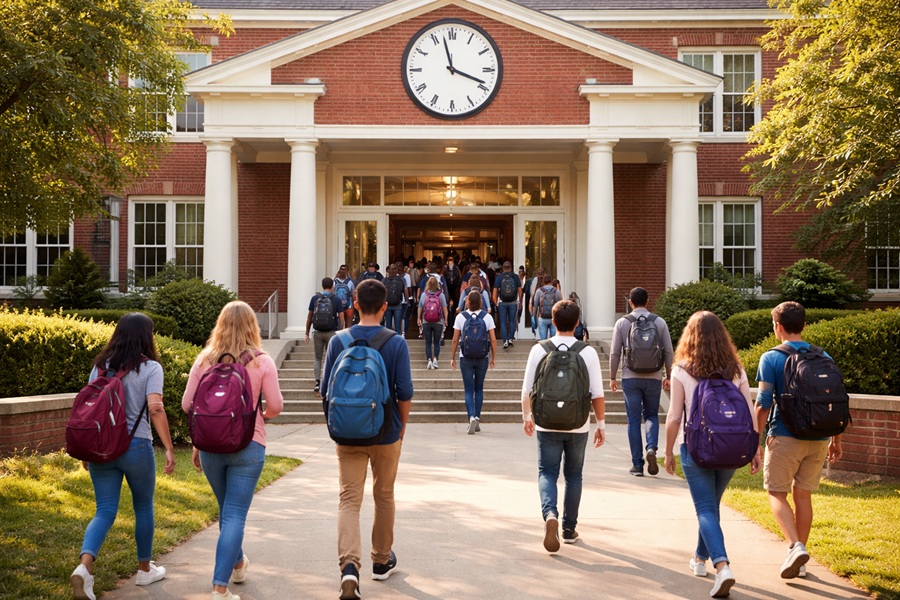
Image by AI



There is a whole network of para-educational institutions and lobbying groups that have not rested since the day the Department of Education of the Government of Catalonia (Generalitat) authorised secondary schools, if they so decided—by majority vote in the school council, with weighted voting among the different represented sectors—to opt for a continuous or compact school day: teaching only in the morning (note: teaching hours, not teachers’ working hours).
Over the past few years, the campaign in favour of forcibly reinstating the split school day—classes in the morning and afternoon—has steadily intensified, to the point of becoming something close to an unhealthy obsession. There is a great deal at stake, of course. Even the Department of Education itself seems to have caught the bug—quite willingly, it should be said—and everything suggests that it is merely waiting for the right moment to revoke the continuous day and reimpose compulsory morning-and-afternoon schooling. All day at school, from nine to six.
The arguments deployed have been of every conceivable kind, ranging from the timid to the allegedly “scientifically” endorsed. That pupils eat too late and this harms their health; that they are half-asleep in the mornings; that if they are not in school in the afternoon they will be corrupted by bad influences—the evil always lurks, but apparently only outside school—and that secondary schools should therefore function as a kind of teenage daycare. That the “educational community” and families are opposed to the continuous day, and that the only people who benefit from it are teachers… There have even been moments of genuine delirium tremens, in which the morning-and-afternoon schedule is justified in the name of “timetabling rationalisation”, work–life balance, and greater pupil autonomy—an authentic contradictio in termini, as if any of this depended on school timetables rather than working hours. In short: no school autonomy to speak of, no nonsense—morning and afternoon classes, end of discussion. Whether students learn anything, or whether the model is academically counterproductive, appears to matter not at all; nor does what they actually do there. The only thing that matters is that they are in school.
And yet, if we pause for a moment and note that the majority of secondary schools currently operate with a continuous day, it becomes clear that the “educational community” and families cannot be quite so opposed after all. If their representatives on school councils vote in favour—remember, this requires weighted voting—it is presumably because they do not see it as such a bad arrangement. It is a democratic, participatory process, and questioning it is tantamount to questioning the very foundations of participatory democracy.
In fact, whenever conflicts have arisen, they have tended to move in the opposite direction: when the Department, often hastily and without prior notice, has informed certain schools of their conversion into so-called school-institutes1 and prohibited them from maintaining the continuous day, families have protested because they wished to keep it. Curious, isn’t it? There have been more than a few public rows over this. Might it be that school autonomy only counts when it obediently rubber-stamps the directives of a Department operating at the behest of pedagogocratic lobbies? And incidentally, in these supposedly pupil-centred times, it is striking that no one seems to have thought to ask the students themselves.
Meanwhile, the facts are stubborn things. We know that afternoon classes were a living hell—both socially and climatically (for half the year)—and that with the continuous day, disruptive behaviour and disciplinary incidents, which were far more frequent in the afternoons, fell significantly. We know that if many students arrive at school half-asleep in the morning, it is not because they got up at seven, but because they stayed up late into the night in their bedrooms, glued to computers, mobile phones and social media. We know that with a continuous day they have more time for extracurricular activities and leisure, and that they must learn to manage their time independently—we are talking about adolescents who will soon be adults. We know that academic results, at worst, remain stable—education may not be in the business of miracles, though it does seem to attract miracle-mongers. And ultimately, we know that a secondary school is not a boarding school, not a convent, and not a hippie commune.
But no—evidence counts for nothing. Because everything put forward in defence of the split day is merely a reflection of the true, unspoken, unconfessable leitmotif: a deeply ingrained conception of what an education system should be, and of the role assigned to state schooling by hegemonic social engineering. A role that has little to do with the transmission of knowledge, and much to do with childcare—and, while we’re at it, indoctrination. That is the real reason behind this entire charade. What matters is that students remain in school; what they do there is of no importance whatsoever.
And we have a problem, because two extremely dangerous impulses for state education converge eagerly in this leitmotif—pedagogism and the profit motive. In the case of pedagogism, the aim is obvious: total control over students’ processes and, above all, their time, turning secondary schools into reservoirs of adolescents. In the case of profit—especially in an increasingly commodified education system—it is enough to think of catering companies and leisure-activity providers, who, once they sink their teeth into schools, gain access to a captive clientele. They already have it in private education; now they want it in the public sector as well.
The school model that perfectly aligns these two impulses, in a true elective affinity, is the convent school: full-time schooling, yes—but with pedagogues acting as spiritual commissars in place of friars, and overnight stays still optional, for now. Everything in due course.
As the anthropologist Manuel Delgado recently put it in a tweet: “It’s frightening how much power pedagogues are acquiring, and their obsession with turning children into full-time school pupils. Children—and everyone else too”2.
He is absolutely right. Add a business opportunity to the mix, and the cocktail is complete.
___
1 Instituts-escola are Catalan state schools that combine primary and lower secondary education (typically ages 6 to 16) within a single institution. They were created as part of a policy aimed at organisational continuity and administrative efficiency, often involving the merger or restructuring of existing primary schools and high schools.
2 Original, in Catalan: https://x.com/Fortpienc1/status/2008473288574447789
Source: educational EVIDENCE
Rights: Creative Commons