


- Humanities
- 13 de January de 2026
- No Comment
- 30 minutes read
Some musical characteristics of Lux, by Rosalía

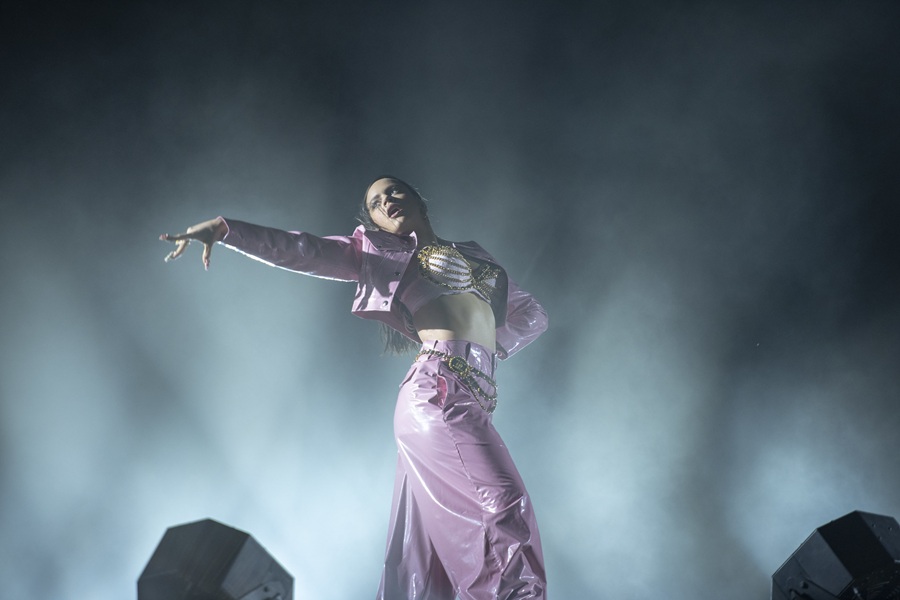
Photo: Bilbao BBK Live 2019 album, viernes/ Flickr


Rosalía Vila Tobella, known simply as Rosalía¹ (Sant Esteve Sesrovires, Barcelona, 1992), is the most successful Spanish artist associated with what Spanish musicology terms urban popular music² in recent years. This success is grounded not merely in popularity but in genuine artistic quality and a marked originality, despite her reliance on well-established musical idioms—sometimes left largely intact, more often hybridised with others. In addition to her work as a singer, Rosalía is also a composer and producer.
Lux is the Barcelona-born artist’s fourth full-length album. Streaming versions contain fifteen tracks, while physical editions include three additional ones, allowing the album to be conceived as a four-movement whole, loosely analogous to the sonata principle of a classical symphony. The fact that certain tracks segue directly into one another within each movement points partly to art music—where continuity often serves to extend musical discourse—but perhaps also to The Beatles³ or to symphonic rock. Lux borrows the concept, though not the musical substance, of that tradition.
Lux is not classical music. It is pop music shaped by the influence of art music—an influence both unusually prominent here and largely unprecedented in Rosalía’s output—while still retaining a substantial flamenco inheritance and traces of the so-called urban idioms that defined El mal querer and, even more clearly, Motomami.
Instruments, voices, and ensembles
Rosalía possesses a fine soprano voice⁴, which she deploys with considerable musical sensitivity whenever the stylistic context allows. Hers is a natural voice, far removed both from the rajo (the raw, torn vocal quality typical of many flamenco singers) and from the artificial placement of operatic vocalism. Yet she is perfectly capable, when she chooses, of adopting an operatic mode of vocal production, as she does in section B of Berghain (see below).
At least two choirs take part in the album: the Cor de Cambra del Palau de la Música Catalana, which had already collaborated with Rosalía at the 2019 Goya Awards, and the Escolania de Montserrat⁵. In some tracks they appear separately; in others, the two ensembles are combined.
Lux also features the London Symphony Orchestra, whose forces expand or contract according to the needs of each track. Thus, the central section of Berghain employs a full symphony orchestra—strings, winds, and percussion—whereas its instrumental introduction is scored exclusively for strings. It is reasonable to assume that the classical instrumental soloists heard on this album—who are not listed in the credits on the singer’s website—are members of the orchestra mentioned above.
In conventional pop and rock, instrumentation is largely fixed from start to finish: lead vocals, one or two electric guitars, bass, drums, and occasionally keyboards sound throughout the entire track, with the exception of the instrumental introduction (in which the singer does not appear) and the solo section, which is usually assigned to the electric guitar. Lux, by contrast, displays a strikingly fluid instrumental palette. Instruments enter, withdraw, and reappear, often generating—together with changes in intensity (see below)—processes of accumulation (instruments are gradually layered in as the intensity of performance increases; at the climactic moments of these processes, the choirs may join the orchestra) and rarefaction⁶, in which both texture and volume progressively thin out.
One of the album’s most distinctive features is the near-total absence of the drum kit. Many passages dispense with percussion altogether—a gesture that aligns the music more readily with art song or the singer-songwriter tradition—while others employ handclaps and a wide variety of percussion instruments, alone or in combination. What is largely missing, however, is the drum kit itself, the emblematic percussion ensemble of pop and rock⁷. In Reliquia, Aaron Funk provides programmed percussion, but its rhythms neither imitate the drum kit nor conform to its idiom. In Divinize, low-pitched percussion rolls appear—possibly played on a tom by a London Symphony percussionist and subsequently processed in post-production.
Particularly significant is the use of timpani, arguably the most important pitched percussion instrument in the classical orchestra of the eighteenth and nineteenth centuries. In some tracks they function conventionally, as they might in a Romantic score (Berghain) or in twentieth-century art music (Porcelana); elsewhere, their definite pitch⁸ is exploited by multiplying their number and assigning them the role of a bass instrument—one that substitutes for the electric bass, which is entirely absent from the album. This is especially evident at the end of La yugular, in Novia robot, and most clearly in Porcelana and La rumba del perdón (from 00:49 onwards).
In Dios es un stalker, a pizzicato double bass—possibly subjected to electronic treatment—replaces the electric bass. Its Caribbean-inflected rhythm, shared with the piano and certain percussion instruments (alongside flamenco handclaps), coexists seamlessly with bowed strings played in a Western art-music idiom, complete with characteristic tremolos⁹.
Electronic elements—extensively explored in El mal querer¹⁰ and consolidated in Motomami—remain present in Lux, though adapted in a chameleon-like fashion to the album’s new aesthetic. This includes both electronically generated sounds and subtle post-production effects, often filters, of the kind discussed by Jaime Altozano in relation to Motomami.
Intensity
In fast, conventional pop and rock songs, instrumentalists and singers tend to perform everything at the same intensity, at the same volume; if this is not the result, the recording is processed through a compressor, which removes unwanted disparities and makes everything sound equally loud. This uniformity of intensity is related to the aesthetic of this kind of music, but also to practical considerations: the noise of conversations in a bar or the sound of a car engine will never overpower the singer and the instrumentalists, whom we are thus guaranteed to hear at all times. This feature is termed fixed intensity by the brilliant French populariser Pierre Charvet, who adds two further characteristics: fixed form and fixed pulse (see the sections on “Form” and “Metre”).
One of Lux’s most striking departures from pop-rock convention lies precisely in its rejection of this norm. Rosalía’s vocal dynamics range from pianissimo in the album’s slower songs to fortissimo in the operatic section of Berghain, encompassing the full spectrum in between. This dynamic freedom recalls both classical music and the singer-songwriter tradition—two repertoires that stand apart from the fixed-intensity aesthetic dominant in urban popular music.
Rosalía had already rejected fixed intensity in her debut album, Los ángeles, under the influence of flamenco, whose singers make extensive use of dynamic shading. In that album, her vocal writing often inhabits pianissimo and piano, moving gradually through intermediate levels towards forte, though rarely dwelling there. In the songs on this first album, Rosalía displays exquisite taste, in part because she achieves a subtle range of dynamic nuances.
Form
In musical terms, form refers to the structure of a musical work, arising from the balanced distribution of its constituent parts; each musical form may be understood as a scheme generated by the particular way in which sections are repeated within a composition.
Whereas classical music offers an extraordinary variety of formal models, the vast majority of urban popular songs rely on a single structure: strophic form with chorus, in which two sections alternate repeatedly (for example, ABABAB). Typically, one section, generally A, carries changing lyrics, while the other—the chorus—repeats the same text throughout¹¹.
Many of Rosalía’s songs naturally follow this pattern.
The striking Berghain is the track on the album most strongly influenced by classical music, for several reasons. The solo voice, the choirs, and the orchestra do not merely appear as such, but actively imitate stylistic features characteristic of classical music, as will be discussed below. And, since we are speaking of form, Berghain adopts rondo form—one of the standard forms of Western art music—instead of following the familiar verse–chorus pattern. A rondo consists of a single recurring section alternating with other, increasingly different sections an indeterminate number of times. The shortest possible rondo follows the pattern ABACA, while a valid scheme for longer rondos might be ABACAD…A. The form of Berghain may therefore be outlined as follows:
Introduction – A – B – A’ – C – A’’ – D – Coda¹²
The introduction is a string passage evoking a Vivaldi concerto; A is a homophonic choral-orchestral section; in B, Rosalía sings in German in an operatic style; C presents a Spanish-language section in a more pop-oriented idiom; D is sung and composed by Björk; and the coda consists of a spoken passage delivered by Yves Tumor.
Novia robot, included only in the physical edition, would be through-composed¹³ (which consists in the successive appearance of new sections that do not recur) were it not for the return of section C, which functions as an incipient chorus in different languages.
Spoken section – A – B – C (“chorus”) – rapped section – D – C (“chorus”) – E
Metre
In pop and rock, the overwhelming majority of songs are written in duple metre¹⁴, whereas triple metre is far more common in classical and traditional repertoires. Among Spanish singer-songwriters with less overt Anglo-American influence—from Serrat and Llach to El Kanka and Rozalén—the proportion of songs in triple metre is significantly higher than in mainstream pop or rock¹⁵. La perla is a waltz in triple metre. Its metrical origin may lie in classical music—a hypothesis reinforced by the symphony orchestra that enters at the end, in a clear process of accumulation—or it may derive from the work of certain Spanish singer-songwriters such as Rozalén¹⁶.
La yugular begins in compound duple metre (6/8) and subsequently shifts to simple triple metre (3/4), alternating passages in each¹⁷.
Divinize is written in the relatively uncommon quintuple metre (5/4).
In De madrugá, the triple metre is clearly of flamenco origin, a musical tradition characterised by a remarkable diversity of metres.
This concern with metric complexity was already evident in El mal querer—for instance in Pienso en tu mirá—where Rosalía plays with the already intricate flamenco rhythm of the bulería, equivalent to the hemiola found in classical works influenced by traditional music, and even suppresses a beat in some instances, as Jaime Altozano has persuasively noted.
Scales
The most common scales in pop and rock are the major scale, typically perceived as brighter in affect, and the minor scale, associated with darker or more melancholic moods. These are essentially the same scales that dominate Western art music from the seventeenth to the nineteenth centuries and well into the twentieth. To these must be added the Andalusian scale, a variant of the Phrygian mode¹⁸, which Rosalía employed more extensively in Los ángeles and El mal querer, but which also appears in four tracks on Lux: Sexo, violencia y llantas, Mundo nuevo, De madrugá, and La rumba del perdón.
Melody and related issues: melismas
In flamenco, the use of the Andalusian scale (though some palos are in the major or minor mode) is often associated with melismas, whereby several notes are sung on a single vowel, transforming each vowel into a small melodic unit. Melismas are rare in pop and rock, with notable exceptions in soul, gospel, and certain strands of tradition-based urban popular music.
Although only four tracks on Lux might be described as overtly flamenco-inflected, melismas appear in several others that share nothing flamenco beyond the melisma itself. In Sauvignon blanc—a slow song in a style associated with certain strands of Anglo-American pop from the 1980s and 1990s, and my personal favourite on the album—a clearly Andalusian melisma appears near the end, blending seamlessly with the rest of the track. The same can be said of the melismas shortly before the first chorus of Tírame magnolias, in Reliquia, or in Mio Cristo, where the melisma is supported by an isolated flamenco cadence.
Lux and Motomami are Rosalía’s most heterogeneous albums, in contrast to the stylistic homogeneity of Los ángeles—the most flamenco-oriented of her releases—and the strong Andalusian imprint of El mal querer. This diversity reflects not only the academic context of her second album, which served as her final degree project in Flamenco Singing at Barcelona’s ESMUC, but also her broader musical evolution.
In Sauvignon blanc, a melodic formula recalls Hentai from Motomami. Notably, the quintessential slow songs of Rosalía’s two most recent albums share melodic designs based on the ascending major sixth¹⁹—an interval frequently associated with slow, delicate, and emotionally charged melodies in nineteenth-century art music and twentieth-century film scores, often linked to the expression of romantic feeling, as noted by Luis Ángel de Benito and Jaime Altozano²⁰.
In De madrugá, a relatively low-register melody recurs in ostinato-like fashion, recalling a motif from Saoko and, to a lesser extent, from La combi Versace, both from Motomami. The resemblance lies not only in pitch material and registers but also in timbre: all employ similar synthesised sounds. A comparable repeated low melody appears in Porcelana, likewise based on the interval of a fourth.
Several tracks on Lux—notably Novia robot and Porcelana—contain extended rapped passages. Yet the harmonies underpinning them are those chosen for the songs as a whole, far removed from the bleak harmonic language of the most formulaic contemporary rap beats.
Harmony
If, until now, Rosalía had avoided the most typical pop chord progressions²¹ (understanding the term in its strictest sense), it was because she drew instead on other styles, such as flamenco, electronic music, trap, or reggaeton.
On her latest album, the Barcelona-born singer embraces pop harmonic schemes without hesitation, while avoiding the most ubiquitous progression of all—found in Let It Be, With or Without You, Torn, La senda del tiempo, and countless other songs:
I-V-VI-IV (in Do major would be Do-Sol-la m- Fa)
There is, however, extensive use of the supertonic (the second degree of the scale, which in D major would be Re minor), and Rosalía shows a particular fondness for the following chord progression:
V–II–IV–I (in Do major would be Sol-re minor-Fa-Do)
Whether by coincidence or by design, these are the same chords used in Bitter Sweet Symphony by The Verve22—a song that features an orchestra and even includes the word “symphony” in its title.
The same progression appears in the chorus of Reliquia, but displaced with respect to the initial accented beat:
II–IV–I–V (en Do major son re minor-FA-DO-SOL).
The effect, however, is similar (rather like repeating the words “night rate” until it begins to sound like “nitrate”). These same chords also appear—again displaced with respect to the accented beat, but producing a comparable effect—in Focu ‘Ranni, one of the tracks not available on streaming platforms:
I-V-II-IV (en Do major, re minor-FA-DO-SOL).
Texture
The texture found in the vast majority of urban popular songs is that of melody with accompaniment: a principal melodic line supported by a series of chords sounding simultaneously with it. For each chord, the melody unfolds over several notes. Its most characteristic manifestation is a solo voice with instrumental accompaniment.
Most of Rosalía’s songs adopt this texture, but in Lux it is less immediately apparent than in conventional pop-rock (in which the singer is accompanied by one or two guitars, bass, and drums), owing to the constant reconfiguration of the instrumental and vocal forces accompanying the voice.
An exception to this dominance occurs in the principal choral section of Berghain—the German-language passage following the instrumental introduction and recurring three times—which employs a homorhythmic or homophonic texture²³.
Final assessment
In my view, Lux is the finest of Rosalía’s four studio albums, followed by Los ángeles (despite the fact that I do not like flamenco), El mal querer, Motomami, and—at some distance—the standalone singles not associated with full-length releases. This ranking may reflect my own preferences: classical music is my favoured repertoire, while reggaeton and trap are among those I enjoy least. Yet drawing on art music as a tradition of cultural prestige is no guarantee of artistic quality; there are far less successful examples of such influence in urban popular music.
That the diverse styles present on Lux cohere so convincingly is due to Rosalía’s artistic personality and musical intelligence, which allow her to absorb these influences and unify them into a coherent and compelling whole.
¹ There is some debate as to whether Rosalía should be written with or without an accent. The Spanish Wikipedia entry gives her legal name as Rosalia Vila Tobella (without accent), suggesting that her given name is in Catalan, while her stage name Rosalía appears with an accent, as it does on platforms such as Spotify, YouTube, Apple Music, and Amazon. However, on the singer’s own website, where her full name appears in the credits for Lux, it is written with an accent.
² Spanish-speaking musicologists coined the term música popular urbana some years ago to refer to the broad cluster of styles centred around pop and rock—what older generations once called música ligera, a label now largely obsolete, often pejorative, or restricted to a narrower subset of popular song. To add to the confusion, in recent years both critics and the general public have begun using música urbana to refer specifically to styles derived from hip hop, including reggaeton and trap. For decades, however, the umbrella terms pop (as used by Pierre Charvet) or rock (as in the Historia del rock edited by Diego A. Manrique and published by PRISA in 1986) were commonly employed to designate what musicologists would later call música popular urbana.
³ A well-known example is the medley of eight consecutive tracks that occupies side B of Abbey Road. Among the groups with which I am familiar, The Beatles are the one in which I find the greatest number of departures from standard pop-rock practice: a higher-than-usual incidence of triple metre; alternation between duple and triple metre; asymmetrical phrasing (Yesterday); homorhythmic textures; contrapuntal textures (with successive melodic entries); instruments from non-European traditions; instruments played in a Baroque manner (the trumpet solo in Penny Lane); classical chamber ensembles (such as the string quartet in Yesterday or the string octet in Eleanor Rigby); orchestral sections (the crescendo in A Day in the Life); and even pieces written in the style of avant-garde art music (Revolution 9 or the unreleased Carnival of Light, both examples of electroacoustic music).
⁴ Female and treble voices are traditionally classified as soprano (higher) or contralto (lower), with the mezzo-soprano lying between the two. Rosalía has sometimes been described as a light soprano, which is incorrect, as this would require the ability to sing the high Fa above the staff. The highest note she produces in Berghain is a high La, which is nevertheless a considerable achievement.
⁵ In the credits for Berghain, alongside the Cor de Cambra del Palau de la Música Catalana, a choir named If A Bird Germany appears, presumably assembled for the occasion. In the album description on the singer’s official website, however, L’Orfeó Català is listed instead of the Cor de Cambra.
⁶ These processes are discussed by the composer Salvatore Sciarrino in his book Le figure della musica: da Beethoven a oggi.
⁷ In the 1960s and 1970s it was common—especially in so-called canción melódica—for singers to be accompanied by orchestras of varying size. Their presence was considered natural and not necessarily associated with classical music, and such ensembles typically included electric guitar, electric bass, and drum kit, unlike the orchestration heard on Lux.
⁸ Most membrane percussion instruments in Western classical music are of indefinite pitch: they cannot produce specific notes and therefore cannot carry melodies, serving instead a rhythmic function. Timpani, by contrast, are definite-pitch instruments: each drum can be tuned to a precise pitch.
⁹ On string instruments, tremolo is produced by rapidly repeating the same pitch through quick back-and-forth movements of the bow.
¹⁰ Two tracks on Los ángeles—the most flamenco-oriented and acoustically spare of Rosalía’s albums—already include electronic elements in a style closer to art-music electroacoustics than to popular electronic music, which is the type we are referring to in connection with the Catalan singer-songwriter’s other albums. In Si tú supieras, compañero, acoustic instruments are electronically manipulated; more markedly, Por mi puerta no lo pasen introduces electronically generated or processed sounds, recalling musique concrète as practised by Pierre Schaeffer and Pierre Henry rather than the early Études of Karlheinz Stockhausen.
¹¹ A significant number of songs include a third section, C, which appears only once and constitutes a variant within strophic-with-chorus form rather than a distinct formal type. Sauvignon blanc, for instance, follows a verse–chorus structure with an intervening C section.
The so-called pre-chorus does not constitute an independent section; it should be understood as a subsection of B, which comprises both pre-chorus and chorus proper.
¹² Introductions and codas are generally shorter sections with less melodic individuality than the main sections designated by capital letters (A, B, C, etc.). The introduction appears before section A, and the coda at the end of the work. Both the introduction and the coda of Berghain are substantial enough to be considered full sections in their own right, but doing so would make it more difficult to relate the song’s structure to established classical forms.
The apostrophe following a capital letter indicates that the repeated section is not literal and includes some degree of variation.
¹³ What is here termed through-composed form was formerly called rhapsodic. A well-known example of this relatively rare form in urban popular music is Bohemian Rhapsody by Queen, which consists of a succession of non-repeating sections.
¹⁴ Pulse may be understood as an internal musical heartbeat, not necessarily sounded, in which beats are evenly spaced in time. Accent refers to the internal emphasis carried by certain beats. Metre is the regular recurrence of accents within a sequence of pulses. The principal metres are duple (with an accent on every second beat, as in 2/4) and triple (with an accent on every third beat, as in 3/4). For the sake of simplicity, quadruple metre may be regarded as two successive duple metres.
Both of these basic metres are of simple (binary) subdivision: each beat is divided into two parts, of which the first is more strongly accented than the second. There are also metres with compound (ternary) subdivision, such as 6/8, which has two beats, each of which is divided into three parts, with the first accented and the second and third unaccented.
¹⁵ A notable example is the album Sílvia & Salvador by Sílvia Pérez Cruz and Salvador Sobral, which constitutes a veritable apotheosis of triple metre.
¹⁶ In addition to composing and performing songs in triple metre, Rozalén wrote the waltz Al cantar for Amaia Romero.
¹⁷ We are familiar with songs by The Beatles in which duple and triple metres alternate, both with compound subdivision (for example, 2/4 and 3/4), but we were not aware of an alternation of the kind employed by Rosalía in this song. In this case, we cannot speak of hemiola or of bulería metre—both of which Rosalía knows well—because the tempo, or pulse speed, changes between sections with different metres (as also occurs in some Beatles songs), and because the two metres do not alternate beat by beat but rather appear in longer spans.
¹⁸ A scale or mode is a set of pitches of different heights used in a composition, ordered from lower to higher (ascending scale) or from higher to lower (descending scale). Each scale or mode differs from the others because the distribution of tones and semitones in relation to the first pitch—which is more important than the rest and is known as the tonic—is different in each case. On the piano, the interval between any two adjacent white keys is a tone, except between Mi and Fa and between Si and Do, where the interval is a semitone.
The major mode may be illustrated by a scale consisting of white-key pitches whose first note, or tonic, is Do; the minor mode (very much simplifying) by a scale of white-key pitches whose first note, or tonic, is La; and the Phrygian mode by a scale of white-key pitches whose first note, or tonic, is Mi. The Andalusian scale is a variant of this mode in which the third degree is unstable: at times it is Sol natural (the white key of the Phrygian mode), and at others Sol sharp (the adjacent black key, sounding a semitone higher than Sol natural).
¹⁹ An interval is the difference in pitch between two notes. An ascending sixth occurs between two successive notes in which the first is lower and the second higher, such that there are six scale degrees between them, including the notes that form the interval itself. For example, there is an ascending sixth between Do and La: if we count the scale degrees between them, the total is six— do, re, mi, fa, sol and La. (A more pedestrian, but serviceable, way of measuring an interval is simply to count the lines and spaces of the staff). A major sixth spans nine semitones, whereas a minor sixth spans eight; the minor sixth is therefore slightly “shorter” than the major sixth
²⁰ In an episode of the Radio Clásica programme Música y significado, Luis Ángel de Benito and Jaime Altozano pointed out that the ascending major sixth appears at the opening of the main themes of Chopin’s Nocturne in Mi-flat major, Op. 9 No. 2, Liszt’s Liebestraum No. 3, S. 541, and the theme associated with Marion (the character who will enter into a romantic relationship with Indiana Jones) in the film music composed by John Williams for the movie saga directed by Steven Spielberg. Sauvignon blanc is even written in La-flat major, the same key as Liszt’s Liebestraum No. 3.
²¹ A chord is a collection—a vertical block—of three or four pitches of different heights sounded simultaneously. Chords are built on degrees of the scale, which we designate using Roman numerals; for example, the chord built on the first degree of the Do major scale is labelled I, while the chord built on the fifth degree of the same scale is labelled V. The degrees of the C major scale are therefore: do (I), re (II), mi (III), fa (IV), sol (V), la (VI) and si (VII).
²² This song was registered under the name of Richard Ashcroft, and there has been controversy as to whether it constitutes a lawful quotation or an act of plagiarism in relation to The Last Time, a song composed by Mick Jagger and Keith Richards for The Rolling Stones. It appears that Ashcroft did not cite the original Rolling Stones song, but rather the orchestral version recorded by the Andrew Oldham Orchestra for the album The Rolling Stones Songbook.
²³ Homorhythm, or homophony, is a type of polyphonic texture in which all melodic lines (or voices) move in the same or nearly the same rhythm: they begin together and pause or breathe at the same points; with regard to the text, each voice sings the same syllable simultaneously. The upper melodic line and the rhythmic profile are therefore easy to perceive.
There has been debate as to whether the principal influence on the choral section of Berghain is O Fortuna from Carmina Burana by Carl Orff, but other models are also conceivable, such as Les Noces by Igor Stravinsky or Les Choéphores by Darius Milhaud.
___
***The author follows the Spanish fixed-do system and this translation retains the capitalisation used in the original.
Source: educational EVIDENCE
Rights: Creative Commons