


- Economy
- 20 de February de 2026
- No Comment
- 16 minutes read
A comparative analysis of secondary teachers’ salaries: Spain, Catalonia and the European Union

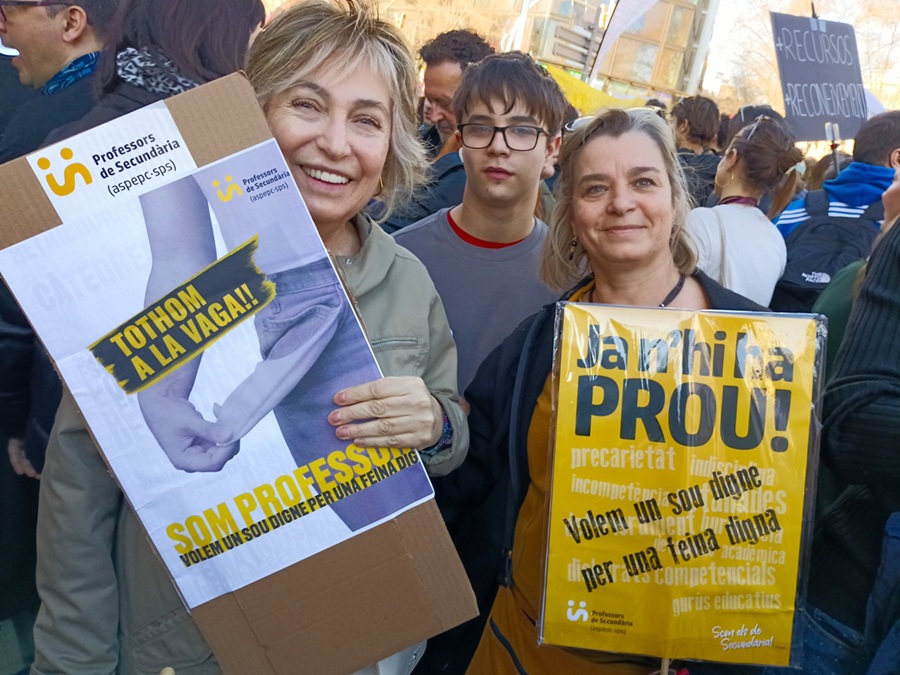
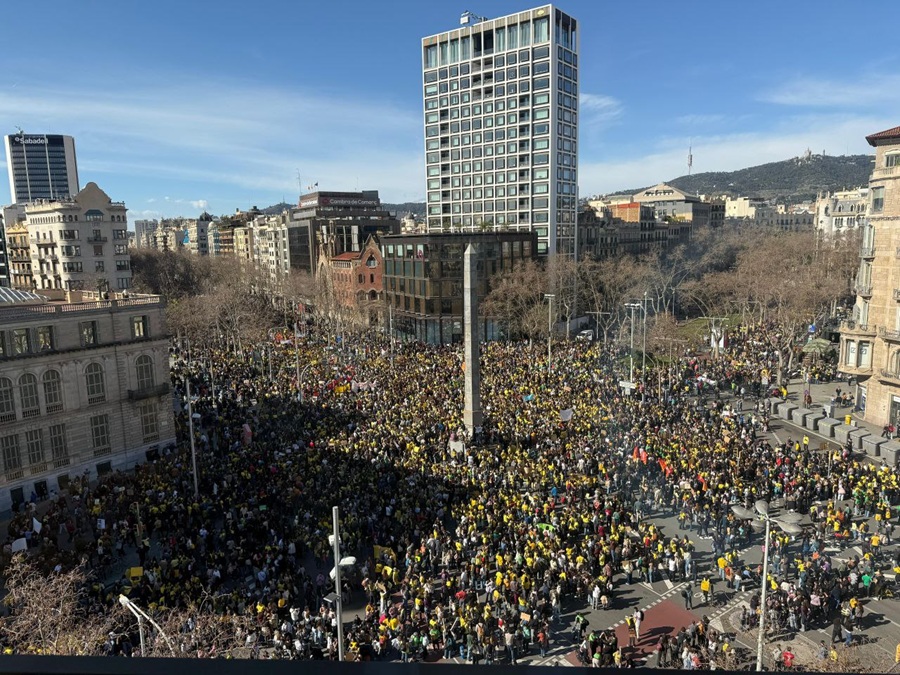
On 11 February, teachers in Catalonia took to the streets in a strike estimated to have mobilised around 100,000 participants. / Photo: Secondary Teachers’ Union



“An exhausted teacher makes for an exhausted school”. A Catalan teacher utters this sentence after a working day of more than eight hours, with overcrowded classrooms, constant bureaucratic tasks, and interminable meetings. This image may seem anecdotal, yet it reflects the everyday reality of thousands of teachers in Catalonia. Although education ought to be regarded as a strategic investment, teachers’ working conditions show clear signs of progressive impoverishment, in sharp contrast to the official rhetoric of systemic improvement. Indeed, Catalan teachers have been called to strike on 11 February 2026 to denounce the lack of investment, to recover lost purchasing power, to reduce pupil–teacher ratios, to protest against excessive bureaucracy, and to highlight the shortage of resources needed to guarantee inclusive schooling. This dispute may harden further with the announcement of a five-day strike during March.
This article offers a comparative analysis of Catalan teachers’ conditions in relation to their Spanish and European counterparts, not only in terms of salaries, but also with regard to working hours, class sizes, social benefits, and levels of occupational stress.[1] The aim is to provide evidence that can contribute to public and academic debate, and to support a rethinking of education policies from a perspective of justice and sustainability.
Salaries in comparison with the European Union
According to data from Eurydice (2025), the OECD (2025), and the Ministry of Territorial Policy (2025), Catalonia falls within the lower band of salaries in Western Europe. The starting annual salary of a Catalan secondary teacher is €30,846, below Luxembourg (€80,200), Germany (€62,926), Denmark (€51,619), Belgium (between €43,541 and €33,988), the Netherlands (€40,723), Sweden (€39,645), and Spain (€34,619).
Table 1. Salaries of secondary teachers (compulsory secondary education and upper secondary) in the EU and in Catalonia (academic year 2020/21).
| Country | Nominal starting salary (€) |
| Luxemburg | 80200 |
| Germany | 62926* |
| Denmark | 51619 |
| Belgium | 43541-33988 |
| The Netherlands | 40723 |
| Sweden | 39645 |
| Austria | 39106 |
| Finland | 38824 |
| Ireland | 37692 |
| Spain | 34619 |
| Catalunya | 30846 |
| France | 29382 |
| Italy | 26114 |
| Malta | 25763 |
| Cyprus | 24189 |
| Portugal | 22374 |
| Slovenia | 19777 |
| Lithuania | 15781 |
| Estonia | 15780 |
| Croatia | 15185 |
| Czech Republic, Greece, Slovakia, Latvia, Romania, Poland, Hungary, Bulgaria | < 15 000 |
[1] The article draws on aggregated data and comparative studies; a fully exhaustive analysis would also require qualitative samples (interviews and case studies).
Sources: Author’s own compilation based on Eurydice/EACEA (2025), the Departament d’Educació i Formació Professional per Catalunya (2026) and on Ministeri de Política Territorial i Funció Pública (2025). (*) Depending on the land.
The situation becomes even more serious once the cost of living is taken into account: Catalonia has housing, food and transport costs comparable to those of major European metropolises, yet salaries closer to those of Italy, Malta or Cyprus. This mismatch results in a loss of purchasing power and produces a deterrent effect on younger generations who might otherwise consider teaching as a viable career.
Salary progression and additional payments
In many European countries, starting salaries for secondary teachers are merely the beginning of a structured professional career. In Germany, Belgium, or the Netherlands, salary progression over time is substantial, with increases linked to seniority, merit, and continuing professional development. In Catalonia, by contrast, mechanisms for progression have been constrained by successive rounds of cuts introduced since 2010.
One particularly illustrative example is the reduction of the experience-based salary supplement, known as sexennis (six-yearly increments recognising teaching experience and continuing professional development). This pay component forms part of the overall remuneration structure of Catalan teachers and is linked primarily to length of service rather than performance-based appraisal. Its administration has become a recurring source of conflict, to the extent that more than 500 teachers across Catalonia have filed legal claims against the Generalitat for unpaid amounts derived from its accrual (Professors de Secundària, 2025).
Moreover, in 2010 the additional salary payments (extra monthly payments) of Catalan teachers were limited to 80% of a standard monthly salary. This restriction resulted from the freezing or partial payment of a role-related allowance included in the monthly payslip, which forms part of teachers’ non-base salary remuneration. While in other Spanish autonomous communities such allowances—including experience-based supplements—are paid in full within additional salary payments, in Catalonia these components have been subject to more severe reductions.
Promotion to the senior teaching grade (càtedres)
In Catalonia, competitive procedures for access to the senior civil-service teaching grade (càtedres) in secondary education have not been convened for more than a decade. This prolonged absence has significantly restricted teachers’ professional progression and their access to the salary supplement associated with this higher administrative grade within the public education service.
By contrast, several autonomous communities have launched calls for access to this senior grade in recent years—either through ordinary merit-based competitions or through extraordinary stabilisation processes derived from state legislation. This has been the case in Madrid (2019), Murcia, the Basque Country and Castile and León (2020), Extremadura (2021), the Valencian Community and Galicia (2022), Andalusia, Aragon and the Canary Islands (2023), or Asturias and the Balearic Islands (2024). The absence of comparable procedures in Catalonia has contributed to a widespread perception of professional stagnation and of comparative disadvantage within the upper civil-service pay structure (A1 group, level 26).
From a European perspective, comparative data (Eurydice, 2025) indicate that most EU countries provide additional allowances linked to responsibilities, working conditions, or institutional context, rather than a single fixed supplement attached to a senior grade. In this respect, the Catalan càtedres system represents a distinctive administrative mechanism within a civil-service framework, rather than an academic rank comparable to those found in higher education systems. Thus, for example, in Finland secondary teachers’ salaries tend to be higher than in Catalonia, as higher academic and professional qualifications are required. A similar situation applies in Denmark, where salaries are higher and adjusted to the cost of living, and where additional allowances may sometimes be granted for holding specific responsibilities or posts. France, Hungary, and the majority of EU countries provide additional payments for teaching in disadvantaged schools or under special working conditions; however, these are not linked to a senior-grade system such as the càtedres in Catalonia, but rather depend on specific circumstances, including teaching in socially disadvantaged contexts or assuming administrative responsibilities.
Working hours and teaching load
OECD data (2024) place the working week of secondary school teachers in Spain at over 37.5 hours, of which 18 hours correspond to direct classroom teaching. The same applies to teachers in Catalonia, whose compulsory teaching load also amounts to 18 weekly hours. The remaining time is devoted to coordination meetings, supervision duties, tutoring, assessment, lesson preparation, marking, and administrative tasks. Although this figure may appear moderate, evidence shows that in practice actual working hours often exceed 45 hours per week, particularly during assessment periods.
By comparison, in some European systems compulsory teaching time differs between lower secondary and upper secondary education. In Finland—often regarded as an educational benchmark—teachers deliver fewer than 15 hours of weekly classroom teaching, leaving more time for lesson preparation and methodological innovation. In Germany, teaching loads are also lower than 18 hours, and support resources are more abundant. Countries such as Malta report teaching loads of around 15 hours per week. Romanian teachers similarly record 17.4 weekly teaching hours, below the EU average estimate (19.6 hours). In other countries, such as Portugal, Belgium or the Netherlands, compulsory teaching time often ranges between 20 and 27 hours per week, placing them in the upper band of the European average.
Pupil–teacher ratios
Class size constitutes another critical factor. In Catalonia, the average stands at approximately 28 pupils per classroom in compulsory secondary education and 32 pupils in upper secondary education (batxillerat) (Department of Education, 2024). By contrast, in Denmark or Finland class sizes typically range between 18 and 20 students. This difference has a direct impact on educational quality, the personalisation of learning, and teachers’ emotional wellbeing, as educators are required to manage larger and more heterogeneous groups. OECD data on class size and teaching load (2024) may vary depending on the source and educational level, but they reveal consistent trends over time.
Social benefits and professional recognition
An often-overlooked dimension in international comparisons concerns social benefits and profession-related allowances. In countries such as France or Germany, teachers benefit from public transport discounts, housing support, specific health insurance schemes, family-work reconciliation measures, and subsidised continuing professional development programmes. These benefits help stabilise teaching careers and reduce the stress associated with the profession.
In Catalonia, such forms of support are largely absent. Comparison with other public-sector professions—such as doctors, judges, or firefighters—reveals unequal treatment, reinforcing the perception of insufficient recognition and social value attributed to teaching. Furthermore, the absence of territorial or function-specific financial incentives, such as supplements for teaching in schools with high levels of social or educational disadvantage or for engagement in educational research and innovation, undermines both professional motivation and long-term retention within the public teaching service. More broadly, the lack of economic and social incentives contributes to lower retention of experienced teachers and increases the risk of migration to other regions or countries offering more favourable working conditions.
Occupational stress and health
Several studies (OECD, 2023; UNESCO, 2024) identify teaching as one of the professions most exposed to chronic stress, anxiety, and burnout. In Catalonia, combined survey data indicate that more than 60% of teachers report high or very high levels of stress, primarily linked to excessive workloads, classroom management difficulties, and a lack of institutional support.
These conditions have a direct impact on teachers’ physical and mental health, resulting in increased fatigue, insomnia, headaches, and musculoskeletal disorders. The combination of relatively low salaries, extensive teaching hours, high pupil–teacher ratios, and limited social recognition amplifies occupational stress and may lead to absenteeism and staff turnover, ultimately affecting teaching quality and teachers’ long-term commitment to their pupils.
From a comparative perspective, countries such as Finland or Denmark provide psychological support services, longer preparation time, supervision, and sufficient institutional resources to mitigate occupational stress. These cases demonstrate that improving working conditions has a direct and measurable impact on teachers’ wellbeing and on educational outcomes.
In sum, without political and social intervention aimed at improving benefits, recognition, and working conditions, occupational stress will continue to erode teachers’ motivation and retention in Catalonia, with direct repercussions for the education system as a whole.
Conclusions
International comparison clearly shows that Catalan teachers operate at a disadvantage relative to many of their European counterparts. Low salaries, stalled career progression, excessive working hours, high pupil–teacher ratios, and a lack of social benefits together form a troubling scenario. Added to this is a level of occupational stress that undermines both teachers’ motivation and their health.
If a high-quality public education system that is competitive at the European level is to be guaranteed, these trends must be reversed. This would require increasing salaries, reducing class sizes, improving mechanisms for career progression, and implementing coherent policies of institutional support and social recognition. Ultimately, teachers must be placed at the centre of education policy—not merely as transmitters of knowledge, but as a key pillar of the country’s future.
Bibliography:
- Departament d’Educació de la Generalitat de Catalunya (2026). Taules de retribució. Barcelona: Generalitat de Catalunya.
- Departament d’Educació de la Generalitat de Catalunya (2024). Estadística d’Educació 2023-2024.Barcelona: Generalitat de Catalunya.
- Euronews/OCDE (2023). Stress and Well-being among Teachers in Europe.Brussel·les: Euronews Research.
- Eurydice/EACEA (2025). Teachers’ and School Heads’ Salaries and Allowances in Europe 2023/24.Brussel·les: European Commission.
- Ministeri de Política Territorial i Funció Pública (2025). Informe sobre retribucions públiques a Espanya.Madrid: Govern d’Espanya.
- OECD (2024). Education at a Glance 2024: OECD Indicators.París: OECD Publishing.
- Professors de Secundària (2025). Professors de Secundària (aspepc·sps) lluita per les retribucions: impugnem la nova ordre dels estadis i exigim el pagament del deute. https://secundaria.info/portal/article.php?sid=20250613084728
UNESCO (2024). Global Report on Teachers’ Working Conditions. París: UNESCO.
Source: educational EVIDENCE
Rights: Creative Commons