


- Literature
- 27 de February de 2026
- No Comment
- 11 minutes read
Antònia Carré-Pons: “Those of us who devote ourselves to writing tend to be clumsy in some area of life”

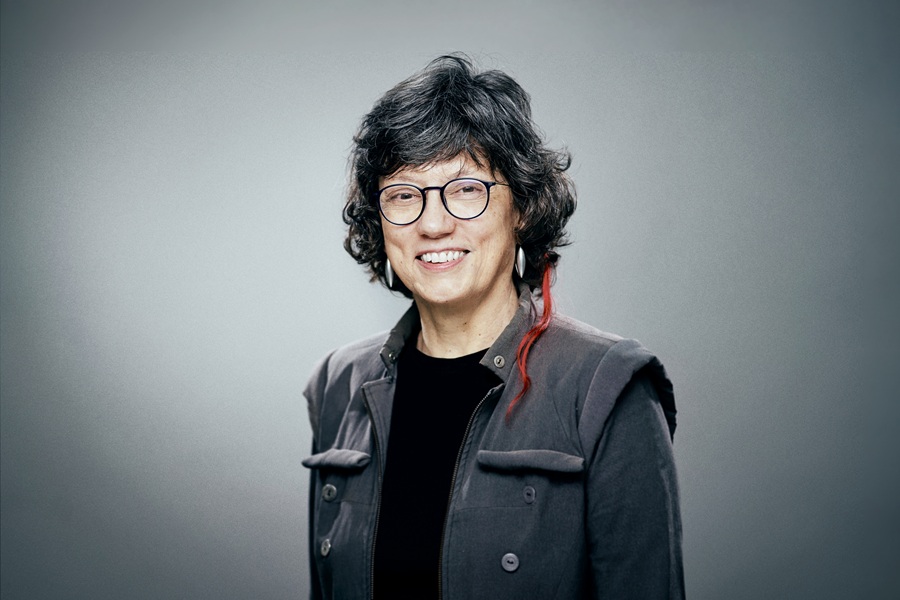
The writer, philologist and editor Antònia Carré-Pons. / Photo: David Ruano



Antònia Carré-Pons is a writer, philologist and editor specialising in medieval literature. She has just won the Premi Nollegiu de Narrativa for her novel La gran família (Club Editor).
Let’s start with your new novel. You quote J. V. Foix: “An obituary writer and a writer are, more or less, the same thing”. Do you agree? Could you expand on that?
If I didn’t agree, I wouldn’t have placed that quotation at the beginning of the second part of the novel. The full quotation, from Tocant a mà…, goes as follows: “An obituary writer and a writer are, more or less, the same thing. Only those who do not know how to live write, in these times of frantic rushing about and crooked furrows. Have you never ridden a bicycle?” This quotation by Foix, which urges us to live rather than to write, has been lodged in my soul ever since my student days in Catalan philology. I have always thought that those of us who devote ourselves to writing tend to be clumsy in some area of life: we are either unsociable or prickly, or we do not know how to act in a particular situation, or we are incapable of keeping a relationship alive, or… It is clear that Foix thought something similar, but he expresses it in a far more poetic way than I ever could.
“Markus, as you can see, what specimens humanists and Enlightenment thinkers were: they were utterly wrong to believe that culture and reason would improve the world”. Do you think so?
Yes, I do. Very often, when we write, we make our characters say things that we ourselves think. The men—and I say men because women spoke very little—of humanism and the Enlightenment were convinced that education would improve the world because it would make us better people. This view also permeates nineteenth-century novels, such as Les Misérables by Victor Hugo, to mention just one example. Today we know that this hope was vain. With Nazism and the fascisms, we learned that culture does not necessarily make you a better person: there were Nazis who listened with admiration to Johann Sebastian Bach or Richard Wagner.
“With Nazism and the fascisms, we learned that culture does not necessarily make you a better person: there were Nazis who listened with admiration to Johann Sebastian Bach or Richard Wagner”
You published your first book, I ara què faràs, Clara?, twenty-five years ago. How has your fiction evolved?
The first novel I published was a young adult novel. Since then I have published historical fiction, poetic prose, short stories, a dialogued novel (that is, without a narrative voice), and so on. Once a journalist told me I was a chameleon-like writer, and I think she was right: my literature is characterised by the fact that each book is different from the previous ones. I suppose there is a style that identifies me, but each time the characters, the plot and the narrative voice change. It is not deliberate. It simply comes out that way—what can you do!
If I had to speak of an evolution, I would say that I increasingly tend towards simplicity (which is not the same as simplicity of thought), towards a lack of artifice, and towards the use of a direct, living language.
How much autobiography is there in La gran família?
I have written a novel, not an autobiography. That said, I acknowledge that there are quite a few autobiographical elements. The protagonists, Rateta and Sió, are two sisters who grow up in a butcher’s shop. Like my sister and me. The elder sister leaves the family business and becomes a medievalist. Well—like me! And there is an illness that affects the women in the family: breast cancer. That is also true. From that point onwards, however, there is a great deal of literature.
How is it possible that you have spent forty years studying Espill by Jaume Roig? How did you come across it—and stay with it?
I began studying it by chance. When I was twenty-two and working on my master’s thesis, a professor recommended the Espill to me because it was a little-studied text. I threw myself into it head first. Because it is very difficult, it offers endless possibilities, and I have been able to spend forty years reading it, studying it, thinking about it, writing articles on it and producing critical and accessible editions. I have also translated it into modern Catalan to make it accessible to contemporary readers. There are two versions: one published by Quaderns Crema and another by Cal Carré.
What are your favourite texts of medieval Catalan literature?
Apart from the Espill, obviously! The great novels: Tirant lo Blanc and Curial e Güelfa. There are also lesser-known works that are very good and very entertaining, such as Història del príncep Jacob and Història de Paris i Viana, both published by Cal Carré. And Ausiàs March is an extraordinary poet: he has a vital energy and a poetic force that leave you stunned.
Among your favourite readings you mention Fante, Dostoevsky and Dovlatov…
I am an eclectic reader. What interests me most about those three is their way of writing. Fyodor Dostoevsky has an overflowing prose that drags you into dark worlds. John Fante and Sergei Dovlatov have the skill of saying many things with very few words. And I think that is a great merit.
You also mention Sara Mesa, Eva Baltasar and Mercè Rodoreda…
All three speak about life with psychological depth and great poetic force, which is sometimes radiant and sometimes tortured. I like all three because they are very different, and because they have many things in common.
Those of us familiar with Cal Carré know the story behind the publishing house. Still, could you summarise it here?
The publishing house was founded in September 2021 as a tribute to my family, especially to my sister, who died of cancer in December 2020. That is why all our books end with a dedication: “In memory of Joana Carré Pons”. The family butcher’s shop had been closed since 2016 because of illness, and we decided to transform the butcher’s shop into a publishing house, keeping the name and the logo, which is a very cheerful little pig. We moved from selling food for the body to books, because we are convinced that nourishment for the soul is just as important.
How did you come to the decision to publish texts by the Woolfs?
Because Virginia Woolf is a wonderful author whom I admire greatly. And Leonard is good too, though not as good—and he was well aware that she was the truly great one. That does him credit. Together they founded a small, artisanal, family-run publishing house called the Hogarth Press. Since Cal Carré is also an artisanal, family-run press (my nephews help me with social media), the first book we published was Two Stories by the Woolfs, translated by Marta Pera Cucurell—the book that inaugurated the Hogarth Press. In this way, we paid them tribute.
“George Sand is better known for her love life than for her novels. And she wrote around seventy of them”
Tell us about your new releases: George Sand, Willa Cather, Elizabeth Gaskell…
George Sand is indeed better known for her love life than for her novels—and she wrote around seventy. In Catalan we have the famous Un hivern a Mallorca and little else. At Cal Carré we want to reclaim her, and so far we have published El castell de Cimtort and La Cora, both translated by Georgina Solà Sellés, a very young translator (she is twenty-six) with a great future ahead of her.
Willa Cather is a highly regarded author in the United States, but she had been very little translated here before Cal Carré. We published her thanks to Núria Sales, who once spoke to me about her and said she would like to translate her. I confess that I did not know her work. I began reading her obsessively and loved her, so Núria Sales translated Alexander’s Bridge, O Pioneers! and Lucy Gayheart. When Núria died at the age of ninety, Esther Tallada took over. She translated the delightful story Old Mrs. Harris (it is a slim volume, a small and brief book) and My Ántonia, one of Cather’s most important works. This last one is a substantial, two-colour-spined volume: at 480 pages, it is the longest book we have published so far—and it reads in no time at all.
“Elizabeth Gaskell was born a few years after the death of Jane Austen and was a contemporary of George Eliot and the Brontë sisters. Yet she is the least known and least read of them all”
Elizabeth Gaskell was born a few years after the death of Jane Austen and was a contemporary of George Eliot and the Brontë sisters. Yet she is the least known and least read of them all. That is something we want to remedy. We began by publishing Cranford, in a splendid translation by Marta Pera Cucurell. Gaskell knows how to lead you into Cranford, introduce you to its inhabitants, and quickly make you side with the goodness of the daughter against the meanness of the elder brother and the mother. I like a novel that draws you into the plot straight away.
It is clear that women play a central role in Cal Carré’s catalogue. For historical and patriarchal reasons, when we speak of classic authors men occupy far more space than women. That is why we publish them. And we do one more thing to make women’s art visible: on the covers of our books we use images of paintings created by women.
What are you working on at the moment?
To keep writing, to keep publishing, and—as Anton Chekhov says at the end of Three Years—to go on living, and seeing.
Source: educational EVIDENCE
Rights: Creative Commons