


- Science
- 6 de February de 2026
- No Comment
- 7 minutes read
Thank you, Barbacid

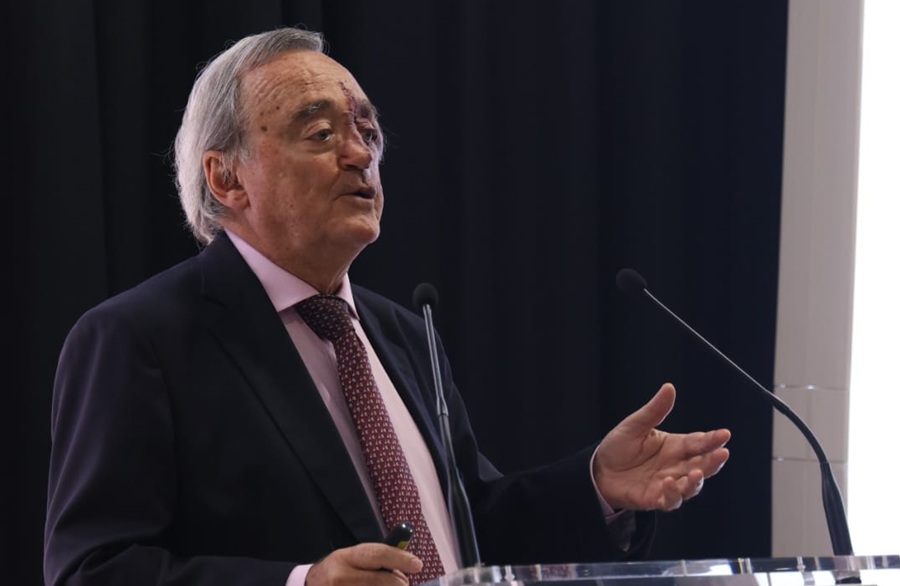
Mariano Barbacid at the Círculo de Bellas Artes en 2025. / Image: Wikipedia – Author: MAT.MHACCV


In 2008 my mother died of pancreatic cancer. It took her within a few months. Of course, the disease had almost certainly been there for much longer, without making itself known. Pancreatic cancer—particularly pancreatic ductal adenocarcinoma (PDAC)—has since remained one of the most lethal neoplasms. Its resistance to conventional therapies and its late diagnosis have turned this disease into a paradigm of therapeutic failure in oncology.
In this context, the study led by Mariano Barbacid at the Centro Nacional de Investigaciones Oncológicas (CNIO), recently published in Proceedings of the National Academy of Sciences (Liaki et al., 2025), represents a significant experimental milestone, albeit still strictly preclinical. At the very least, it offers hope for patients currently fighting the disease and for those close to them. Time, however, is never on their side, and the yearning for a cure—as those of us who have lived through this know—is immense.
From a medical perspective, the work fits into the long history of attempts to render KRAS pharmacologically targetable, one of the most infamous oncogenes in cancer biology. Mutated in around 90% of pancreatic tumours, KRAS has for decades been regarded as an almost untreatable target. Recent inhibitors have shown some efficacy, but the tumour develops resistance within months. Barbacid’s team proceeds from a systemic hypothesis: resistance cannot be overcome by blocking a single molecular node, but rather by simultaneously targeting several critical points in the tumour signalling network. I confess that, being no expert in these matters, I found Barbacid’s own description philosophically captivating, as it brings together both Mario Bunge’s systemic perspective and a key idea in complex systems theory: the relevance of nodes in complex networks.
Note that I speak of Barbacid’s team, as he himself always does: a team composed largely of women. That he is the visible head, by virtue of his experience and long-standing scientific leadership, and that he happens to be a man, has nothing to do, in my view, with certain proliferating gender debates. If anything needs to be said on that matter, it should be said by the female researchers at CNIO. We have a peculiar talent for finding faults and for failing to back our own internationally. One only has to recall the case of the marginalisation of Francisco Mojica, discoverer of CRISPR gene-editing technology, who in my view would have deserved the Nobel Prize at the time. And now, should human clinical trials prove even minimally successful, I believe Mariano Barbacid would also be worthy of that distinction—perhaps jointly with other colleagues who have developed similar therapeutic approaches—not merely because of this particular article, but because of his long career. This is no flash in the pan, but the result of decades of work. As has long been the case in modern science, major advances are no longer the work of lone geniuses. Modern research teams are large, and the Nobel Prize is often awarded to a few individuals as representatives of vast institutions such as CERN, the ATLAS experiment, the COBE satellite, and others. Public recognition of Barbacid is, or ought to be, recognition of the Spanish National Cancer Research Centre (CNIO) and of his entire team. Or at least, that is how anyone with a basic understanding of science ought to see it.
Turning to the study itself, the experimental approach consisted of a triple therapy with three drugs whose combination produced complete and durable tumour regression in mice, with no relapses for over 200 days—an exceptional result in experimental oncology. The article also provides an interesting theoretical argument: the simultaneous genetic ablation of three nodes in the system is sufficient to trigger permanent tumour regression, thus rationally justifying the combined pharmacological therapy. From a systems biology perspective, the study illustrates how tumours exploit redundancies in signalling networks and how a multipoint intervention can collapse that network, preventing adaptive escape routes.
The CNIO’s press release emphasises that (in mice, it must be stressed) tumours disappeared without significant toxicities and that the treatment prevented the emergence of resistance, one of the main problems of current targeted therapies. However, the authors themselves underline that they are not yet in a position to begin clinical trials and that translational optimisation will be complex and slow. An epistemological warning is crucial here: the leap from murine models to human clinical practice is uncertain. Mice tolerate toxicities that would be unacceptable in humans, and tumour microenvironments, pharmacokinetics, and genetic heterogeneity differ substantially between species. Some of the drugs involved are known to produce adverse effects in humans, and the study itself warns that complete KRAS elimination in adult mice may have systemic collateral consequences.
From a philosophical perspective on biomedicine, this work reflects a paradigm shift: the aim is no longer to find a ‘magic bullet’, but to design rational cocktails capable of collapsing complex signalling networks. This approach recalls the combination therapies used, for example, against HIV, or other multi-drug chemotherapies, but with a highly precise molecular rationale.
In conclusion, the study by Barbacid’s team constitutes a preclinical result in murine models, with considerable ground still to cover before any clinical application. The history of oncology is full of cures in mice that failed in humans, so we must be cautious: it is nonetheless a conceptually significant step towards precision combination therapies. It also creates something invaluable in hospital corridors: hope.
Thank you, Professor Barbacid—from the bottom of my heart—to you and to your entire team for this titanic devoted to something that matters so much to so many people.
References:
Liaki, V. et al. (2025). A targeted combination therapy achieves effective pancreatic cancer regression and prevents tumor resistance, Proc. Natl. Acad. Sci. 122 (49) e2523039122, https://doi.org/10.1073/pnas.2523039122 (2025).
Source: educational EVIDENCE
Rights: Creative Commons